



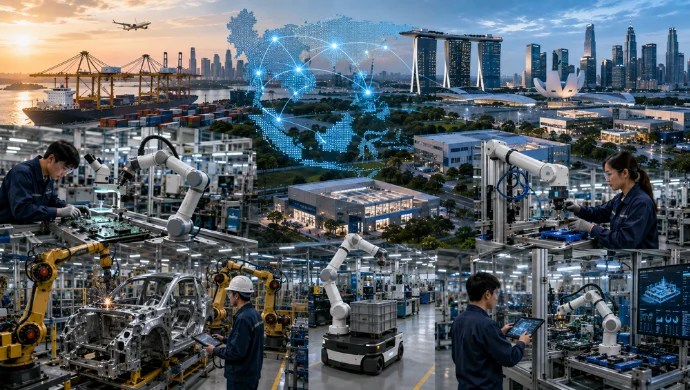

Southeast Asia is building manufacturing capability across a network of increasingly specialised production centres.
Vietnam, Malaysia, Thailand, and Singapore each specialise in different segments of the electronics, semiconductor, and automotive supply chains, forming an integrated production ecosystem. Vietnam has become a key electronics manufacturing hub, Malaysia has built considerable semiconductor assembly capabilities, Thailand maintains a deep automotive manufacturing base, and Singapore anchors higher‑value technology and advanced semiconductor activities. Together these markets are connecting capital, suppliers, technical expertise, and manufacturing capacity in an increasingly interlinked network.
The same structure is beginning to shape the machinery inside these factories. Production is distributed across more specialised facilities, and the automation deployed within them must accommodate different processes, volumes, and physical layouts. Industrial robots fit naturally into this environment because a robotic workcell can be configured around the process rather than a fixed production line. The robot, tooling, fixtures, vision systems, and production controls can be assembled around a defined task and adapted as the cell’s requirements evolve.
A manufacturing region is becoming a manufacturing network
ASEAN attracted US$226 billion of foreign direct investment in 2024, up eight percent despite an 11 percent decline in global FDI. Manufacturing FDI rose by nearly 150 percent to US$44 billion, driven by supply‑chain‑intensive industries and the digital economy.
Source: ASEAN Secretariat / UN Trade and Development, ASEAN Investment Report 2025
The numbers matter because factories represent the physical endpoint of that capital. Semiconductor packaging lines, electronics assembly plants, automotive facilities and logistics‑linked production all require increasingly precise movement of material and parts.
The regional picture is also becoming more differentiated. Malaysia has a long‑established position in outsourced semiconductor assembly and test. Vietnam is expanding its electronics and semiconductor assembly, testing and packaging capabilities. Thailand remains a major automotive manufacturing base while developing new EV and electronics capacity. Singapore combines semiconductor manufacturing, research and advanced services, and India is opening new facilities for designing multi‑purpose chip fabrication. The result is not a single Southeast Asian factory, but a set of manufacturing clusters linked through suppliers, components, capital and logistics.
As the production base becomes more complex, automation changes with it
A factory producing a narrow product range at very high volume can justify an automation architecture built almost entirely around that process. The robot, tooling, fixtures, conveyors and controls can be optimised together and left in place for long production runs.
Newer manufacturing environments emerging across Southeast Asia often have different requirements. Product variants can change, supplier networks can shift, and production lines can be expanded in stages. Existing facilities may need automation without a complete redesign.
This is where work‑cell‑level automation becomes useful. Instead of treating automation as an all‑or‑nothing decision for an entire production line, engineers can introduce robotic capability around individual processes and connect it to the machines already operating around them.
Collaborative robots are particularly suited to this layer. They can occupy compact workspaces, operate within production environments where operators remain present, and be redeployed as the cell evolves.
The opportunity is therefore not simply to install more robots. It is to make a larger portion of the production environment addressable by robotics.
The economics of automation are increasingly tied to integration
The robot is only one part of the automation investment. The choice of end‑effector, vision, controls and supporting equipment can determine how much engineering and commissioning the final cell requires. This is where system integrators add value: they can select the combination that fits the application instead of forcing every process around one set of components.
For manufacturers, that flexibility can directly affect the economics of deployment. Using the right components together can reduce custom engineering, simplify commissioning and make future changes easier, particularly when the robot has to work with equipment already installed on the factory floor.
Why collaborative robots matter inside that architecture
Collaborative robots occupy a useful position within this manufacturing architecture because they extend robotic automation into workcells where the requirements do not always justify a conventional high‑speed industrial robot and its dedicated cell. Conventional industrial robots remain well suited to applications where cycle time, payload and throughput define the mechanical requirements. Collaborative robots become relevant when the same production environment also needs a compact footprint, frequent reconfiguration, or closer interaction between operators and automation.
Source: Strategic Market Research Report 2025, Forecast for 2032
The distinction therefore sits in the architecture of the production cell rather than simply comparing robot categories. The mechanical envelope, cycle requirements, operator interaction and integration environment determine which platform fits the application. A high‑throughput cell may require the speed and payload of a conventional industrial robot while another cell may benefit from the flexibility of a collaborative robot.
This makes openness an increasingly practical consideration in cobot adoption. The manufacturer may buy the robot, but the final automation system is usually assembled from many other components, often supplied by different companies. Some newer platforms are building a modular robotics stack across cobots, mobile manipulators, special‑purpose and subsea systems, with the flexibility to work with different tools, sensing and control layers.
This is particularly useful across Southeast Asia where manufacturing capacity is developing across different facility sizes, production volumes and product categories. The region has no single factory architecture for automation platforms to conform to. It has a growing collection of production environments where the robot has to fit the process, the available space and the way the cell is operated.
Semiconductors are one of the clearest examples
Southeast Asia’s semiconductor industry shows how deeper manufacturing capability creates more opportunities for automation inside the factory. Malaysia has built a major assembly and test base, Vietnam is expanding across assembly, testing and packaging, while Singapore remains a mature semiconductor and advanced manufacturing hub. As these facilities become more sophisticated, automation becomes part of the production environment itself. A collaborative robot, for example, can handle the movement of components within a controlled workcell while fixtures, tooling and surrounding equipment manage the rest of the process. The robot is only one part of that system. As semiconductor manufacturing expands across the region, these individual automation layers will become increasingly important to how new facilities are designed and operated.
India, Vietnam, Malaysia and Thailand are building different automation markets
India enters this regional manufacturing network from a rapidly expanding automation base. Industrial robot installations reached a record 9,120 units in 2024, up 7 percent, making India the sixth largest annual installer globally. Automotive accounted for 45 percent of installations, while general industry is also increasing adoption. The country’s operational stock reached 52,570 robots in 2024, leaving substantial headroom as domestic manufacturing capacity expands, according to IFR, World Robotics 2025.
Vietnam’s manufacturing growth is closely tied to electronics and supply‑chain diversification. Electronics and ICT production is expected to grow 10.4 percent in 2026 after 8.4 percent growth in 2025, while semiconductor and PCB production is also expanding, per Atradius’s Industry Trends Electronics & ICT report, January 2026.
Malaysia has a deeper electronics and semiconductor manufacturing base. Electronics represents a significant share of its exports, while its semiconductor strategy is moving beyond established backend capabilities toward higher‑value segments and the surrounding equipment ecosystem. SEMI’s 2026 regional analysis points to Malaysia’s OSAT strength, growing wafer‑level capabilities and expanding semiconductor ecosystem.
Thailand brings a different manufacturing structure, with a long‑established automotive base and growing interest in EV‑related production and electronics. Its automation requirement therefore comes from a different industrial mix than Vietnam’s electronics‑led expansion or Malaysia’s semiconductor ecosystem, per McKinsey’s Southeast Asia Quarterly Economic Review, June 2026.
The result is a region where automation requirements vary significantly by factory, even when the broader investment trend is shared. That makes flexible automation platforms particularly relevant. The same robotic architecture can be adapted to different cells, while the end‑effector, fixture, vision and control layer change around the process.
Robotics is becoming part of the region’s manufacturing architecture
Southeast Asia’s growth is creating a manufacturing environment in which automation is becoming increasingly embedded in the production process itself. Semiconductor facilities require precision and process control. Electronics factories need flexible material handling and assembly infrastructure. Automotive plants require high repeatability alongside increasingly varied production configurations.
The answer will not be one robot type. Highly structured production will continue to favour conventional industrial robotics. Flexible workcells will create room for collaborative robots. Mobile systems will address movement through the factory. More general‑purpose robots will eventually take on environments where task variation justifies their additional complexity.
Collaborative robots occupy an increasingly useful middle layer: industrial enough to become part of production automation, flexible enough to be integrated into workcells that continue to evolve. That makes them less a standalone product category and more a component of the manufacturing architecture Southeast Asia is building.
Also Read
- NSW top prosecutor Sally Dowling and state attorney general discussed which barristers could review her office, estimates hears
- How Three Wearables Reveal What One Misses: A Real-World Test of Personal Health Technology
- Patagonia Gold Corp. Reports Expanded Second Quarter Loss of $2.19 Million
- Shein Stock Declines in Hong Kong IPO Debut After Prolonged Listing Wait