



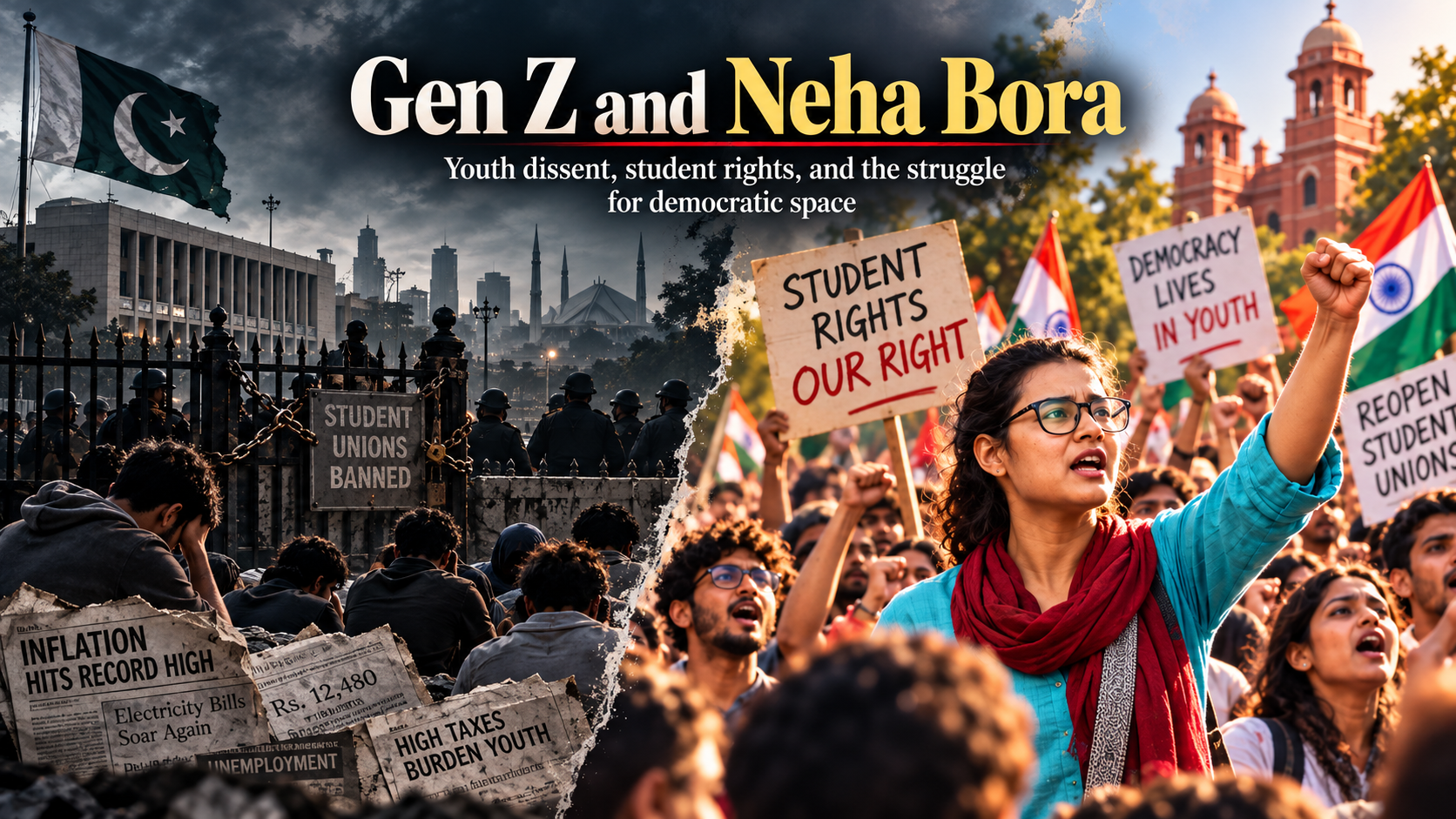
These days, Pakistan’s politically unbalanced hybrid system, coupled with the government’s failure to ease the public’s growing economic hardships, has created anxiety and concern across every section of society. At times, people take to the streets against inflation and unemployment; at other times, the brazen conduct of powerful elites who appear able to violate the law with impunity further intensifies public anger. Meanwhile, rising lawlessness across all four provinces, frequent killings, and armed robberies are steadily eroding the authority of the state in the eyes of the people and raising serious questions about its credibility.

On the other hand, the public can clearly see that powerful feudal landlords, landed elites and capitalists who enter the assemblies as members of ruling parties are not only protected despite their lawlessness, but are also treated by the state as indispensable to its system of governance. By extending institutional protection to the misconduct of these privileged classes, the state appears to be sending a clear message: this is a class-based society in which political power can only be exercised by a powerful elite or by those privileged groups favoured by it.
Whether the ruling establishment understands the public’s growing anxiety and this increasingly desperate “enough is enough” sentiment is not for the people to determine. It is for those in power to decide whether they are willing to place a hand on the pulse of public concern, or whether they will continue blaming inflation on a faltering global capitalist economy and attributing domestic lawlessness to foreign interference merely to mislead the public.
The deterioration of governance and the failure of both federal and provincial governments have generated countless questions in the minds of the younger generation about its uncertain future. Today’s youth no longer appear satisfied with any political or governmental narrative. This is the cumulative result of a system that, at different times, has been authoritarian, semi-political or hybrid, while continuing to grant privileges to dominant classes. It is a system that has never truly accepted political supremacy or the rule of the people.
Nor does this dominant ruling class appear willing to accept the human and democratic rights guaranteed by the country’s consensus Constitution, or to accord due respect to laws enacted by an elected parliament. Amid linguistic and religious divisions, the ruling class keeps introducing labels such as “Cockroach” and “Gen Z”, cleverly preventing the younger generation from uniting around common political and social concerns.
Those in power should understand, sooner rather than later, that military rulers who, in order to preserve their dominance and protect their political interests, unconstitutionally destroyed the nurseries of political training and dismantled student organisations created consequences that still endure. When the younger generation is deprived of platforms for political and social education, and students are stripped of political freedom, a society emerges that is marked by disorder, frustration, nepotism, lawlessness and corruption. The responsibility for such conditions ultimately lies with rulers—military or civilian—who are driven by undemocratic thinking.
Since student politics and student unions were unconstitutionally eliminated from colleges and universities, Pakistan has, over the past 46 years, produced generations that have neither experienced the intellectual and social culture once associated with educational institutions nor developed the tolerance and capacity for accommodation that political training can cultivate in students.
As a consequence of the ban on student politics in colleges and universities, a directionless volcano has been simmering within the generations that have come of age during the past 46 years. It has no clear political direction, nor has the younger generation been sufficiently equipped to analyse events through a political lens. Pakistan’s depoliticised youth could, at any moment, be swept away by personality cults in a manner reminiscent of authoritarian mass politics, or be seduced by promises offered by non-political, authoritarian forces, ultimately jeopardising their own future.
Examples of this can be seen in the depoliticised generation associated with the ethnic-based MQM and among non-political workers influenced by Imran Khan’s Taliban mindset. In one way or another, the ultimate beneficiaries are the same powerful forces that use their grip on power to manipulate the political system—sometimes by bringing down the RTS system and at other times by producing a Form 47 parliament that provides constitutional protection to those in power and continues to give anti-people forces a share in government.
The question confronting today’s generation is not whether the custodians of the state should continue organising seminars and discussions at universities and colleges owned by capitalists in order to promote preferred narratives; issuing instructions to the media; funding journalistic and cultural institutions to restrict genuine public thought and freedom of expression; or encouraging paid NGO-linked intellectuals to promote meaningless and constitutionally questionable debates about creating preferred provinces or administrative units.
The question posed by the younger generation is much more fundamental: if people are required to pay GST and other taxes on everything from a box of matches to food and basic necessities, why is the money collected from them not being spent on improving their social conditions, providing better electricity and gas services, securing essential needs, and repairing roads from villages to major cities?
One revealing example is Karachi, the largest city in Sindh, where approximately Rs800 is collected every month from households through electricity bills for waste management and sanitation. If residents are already being charged in advance for cleanliness and sanitation, why does the city’s municipal administration fail to provide sanitation workers to clean streets and neighbourhoods?
Similarly, service roads were once systematically constructed by the Karachi Development Authority on both sides of Shahrah-e-Faisal, a major road heavily used by VIPs. Under whose orders, or at whose direction, were these service roads later eliminated? Why, today, is Shahrah-e-Faisal four lanes wide in some places, three lanes in others and only two lanes elsewhere?
In the midst of the country’s deteriorating political and social conditions, if the ruling class seeks to manufacture its own preferred “Cockroach generation” or “Gen Z” and exploit the anger of the younger generation—just as youth anger was seen in Nepal, Sri Lanka and Bangladesh—by diverting it into meaningless controversies in order to reproduce the same ruling elites accused of exploiting the public, then both the people and the younger generation are increasingly beginning to recognise this strategy.
Pakistan’s Gen Z now has before it the example of the powerful and energetic movement represented by Neha Bora and the Cockroach Party in neighbouring India. This movement has shown the Modi government, which has divided sections of society in the name of Hindutva, that the supremacy of a democratic and just social order is a necessity for both the people and the country. No undemocratic form of government can survive indefinitely in the face of sustained political struggle and a strong student movement.
When the Communist Party of India (Liberation), guided by communist political thought, recognised the importance of constitutionally protected student rights in accordance with the demands of the present era, India’s communist parties laid the foundation for a renewed and united student movement. By ensuring the participation of students from across the younger generation, they broadened the reach of communist ideas and transformed the student movement into a source of hope and aspiration for the youth.
Through this process, India’s younger generation united around the struggle for democratic rights. At the same time, the communists entrusted the leadership of the student movement to Neha Bora, a politically mature and ideologically trained leader. With political skill and disciplined training, she gave direction to the concerns and demands of students and transformed the student movement into a powerful voice for disadvantaged and marginalised sections of society.
It was Neha Bora’s communist political training and organisational ability that enabled her to bring people from different backgrounds into the movement, from Junaid in Delhi to Mohammad Irfan, an ice seller. When Neha Bora raised the dignity of the lower castes above divisions of colour, ethnicity and social hierarchy, ordinary Indian youth began distancing themselves from narrow religious politics and became part of Neha Bora’s student movement and Gen Z activism.
Today, equipped with political training, Neha Bora is using her speeches across India to politically educate Gen Z and teach young people how to understand political strategy and the workings of power.
Pakistan’s younger generation must remember that unless students regain their constitutional freedoms within educational institutions, neither the restoration of student unions nor the emergence of politically and ideologically trained leaders such as Neha Bora will be possible.
Students and young people are the guarantee through which the political and democratic rights of the people can be secured, and their political and ideological education is therefore a demand of the times. Pakistan’s younger generation, or Gen Z, no longer needs the kind of depoliticised Gen Z movements witnessed in Bangladesh, Sri Lanka or Nepal. Nor is this generation prepared to allow ruling elites to continue crushing its constitutional rights, or to surrender those rights to ruling forces that exercise power through unconstitutional means.