



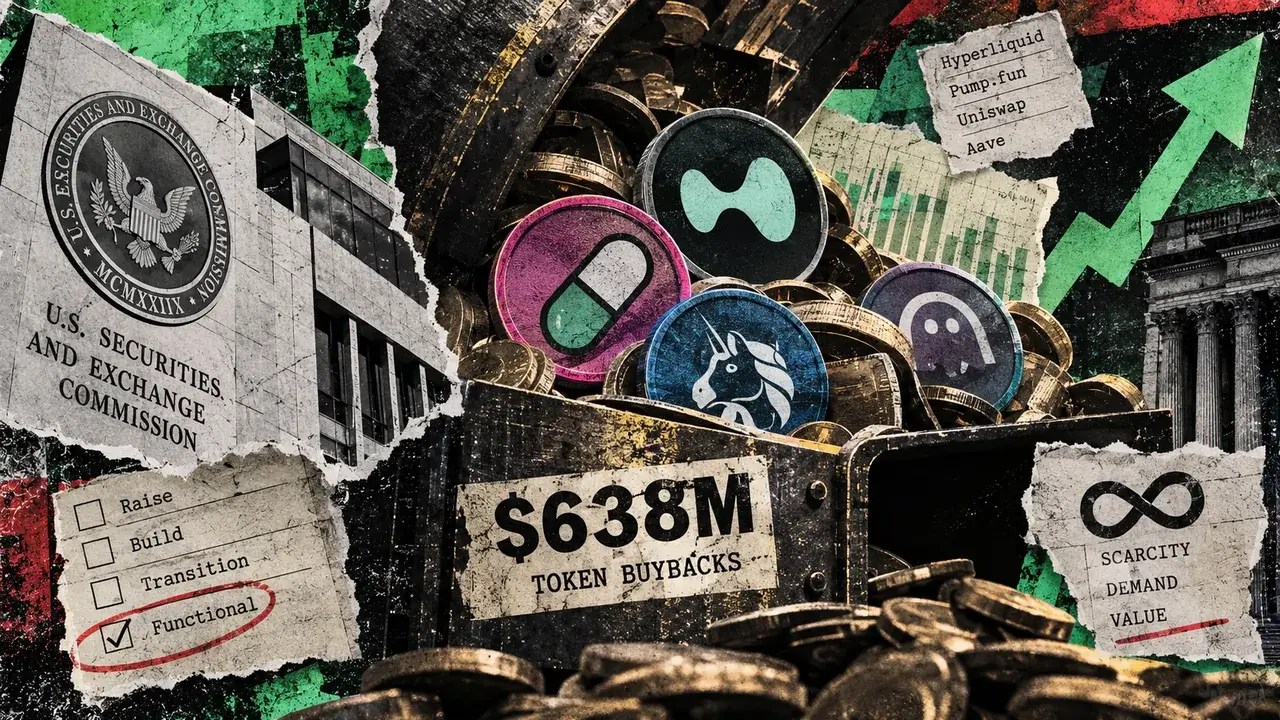
Through late August 2026, crypto projects allocated roughly $638 million to token buybacks, according to Allium Labs data.
This marks a new high, up from $545 million during the comparable period in 2025. Hyperliquid contributed about $370 million and Pump.fun around $200 million, collectively representing nearly 90% of the total.
On September 25, SEC staff addressed the ongoing legal ambiguity surrounding these programs, noting that the clearer a project links its token to business returns, the more readily regulators can classify holders as investors in a security.
What SEC staff said
The SEC’s Division of Corporation Finance discussed buybacks in a fresh set of crypto FAQs aimed at networks that have already become operational.
Staff explained that a buyback announcement for a crypto asset deemed non‑security on a functional network does not constitute the “essential managerial efforts” that lie at the heart of the Howey test for investment contracts.
The guidance cautions newer projects that, on networks still awaiting full functionality, presenting a buyback as a yield or return mechanism may be construed as part of an investment‑contract evaluation.
This response hinges on two assumptions: the network must be functional and the token must already lie outside the scope of securities law. The SEC notes that these staff views, while influential, do not possess binding legal authority.
According to the SEC’s March guidance, a network is considered functional when its native token can be utilized for its intended programmed purpose.
A regulatory life cycle takes shape
The SEC’s March interpretation allows a token to be offered as part of an investment contract while a team raises funds based on promises of managerial effort; the contract concludes when investors no longer anticipate profits from those efforts.
The proposed Regulation Crypto Assets would permit projects to raise as much as $5 million over four years under a startup exemption, while a broader exemption could enable up to $75 million in annual fundraising, both subject to disclosure obligations.
Proposed Rule 400 introduces a transition filing, Form TR, whereby an issuer certifies on EDGAR that it has either completed or permanently discontinued its promised managerial efforts and will not initiate any new ones.
The issuer submits the form directly, and the SEC may later review whether the stated conditions have been satisfied. The agency estimates that roughly 475 issuers per year could avail themselves of this safe harbor, corresponding to about 15% of the approximately 3,165 projects launched in 2024. The comment period ends on October 20.
Taken together, these elements outline a progression from securities‑regulated fundraising to a mature network capable of allocating genuine revenue to token repurchases. The Form TR applies to projects that either halted or completed their roadmaps, whereas the buyback FAQ is relevant only after a network achieves functional status.
This framework incentivizes teams to set out a finite set of milestones they can actually achieve, while deterring promotional narratives that portray buybacks as returns before the product is operational.
Protocol buyback / burn mechanism – scale cited in article, what can offset or interrupt it: Pump.fun 50% of revenue directed to open‑market PUMP purchases and permanent burns (~$500 M annualized revenue; ~$462.5 M cumulative purchases; 167.7 B PUMP destroyed). Offsetting factors: revenue declines; future token issuance or unlocks. Hyperliquid Trading fees finance programmatic HYPE purchases and burns (~$1.3 B bought and burned since launch; >$1 B annualized fees flow toward purchases). Offsets include staking rewards and future emissions that can counteract supply reduction. Uniswap Protocol fees accrue; searchers obtain assets by burning UNI (fee mechanism live since Dec. 2025, expanded across chains). Governance oversees fee deployment and future mechanisms. Aave Treasury‑funded open‑market AAVE purchases (>205,000 AAVE, ≈ $42 M in the first ten months). Constraints: treasury needs; program paused after the rsETH incident.
Current Flow of Funds Into Token Buybacks
Pump.fun reports that half of its revenue is directed toward buying and permanently burning PUMP tokens. Its dashboard indicates roughly $500 million in annualized revenue, approximately $462.5 million in cumulative purchases, and the destruction of 167.7 billion tokens — representing 16.8 % of the original supply.
At the current run rate and allocation, that implies around $250 million in annual purchases,
about 6.4% of Pump.fun’s displayed $3.91 billion fully diluted valuation. The figure measures purchasing power against valuation, with the cash going into open-market token purchases.
Hyperliquid has purchased and burned approximately $1.3 billion of HYPE since its inception, and its documentation notes that over $1 billion in annualized fees now flows into programmatic HYPE purchases.
Uniswap activated protocol fees on the Ethereum mainnet in December 2025 and has since extended the mechanism to additional chains, allowing external searchers to claim accumulated fees solely by burning UNI tokens.
Hyperliquid finances staking rewards from a reserve of future emissions while trading fees continue to burn HYPE. A protocol that burns 5 % of its supply while issuing 8 % via emissions and unlocks can ultimately dilute holders, even when it reports a substantial headline buyback.
A more informative metric for these tokens is net burns minus new issuance, which can then be evaluated relative to valuation.
Aave’s program shows how quickly treasury needs can override a buyback. It acquired more than 205,000 AAVE, about 1.28% of supply, for roughly $42 million in its first ten months.
Governance then debated cutting the annual budget from $50 million to $30 million as revenue softened. The DAO paused purchases on April 19, after the rsETH bridge incident, to preserve balance-sheet flexibility.
Crypto’s tally remains modest compared with Wall Street, where S&P 500 firms allocated $1.02 trillion to share repurchases in the twelve months ending September 2025. The sector’s growth trajectory stands out, climbing from roughly $366,000 in 2024 to $638 million in less than eight months of 2026, driven by mechanisms that automatically convert revenue into market purchases.
Protocol buyback / burn mechanism – scale cited in article, what can offset or interrupt it: Pump.fun 50% of revenue directed to open‑market PUMP purchases and permanent burns (~$500 M annualized revenue; ~$462.5 M cumulative purchases; 167.7 B PUMP destroyed). Offsetting factors: revenue declines; future token issuance or unlocks. Hyperliquid Trading fees finance programmatic HYPE purchases and burns (~$1.3 B bought and burned since launch; >$1 B annualized fees flow toward purchases). Offsets include staking rewards and future emissions that can counteract supply reduction. Uniswap Protocol fees accrue; searchers obtain assets by burning UNI (fee mechanism live since Dec. 2025, expanded across chains). Governance oversees fee deployment and future mechanisms. Aave Treasury‑funded open‑market AAVE purchases (>205,000 AAVE, ≈ $42 M in the first ten months). Constraints: treasury needs; program paused after the rsETH incident.
What Token Holders Actually Own
The rights attached to these tokens are limited. Uniswap’s documentation notes that value accrues to UNI holders via the burn mechanism and any future mechanisms endorsed by governance, while protocol revenue remains under the protocol’s control.
According to the SEC’s March guidance, digital commodities are defined as assets whose holders possess no inherent entitlement to passive yield, future income, or profits. A buyback can tighten supply and generate steady demand, and governance retains the ability to adjust or suspend it at any time.
The same separation from securities law that facilitates trading of a mature token also distances it from the cash‑flow metrics investors typically rely on for valuation.
Bitcoin, which the SEC categorizes as a digital commodity, operates without an issuer or protocol revenue to recycle; consequently, revenue multiples and buyback ratios are relevant for tokens such as HYPE, PUMP, and UNI.
The Future Trajectory of the Token Buyback Model
Should the SEC adopt Regulation Crypto Assets in a form similar to the current proposal, projects could raise funds under the exemptions, delineate finite roadmaps, submit transition reports, and channel revenue into token repurchases once their networks become operational.
Hyperliquid’s fee streams and Pump.fun’s allocation already suggest that industry‑wide token buybacks could exceed $1 billion annually at present run rates. Revenue‑adjusted and dilution‑adjusted buyback yields would likely emerge as standard valuation metrics for protocol tokens.
Feature – Public‑company shareholder vs. Mature protocol token holder. Ownership claim – Equity ownership in the corporation versus generally no ownership of the protocol or company merely from holding the token. Right to profits – May receive distributions if declared; residual corporate rights defined by securities/corporate law versus no inherent right to future protocol income or profits. Buyback effect – Company purchases outstanding shares versus protocol/DAO purchases or burns tokens, potentially reducing supply or adding market demand. Guaranteed buybacks? – No versus No. Who can change the program? – Board/company subject to corporate and securities‑law constraints versus governance, protocol rules or other authorized actors depending on design. New issuance can offset purchases? – Yes, through new share issuance/compensation versus Yes — emissions, incentives and unlocks can overwhelm burns. Claim on underlying revenue – Share represents equity rights in the company versus buyback‑linked token may have no contractual claim on the revenue funding purchases. Useful valuation metric – Earnings, free cash flow, buyback yield, dilution versus protocol revenue, gross buybacks and net issuance/dilution.
If the proposal stalls or emerges in a weaker form, the nonbinding staff FAQ will remain the primary source of guidance, prompting projects to omit return‑focused language from their marketing and to treat buybacks as discretionary actions.
Revenue‑linked programs contract automatically when income declines, and a significant exploit or bad‑debt event could lead other treasuries to hoard capital, as Aave did. In such circumstances, holders would perceive a buyback as having a market impact similar to a shareholder return, yet it stays revocable, governance‑dependent, and devoid of any contractual claim.
The SEC is charting a pathway for crypto networks to allocate their revenue toward token repurchases. At the journey’s end, holders own an asset whose value is linked to the protocol’s success through scarcity and demand, while the protocol retains control of its revenue.
Also Read
- Crypto Industry Rallies Behind Bitget Following $387.5M Exploit
- Bitcoin ETFs Extend Seven-Day Inflow Streak, Pushing 2026 Flows Into Positive Territory
- The Shift from Employment to Entrepreneurship: An Austrian Economic Perspective on AI with Per Bylund
- Payward’s Strategic Billions: Building a Comprehensive Financial Infrastructure Beyond Crypto