




While ordinary savings accounts in Singapore pay a modest 2.5 per cent, and locals eagerly queue for Treasury bills when yields tick up, stablecoin platforms often advertise staggering returns of 20 per cent annual percentage yield (APY). When confronted with such figures, the first question a sensible investor must ask is simple: who is paying this yield, and what is the actual economic mechanism behind it?
I ask this question from personal experience. In 2022, I held TerraUSD (UST), a stablecoin pegged one-to-one with the US dollar. Its Anchor Protocol famously offered yields near 20 per cent annually. When UST lost its dollar peg in May, its sister token Luna collapsed in tandem, erasing tens of billions of dollars in market value almost overnight.
Subsequently, I joined a representative legal action in Singapore regarding the collapse. In July 2025, the Singapore International Commercial Court ruled on five fraudulent misrepresentations, awarding reliance damages to seven representative claimants, while dismissing other claims.
While the legal outcome is significant, the underlying financial lesson is far simpler: high returns are meaningless unless the economic foundation supporting them is real, sustainable, and easily understood.
Anchor’s advertised yield was not backed by genuine, recurring transaction fees from organic customer demand. Instead, its sustainability relied on a fragile ecosystem of reserves, incentive structures, and pure market confidence. Once confidence evaporated, there was no solid economic floor to support the promised returns.
That traumatic experience taught me to treat unsolicited high yields with extreme skepticism. Yet, it also prompted a practical question. For decades, banks, money changers, card networks, and remittance companies have sustained themselves on the revenues of foreign exchange. Can stablecoin liquidity providers tap into this same, time-tested economic activity?
Foreign exchange offers a compelling answer.
FX spreads are the engine
Consider an SME in Ubi paying a supplier in Johor, a family spending baht in Bangkok, a domestic helper sending money home from Lucky Plaza on a Sunday, or a Chinatown shop accepting payment from a tourist. Every single one of these transactions requires converting one currency into another, and that conversion carries a tangible cost.
The gap between the buy and sell rate—known as the FX spread—is the lifeblood of the currency exchange industry. It explains why a bank’s board rate differs from the rate offered at The Arcade, and it has sustained money changers, banks, and remittance firms for generations.
Stablecoin-based FX does not magically create wealth from nothing. Instead, it has the potential to make the liquidity behind currency conversion more transparent, programmable, and accessible.
A stablecoin sitting idle in a digital wallet earns nothing. Real income is generated only when capital is actively deployed to quote and execute genuine exchanges. When a business, merchant, wallet, or individual swaps one currency-linked stablecoin for another, they pay a fee or accept an FX spread. A portion of that revenue can then be distributed to the liquidity providers whose capital facilitated the transaction.
The basic formula for estimating annualized yield is straightforward: Indicative APY ≈ (net FX fees and spreads earned during the period ÷ average capital deployed) × (365 ÷ number of days in the period).
For example, consider a US$100,000 currency conversion with a 20-basis-point all-in spread: US$100,000 × 0.20 per cent = US$200.
That US$200 represents actual value paid by a customer who needed to move funds between currencies and accepted the quoted cost of doing so.
At a 20-basis-point gross spread, US$100,000 of capital would need to support roughly 100 full-turnover conversions in a year to yield a 20 per cent gross annualized figure—equivalent to about two transactions per week. This calculation occurs before accounting for protocol fees, operating costs, rebalancing, and any gains or losses from currency inventory.
The crucial term here is “annualized.” A displayed APY is a projection of recent performance extended over a full year; it is a historical snapshot, not a guaranteed promise of future returns.
Just like a traditional money changer who enjoys a bustling Friday before a long weekend as Singaporeans buy ringgit, only to face a quiet Tuesday, stablecoin liquidity providers face similar market dynamics. If ten new money changers open on the same street corner, spreads narrow dramatically. When conversion flows decline, or more capital enters a specific corridor, returns will drop, potentially falling all the way to zero.
High APY does not mean low risk
A high annualized return can either reflect robust, organic conversion demand or serve as compensation for taking on substantial risk.
A local money changer holding ringgit overnight faces currency risk if the exchange rate moves against them. Stablecoin liquidity providers face a similarly complex risk landscape, including inventory exposure, shifting market flows, thin liquidity, smart-contract vulnerabilities, stablecoin depegging, operational failures, and sudden regulatory changes.
Before chasing any APY, investors should ask critical questions:
- Does the return genuinely originate from actual transaction fees and FX spreads?
- Is the figure historical, and what specific time period was used to calculate it?
- What happens to returns if conversion flow dries up or more liquidity enters the market?
- What currency, stablecoin, smart-contract, and withdrawal risks does the provider assume?
- Is there a clear, independent audit, along with transparent risk-management and redemption frameworks?
- If a platform cannot clearly explain the economic source of its returns, treat the APY as paid advertising rather than objective information.
Why direct pairing matters
When travelers head to Johor Bahru for a weekend getaway, they do not ask to convert Singapore dollars into US dollars first, and then into ringgit. They simply hand over Singapore dollars and receive ringgit directly.
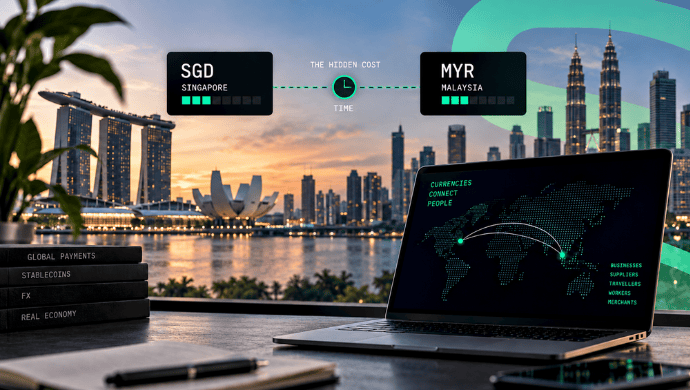
Stablecoin FX has yet to fully replicate this simplicity. A swap from an SGD-linked stablecoin to an MYR-linked stablecoin often follows an indirect route:
SGD stablecoin → USD stablecoin → MYR stablecoin
Using the US dollar as an intermediate step is often logical, as it remains the world’s deepest and most liquid bridge currency.
However, each additional step introduces another layer of spreads, deeper liquidity dependencies, and more points where execution can fail or become unreliable. If either leg of the journey is thin or disrupted, the final conversion becomes more expensive and less predictable.
A direct route is far simpler: SGD stablecoin → MYR stablecoin
Direct routing is not always superior. A thin direct market can easily be worse than a highly liquid route through US dollars. The ultimate goal is not to eliminate the US dollar entirely, but to ensure that USD remains an option rather than an unavoidable middleman.
A mature, modern FX system should dynamically compare the direct route, a USD-bridged route, and any other executable paths, then automatically select the best all-in outcome based on real-time liquidity, spreads, fees, and settlement conditions.
Capital should not sit idle
Traditional automated market makers (AMMs) typically require liquidity to sit locked in isolated pools dedicated to specific currency pairs. A provider supporting multiple currencies must split their capital across many different markets, leaving significant portions of their funds idle while waiting for matching flow.
At Sera, we are building around a different approach called virtual liquidity. Under this model, a provider can make a single deposit available for quoting across a defined set of currency corridors, subject to shared collateral and strict risk limits. Instead of duplicating capital across separate pools for every potential pair, the same collateral can support multiple sources of FX flow simultaneously.
This approach does not guarantee risk-free returns. It is simply a more efficient capital-allocation model, and it demands rigorous safeguards: quotes must remain executable, exposures must remain fully visible, and shared collateral must never become hidden leverage.
The next stablecoin question
Much of the stablecoin debate has, quite rightly, focused on the issuance side: who issues the token, what assets back it, and whether holders can redeem it at par value.
The UST collapse demonstrated the catastrophic consequences when stability relies on a related token and market confidence rather than robust, segregated reserve assets. Similarly, the Monetary Authority of Singapore’s (MAS) stablecoin framework focuses heavily on value stability, reserve backing, and clear redemption rights.
But issuance is only the starting point of the equation.
A stablecoin linked to the US dollar, Singapore dollar, or Malaysian ringgit only becomes truly useful when individuals and businesses can seamlessly exchange it, settle payments with it, and spend it wherever they operate. This requires robust FX liquidity, transparent pricing, efficient routing, widespread merchant acceptance, clear redemption mechanisms, and accountable safeguards.
The next major race in the stablecoin industry will not be won by whoever issues the most tokens. Instead, victory will belong to the infrastructure provider that makes global currency conversion work together at fair, transparent, and highly reliable rates.