




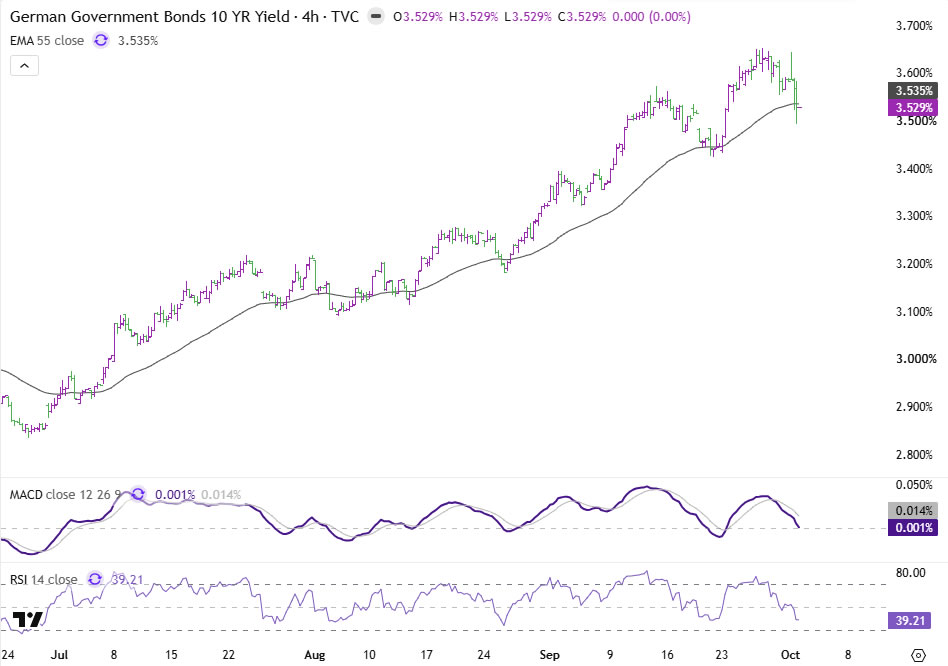
TL;DR: The OAT-Bund spread widened past 140.6bp, its widest since the 2012 eurozone debt crisis, as French 10-year yields surged to 4.935% while German Bund yields fell to 3.529%—a divergence pointing to a France-specific sovereign risk premium that EUR/CHF is now starting to transmit into FX.
Why This Matters
Europe’s bond market dislocation has evolved beyond a single trade. Investors are now differentiating between France and Germany—and EUR/CHF is beginning to mirror that divergence. When two nations share a currency and central bank yet their bond yields move in opposite directions, it signals markets pricing one government’s fiscal credibility differently from another’s. For traders, the spread itself, rather than absolute yield levels, offers the clearest indication of how far this repricing might extend, while providing EUR/CHF with a specific technical framework for confirmation.
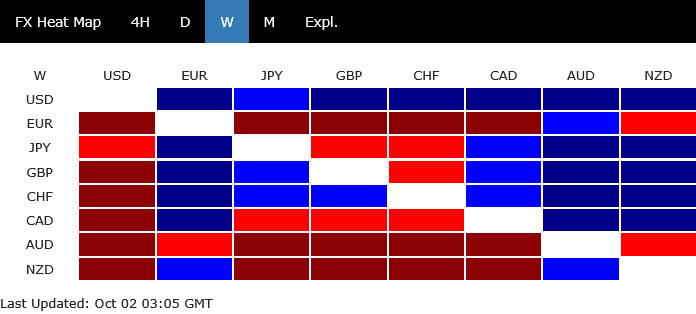
Currency Heat Map.
France Is Being Asked to Pay More for Fiscal Risk
The immediate context is France’s 2027 budget. Prime Minister Sébastien Lecornu’s administration has introduced a package aiming for approximately EUR 54bn in savings, targeting a deficit reduction from 5.4% of GDP in 2026 to 5% next year. The measures include spending constraints and targeted tax adjustments, though the legislation faces a challenging parliamentary process in a fragmented legislature and is expected to undergo substantial amendments.
The bond-market dynamic is straightforward. When investor confidence in a government’s ability to stabilise its deficit and debt trajectory wanes, a larger yield premium is demanded to hold that debt. In France’s case, this premium is evident against Germany, where the Bund market functions as the Eurozone’s core benchmark.
This distinction matters because France and Germany share a currency and an ECB policy rate. A global rates shock can elevate both yields simultaneously. That does not easily explain French yields climbing toward 5% while German yields decline. This is why the spread, rather than the standalone OAT yield, is becoming the clearest gauge of whether markets are intensifying concerns about France.
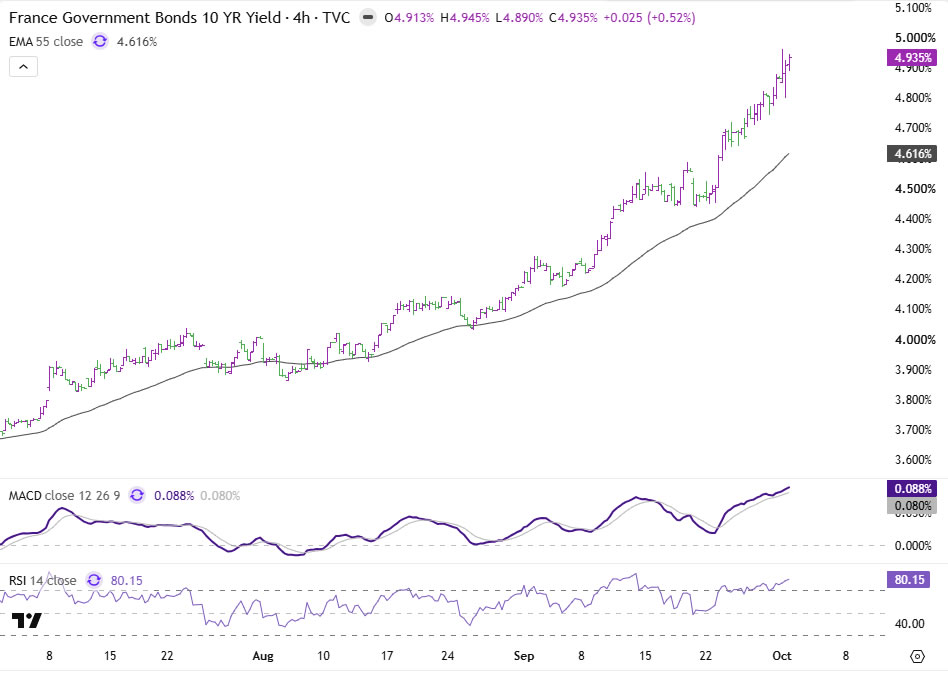
The French 10-year chart underscores the magnitude of the move. Yield sits well above the 4H 55 EMA near 4.616%, with RSI above 80 and MACD remaining positive. German yields, conversely, have retreated toward their 55 EMA near 3.535%, while RSI has dropped below 40 and momentum has turned negative. The technical profile thus mirrors the spread: French risk is accelerating while demand for German duration returns.
Inflation Makes the Backdrop Harder, but Does Not Explain the Divergence
Europe’s inflation environment is adding pressure, yet it cannot alone explain the France-Germany divergence. French national CPI accelerated from 2.4% to 3.0% y/y in September, while the harmonised measure rose from 2.6% to 3.4%. Germany’s harmonised inflation also increased to 3.3%, with energy inflation reaching 14.9%. In France, energy inflation was even higher at 21.2%.
This helps explain why European yields remain structurally elevated. Renewed energy pressure and the Middle East conflict have renewed concerns about inflation’s path back to target. Yet the shared inflation shock makes the OAT-Bund divergence more telling: if inflation alone were driving the bond move, French and German yields should respond similarly. Instead, Bunds rallied while OATs sold off.
Inflation is therefore an amplifier of France’s challenge, not a complete explanation. The widening spread reflects the interplay of higher inflation risk, elevated term premia, and French fiscal uncertainty—a combination that market strategists have also highlighted as the premium on French debt expanded.
European Equities Add Context, but the Spread Carries the Cleaner Signal
European equities declined amid the bond-market stress, with CAC 40, DAX, and FTSE all under pressure. However, the equity move provides a noisier gauge of French-specific risk. German and British shares face the same higher-energy, higher-yield environment even absent France’s fiscal issue, meaning a broad European equity decline aligns with several macro scenarios.
Wall Street, meanwhile, closed modestly higher after the US 10-year Treasury yield retreated from its 5.34% intraday peak, aided by company-specific technology developments. The more useful hierarchy is therefore clear: OAT-Bund spread first. EUR/CHF second. Equities third. The first removes much of the global-rates noise. The second reveals whether FX traders are transmitting the same European risk discrimination into the Swiss franc.
140bp Is Now the Key Sovereign-Risk Test
The spread itself is the most direct test of whether this evolves into a more persistent move. At around 140.6bp, investors are already demanding substantially more compensation to hold French debt than German Bunds. Reuters had recorded the spread at 132.86bp on October 1, already its widest since the 2012 eurozone debt crisis. The subsequent move beyond 140bp therefore represents another meaningful extension.
From here, continued widening would strengthen the case for a structural adjustment to France’s risk premium, rather than a reaction to a single difficult session. Stabilization around current levels would suggest investors await greater clarity from the budget process. A meaningful reversal toward the 90–95bp area seen before the latest acceleration would weaken the case for a durable repricing.
This makes France’s parliamentary budget process the next critical domestic catalyst. The government has laid out the fiscal arithmetic; markets now need to assess how much of it can survive the legislative process.
ActionForex’s Technical View: EUR/CHF Is Starting to Transmit the Same Message
FX is beginning to reflect the bond-market divergence. EUR/CHF has reversed sharply from 0.94850 to around 0.9340, dropping below its daily 55 EMA near 0.9371. Momentum has deteriorated with RSI below 40 and MACD rolling lower.
Franc strength has not been confined to the euro—USD/CHF and GBP/CHF have also fallen, reflecting broader CHF demand. However, EUR/CHF remains the more useful instrument for the French-risk thesis because it directly contrasts the common currency against Europe’s traditional low-risk funding currency.
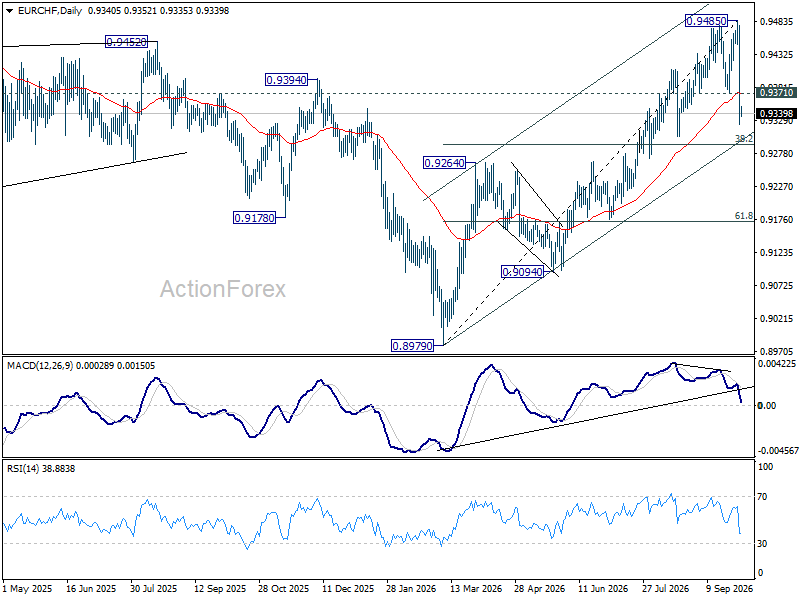
Technically, however, the move remains at an early stage. The rise from 0.89790 to 0.94850 places the 38.2% Fibonacci retracement at around 0.92917 and the 61.8% retracement at 0.91723. EUR/CHF has not yet reached the first level. This provides a useful hierarchy:
- A hold above 0.92917, followed by a recovery, would keep the decline consistent with a relatively shallow correction within the broader advance from 0.89790.
- A sustained break below 0.92917 would strengthen the bearish case.
- A move toward 0.91723 would suggest a substantially deeper repricing and cast doubt on the broader recovery from 0.89790.
However, the bond spread must remain part of the confirmation. A EUR/CHF break below 0.92917 alongside further OAT-Bund widening would provide a much cleaner signal that French fiscal risk is spreading through European assets. The same EUR/CHF break occurring while OAT-Bund stabilizes or narrows would be less convincing—it could instead reflect generic Euro weakness, broader CHF demand, or positioning around US data.
NFP Can Blur the Signal Before France Gives the Next Answer
Today’s US nonfarm payrolls release, with consensus around 90K, introduces a major external complication. A large payroll surprise could dominate global rates, the Dollar, and risk sentiment, potentially obscuring the France-specific signal for several hours. That makes relative moves more useful than outright FX moves after the release.
The most informative configuration would be continued OAT-Bund widening accompanied by renewed EUR/CHF downside. That would suggest French risk remains the driver even through US data noise. If USD/CHF moves sharply after NFP while EUR/CHF remains relatively stable, the Dollar channel would be doing more of the work. If EUR/CHF continues falling while USD/CHF does not, the European risk signal becomes cleaner.
However, NFP is ultimately an external interruption. France’s budget process remains the harder test. The market has already pushed the OAT-Bund spread beyond 140bp. EUR/CHF has begun to respond, but it has not yet broken its first major retracement level.
France and Germany still share a currency and a central bank. For now, their bond markets are increasingly pricing them as very different risks.
Key Takeaways
- The OAT-Bund spread has widened past 140.6bp, its widest since the 2012 eurozone debt crisis, as French yields rise while German yields fall simultaneously.
- The divergence points to a France-specific fiscal risk premium tied to Prime Minister Lecornu’s 2027 budget, not a generic eurozone rates move—inflation runs hot in both countries but cannot explain the split.
- EUR/CHF has reversed from 0.94850 to around 0.9340 but has not yet broken its first key retracement at 0.92917; a break there alongside continued spread-widening would be the cleanest confirmation signal.
- The recommended watch order is OAT-Bund spread first, EUR/CHF second, European equities third, since equities provide a noisier read on French-specific risk.
- Today’s NFP release could temporarily obscure the France signal; monitor whether EUR/CHF moves independently of USD/CHF to determine whether European risk, not the Dollar, is driving price action.