




The SEC’s proposed crypto‑custody fallback could expand investment options while easing implementation for larger advisory firms, but its cost structure may deter smaller players from offering the service.
The agency’s economic analysis says the expense of safeguarding assets and arranging independent oversight may lead smaller firms to decline to offer the service.
Approved on October 1, the rule permits advisers to hold covered client crypto assets when no qualified custodian is available, provided they meet specific safeguards. The agency’s Table 8 estimates an annual cost of roughly $433,800 per adviser electing this approach.
This figure incorporates the cost of an independent control report but excludes certain technology‑related expenses that could be substantial.
For investors, the outcome may be that a crypto asset becomes accessible via advisers with adequate custody capabilities, while remaining unavailable through others.
SEC Commissioner Hester Peirce clarified that adviser “self‑custody” differs from individual investors holding their own keys; under the proposal, an intermediary would safeguard clients’ key material—possibly only a non‑controlling share—and clients would rely on that intermediary’s protections.
For standard advisory clients, the rule applies to crypto assets classified as funds or securities; for regulated‑fund accounts, the coverage extends to securities or comparable investments.
What the annual estimate includes
The primary annual cost modeled is the independent internal control report, averaging $376,000, plus $57,800 in recurring internal compliance tasks.
Table 8 adds these figures together and also shows a one‑time internal compliance expense of $173,500, expressed in 2026 dollars.
The table indicates an initial compliance cost of $173,500, recurring compliance of $57,800 per year, and an annual control report of $376,000, yielding a subtotal of $433,800.
The estimate is based on 300 initial hours and 100 recurring hours annually, billed at $578.33 per hour, covering information exchange, communications, and an agreement to treat the asset as a financial asset under state law.
This subtotal excludes technology, software, hardware, and related processes, which the SEC anticipates could be substantial; recordkeeping and disclosure obligations are detailed elsewhere, so the figure does not represent a full operating budget.
The accountant fee is derived from an inflation‑adjusted estimate in the Paperwork Reduction Act analysis, rounded to the nearest thousand dollars, mirroring the agency’s historical cost modeling; actual report expenses may fluctuate based on asset types, safeguarding infrastructure, and the expertise required to evaluate various networks.
The SEC estimates that about 823 advisers—roughly 5 % of the 16,442 registered firms—might adopt the self‑custody option, though actual participation could be lower.
Scale changes the cost of access
The economic analysis notes that smaller advisers are likely to forego self‑custody due to cost, whereas larger firms may possess the resources to satisfy the safeguards; it also highlights possibilities for cost sharing across broader client bases, multiple assets, or affiliated entities.
This dynamic creates a potential advantage without imposing a strict minimum firm size; an adviser with considerable total assets might still have only a limited pool of crypto assets requiring the fallback.
In contrast, an adviser specializing in crypto may already possess the expertise and infrastructure that other firms would need to develop.
When costs are shared, they impact a small asset base more heavily than a large one if the burden remains unchanged; firms can therefore distribute expenses across their entire operation rather than attributing them solely to fallback users.
The SEC anticipates that many direct costs could be transferred to clients via fees or expenses; as the number of assets and networks grows, controls and accounting work become more complex, raising absolute expenses, while the advantage lies in the ability to spread or reuse infrastructure components.
Accountant pricing could swing either direction; the SEC cautions that rising demand for professionals capable of evaluating crypto controls may limit availability, especially for smaller advisers with limited negotiating leverage.
An option that can expire for each asset
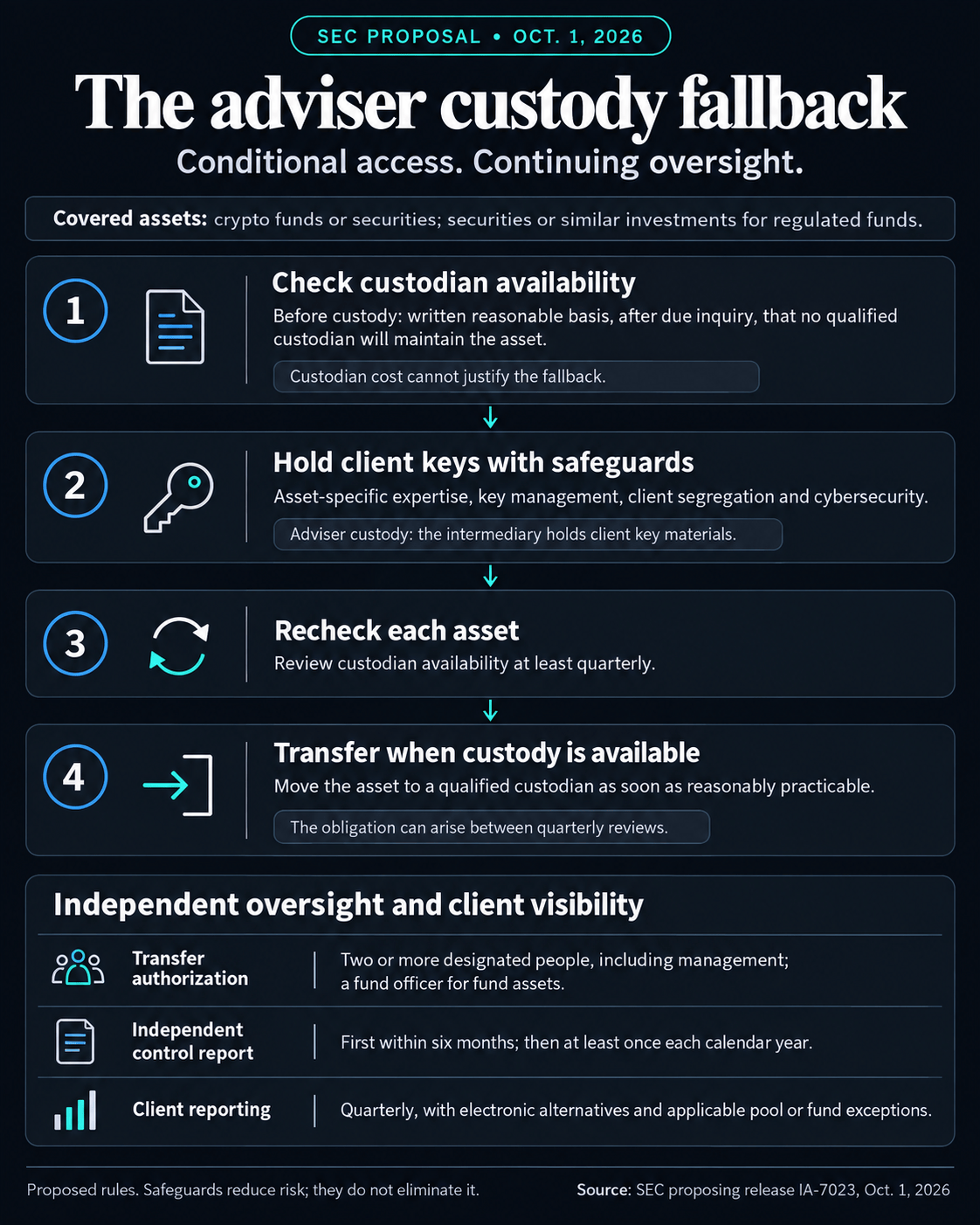
The fallback would apply only if the adviser, after due diligence, determines in writing that no qualified custodian is willing to hold the asset.
Once an adviser learned that a qualified custodian had become available, it would have to place the asset with that custodian as soon as reasonably practicable. That obligation could arise between quarterly reviews. The proposal does not specify a single transfer deadline for every situation.
A firm might incur costs to support an asset and later have to move it out of adviser custody. Eligibility could also leave the firm with only a narrow set of unsupported assets to spread the remaining expense across.
If no client crypto assets remained in self‑custody by the report’s due date, the report would not be required. That could reduce costs for a short‑lived arrangement, although advisers retaining other covered client crypto assets in self‑custody would still face the applicable obligation.
The safeguards buy independent scrutiny
The expense reflects a shift in asset holding; an adviser providing investment advice would also retain clients’ key materials, introducing risks of misuse, misappropriation, or operational error, which must be weighed against any lower‑cost alternative.
As noted by SEC Commissioner Mark Uyeda, the proposal calls for safeguarding expertise, cybersecurity measures, annual reviews, reporting, and client disclosures.
Advisers must develop asset‑specific expertise and systems for key management, require authorization from two or more designated individuals, and keep each client’s assets segregated.
The initial independent control report is due within six months of commencing self‑custody and must be renewed at least annually; it evaluates the design, implementation, and effectiveness of controls and includes verification that records reconcile with the blockchain.
This provides oversight that goes beyond the adviser’s own self‑assessment.
Quarterly client reporting is also required, with electronic options and exemptions for qualifying audited pools and regulated funds; greater client visibility into balances and transactions supports the safeguards, while the accountant’s analysis addresses issues that a simple balance cannot resolve.
These measures do not eradicate custodial risk, and the SEC warns that expenditure alone does not guarantee safeguarding competence; a firm’s capacity to absorb compliance costs is distinct from the effectiveness of its protective systems.
Alternatives could soften the scale advantage
In her September 30, 2025 statement, SEC Commissioner Hester Peirce outlined conditional no‑action relief for certain state trust companies and named national and state banks as additional permissible custodians.
The October proposal further allows eligible state trust companies to hold crypto assets, provided they pass an initial and yearly authorization and safeguard review; when such an institution supports an asset, clients can access it without the adviser needing to construct the fallback.
The cost benefit varies by asset and custody structure, as a firm licensed to offer crypto custody may not support every asset a client desires.
For investors, the key issue is whether the rule will deliver usable access at a reasonable cost and adequate protection; the SEC’s analysis suggests a potential edge for advisers with ample resources and reusable infrastructure.
The extent of client benefit will hinge on firms’ real‑world implementation expenses, the pricing of independent accountants, and the range of assets that eligible custodians start to support.
Also Read
- California Subpoenas OpenAI After AI Models Breach Test Environment, Target Hugging Face
- Banking Industry Group Challenges U.S. Regulator Over Crypto Trust Charters
- Ripple Leadership Set to Speak at Seoul Blockchain Event Amid Growing Asian Adoption
- When the Banks Don’t Work, Bitcoin Does: Cornell University’s Adoption Index