



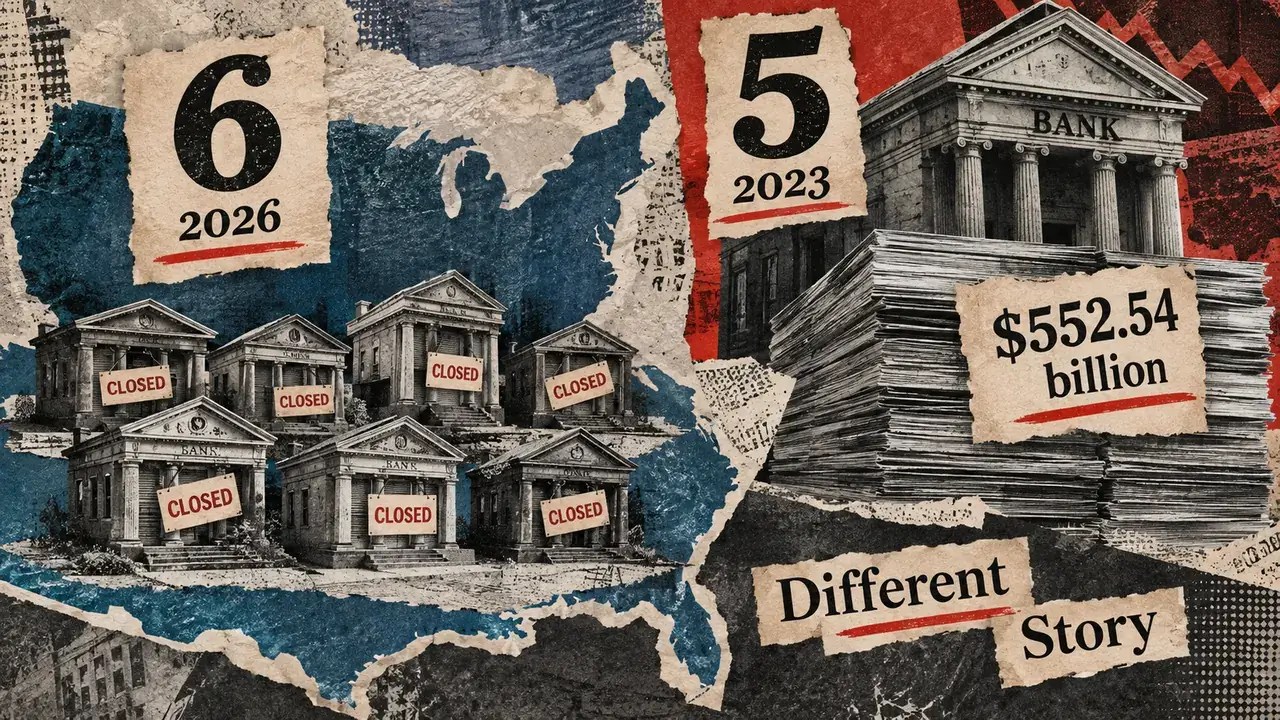
Six US banks have failed in 2026 so far, marking one more closure than in 2023 and prompting familiar concerns about potential banking-sector instability. However, a closer examination reveals critical distinctions that differentiate this year’s failures from previous crises.
According to data from the Federal Deposit Insurance Corporation (FDIC), the six failed banks held approximately $1.43 billion in combined assets—markedly less than the roughly $552.54 billion in assets held by banks that failed in 2023.
Counting each institution equally may yield accurate totals, but it misrepresents the scale of risk involved. For example, one of this year’s failed lenders, Kentland Federal Savings and Loan Association, had just $3.73 million in assets—far smaller than major players like Silicon Valley Bank (SVB). This disparity illustrates how simplistic comparisons can distort perceptions of systemic risk.
Nano Banc’s September 25 closure brought the 2026 tally to six, representing the largest failure so far with $736 million in assets. The FDIC estimated this closure will cost its Deposit Insurance Fund around $114 million.
While such losses are tangible, they do not necessarily signal contagion or broader instability. Each failed bank must be assessed independently rather than viewed as part of a domino effect.
Surface-Level Comparisons Can Be Misleading
The FDIC’s historical records show four failures in 2020, none in 2021 or 2022, five in 2023, and two each in 2024 and 2025. Through September 25, 2026 has already exceeded all annual counts since 2020—an alarming statistic at first glance.
However, context matters. Among the six failed banks this year, only Nano Banc ranks among the larger institutions. Others, like Kentland, were minuscule by industry standards, yet received equal weight in raw failure counts.
The FDIC’s problem-bank list offers additional insight. As of June 30, 47 banks were listed—down from 54 in March and 60 at the end of 2025. These institutions represent about 1.1% of insured banks, remaining within the FDIC’s typical range outside periods of crisis.
Banks appear on this list based on supervisory ratings indicating weaknesses in financial, operational, or managerial capacity—not merely volatile market performance.
It’s important to note that snapshots taken at different times cannot be directly correlated with ongoing events. Four of this year’s six closures occurred after the June reporting date, meaning their impact wouldn’t be reflected in current statistics.
Furthermore, transitions onto or off the problem list aren’t fully disclosed in public summaries, limiting transparency for external observers.
Many Failed Institutions Had Long-Standing Issues
Regulatory filings suggest many of these banks faced prolonged challenges prior to closure:
- Metropolitan Capital: Cited by Illinois regulators for impaired capital and unsafe conditions.
- Small Business Bank: Described by Kansas officials as experiencing years of financial difficulties before ultimate failure.
These cases highlight how unresolved internal issues—not sudden shocks—can lead to eventual collapse. At Small Business Bank, consistent operating losses eroded capital reserves until the institution became critically undercapitalized. Similarly, Kentland struggled with asset depletion and earnings shortfalls as identified by the Office of the Comptroller of the Currency.
Tioga-Franklin Bank had previously entered into an FDIC consent order addressing deficiencies in management, capital planning, liquidity, and credit practices. Though it consented without admitting fault, regulatory scrutiny preceded its failure in August.
Community Bank & Trust – West Georgia remains less understood; while state authorities cited legal authority for closure, detailed financial disclosures were absent. An independent audit by the FDIC Inspector General is currently underway.
Nano Banc also carried a substantial record of past violations. California regulators highlighted recurring infractions and inadequate oversight, alongside a high ratio of uninsured deposits—an indicator of vulnerability during periods of customer withdrawal pressure.
Though concerning individually, none of these failures demonstrate signs of coordinated collapse or shared triggers across institutions.
Broader Industry Health Remains Resilient Despite Localized Setbacks
Despite isolated failures, overall banking health appears stable. In Q2 2026, community banks reported an 8.2% increase in profits compared to the previous quarter. Industry-wide net income reached $90.1 billion, supported by strong capital and liquidity positions.
This resilience suggests that even amid localized distress, the US banking system maintains robustness capable of absorbing limited shocks without compromising wider stability.
The Impact on Stakeholders Is Real—but Contained
Failures inherently affect stakeholders. Nano Banc’s estimated $114 million insurance-fund cost reflects genuine economic consequences. Additionally, Sunwest Bank agreed to assume substantially all deposits and acquire about $476 million in assets.
Customers retained access to services through checks and cards throughout the transition period, underscoring efforts to maintain continuity despite institutional breakdown.
Yet differences emerge in handling uninsured funds. While Tioga-Franklin transferred all deposits, West Georgia’s sale focused on insured accounts, excluding specific brokered deposits. Georgia officials notified affected parties of their rights as uninsured depositors—a process markedly distinct from standard acquisitions.
Asset liquidation post-closure continues generating recoveries, mitigating ultimate costs to the Deposit Insurance Fund.
Connecting Failures to Crypto Risks Requires Clear Evidence
Early speculation linked Nano Banc’s failure to cryptocurrency markets. However, clear causal relationships remain elusive absent concrete evidence linking reserve holdings or service disruptions directly to stablecoin operations.
Unlike 2023—where Circle disclosed $3.3 billion in USDC reserves at SVB—the present scenario lacks comparable data points establishing direct crypto exposure risks.
Without verified disclosures identifying trapped reserves or interrupted merchant processing pathways, linking these failures to crypto market dynamics proves speculative at best.
Conclusion: Headlines Should Reflect Substance Over Statistics
Monitoring developments closely remains prudent. Key indicators include deposit flight patterns, funding accessibility, and shifts in the FDIC’s watchlist composition.
Nevertheless, equating six failures with impending doom ignores fundamental realities. Six struggling banks failing individually underscores operational shortcomings—not systemic collapse.
To claim otherwise demands proof showing how distress spreads among surviving banks—an argument yet unproven.
Sources: FDIC failure announcements and annual summaries. All figures rounded except where noted.
Also Read
- Altcoin Rotation Accelerates: XRP, Solana, and Cardano Lead Broadening Market Rally
- XRP Whale Balances Surge to Record Levels Following 1.6 Billion Token Accumulation Spree
- Iran Debuts Foreign Currency Sales via Four Major Banks to Stabilize FX Market
- Leveraged funds’ Bitcoin futures shorts fall by 5,300 BTC-equivalent as longs shrink