




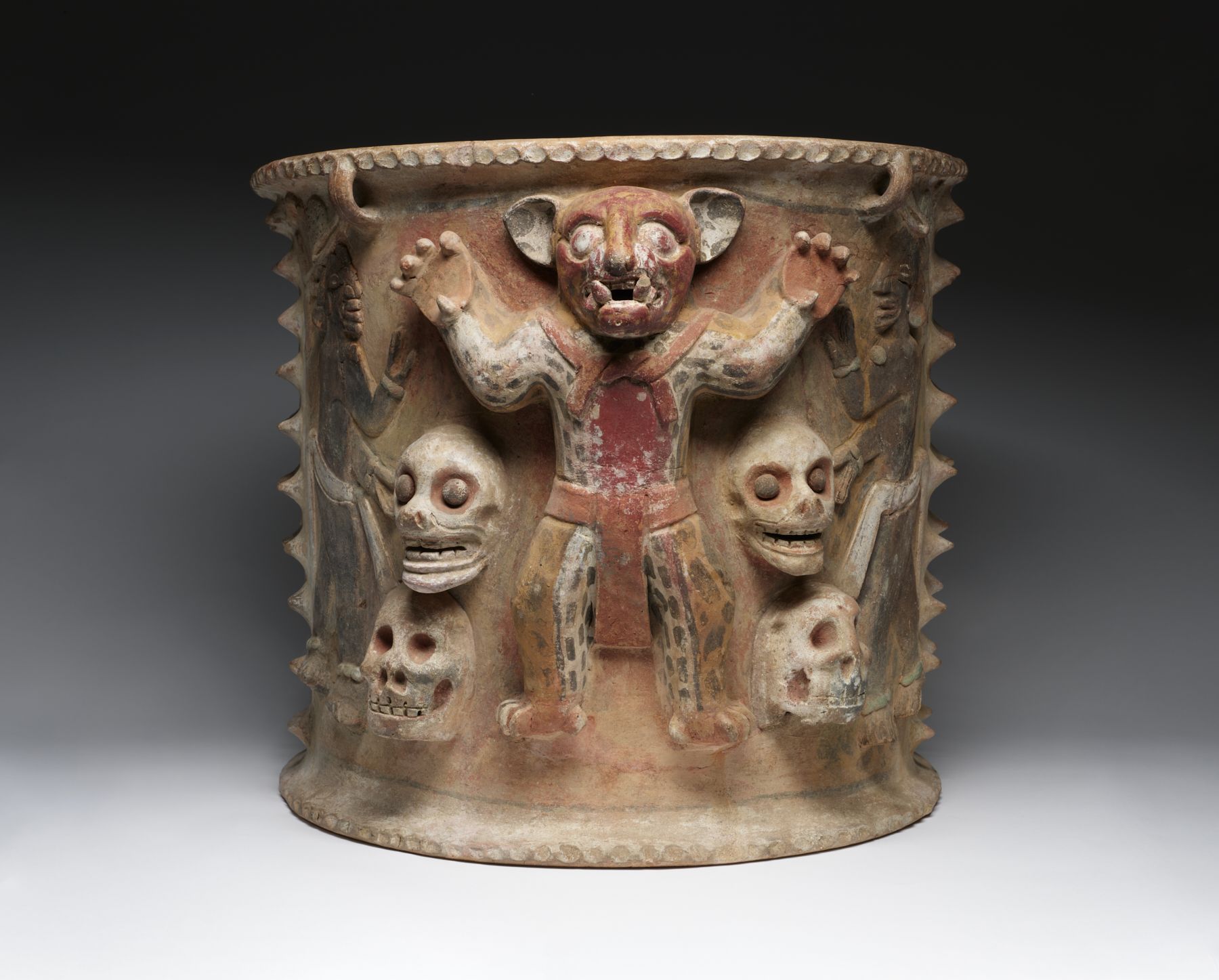
A ceramic urn showing a figure entering the Maya underworld, flanked by skulls.
Key Details
Name: Urn with jaguars and skulls
Type: Ceramic burial urn
Origin: Guatemala
Date: circa A.D. 600–900
This vibrant ceramic urn portrays a figure clad in a blood-splattered jaguar costume, encircled by human skulls and poised to enter the Maya underworld. It once contained the bones of an ancestor, venerated by descendants.
Anonymous donors gifted the piece to Baltimore’s Walters Art Museum in 2008. Standing roughly 17.5 inches (44.5 cm) tall, it was likely crafted by K’iche’ Maya artisans in Guatemala over a thousand years ago. The vessel probably once featured an ornate lid secured by string through loops near its rim, though that lid is now lost.
The urn’s decoration is dramatic: a central figure wears a jaguar costume splashed with blood, claws and teeth bared, gazing outward at the viewer. Scholars believe this represents a deceased ruler entering the realm of the dead, signaled by two pairs of skulls and the dark silhouettes of two Maya underworld gods. Behind them rise spiked forms evoking the thorns of the tropical kapok tree (Ceiba pentandra).
According to The Walters Art Museum, the Maya considered the kapok tree—also known as the ‘world tree’ or Yaxche—to have roots in the aquatic underworld, positioning it as a conduit between realms; its presence on this funerary urn likely reflects that belief. Jaguars held profound spiritual significance, thought to traverse the sky, Earth, and underworld with ease. Thus, the ruler depicted in a jaguar costume may symbolize a mediator between the living and the divine.
The Walters Art Museum notes that this richly symbolic urn underscores a Maya conviction that death was not a final cessation. Instead, it “serves as a graphic reminder of how the dissolution of the body could be a positive change, transforming a beloved ancestor into an honored spirit who would continue to guide the living for eternity.”