




On Thursday, gold hovered near $4,130 per ounce, sitting close to its lowest point since early August despite a notable effort to bounce back. Downward pressure on the precious metal intensified after the release of Federal Reserve minutes, which kept the possibility of another interest rate increase before year-end very much alive. High oil prices continue to add to the strain, sustaining elevated inflation risks.
The minutes from the September meeting revealed that all 19 FOMC members backed the rate increase. Furthermore, most participants indicated that another rate hike before the end of the year would likely be appropriate.
Conversely, markets are largely anticipating a pause at the October meeting. However, the probability of a rate hike in December is estimated at approximately 78%, a factor that continues to cap demand for gold. Meanwhile, oil prices are climbing amid reports that the Donald Trump administration has directed the Pentagon to prepare strike options against Iran, potentially ahead of the midterm elections. Shipping risks through the Strait of Hormuz remain significant, even though Middle Eastern oil supplies are estimated to have recovered to pre-war levels.
Technical Analysis
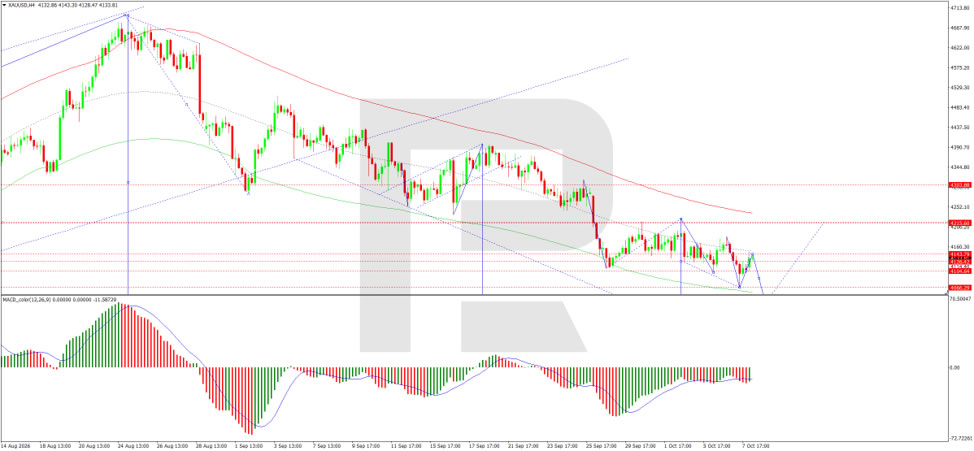
On the H4 timeframe, gold remains within a downtrend. Following the formation of a corrective range around $4,143, the market attempted to rally but failed to secure a foothold above resistance. A further downward move is now developing, with a potential test of support at $4,104. A breach below this level would pave the way for a decline toward $4,066, with $4,027 standing as the primary target for sellers. Alternatively, a preliminary corrective rise toward $4,215 remains possible. The MACD indicator reinforces the bearish outlook: the signal line sits below zero, and the histogram remains in negative territory, suggesting sellers continue to dominate.
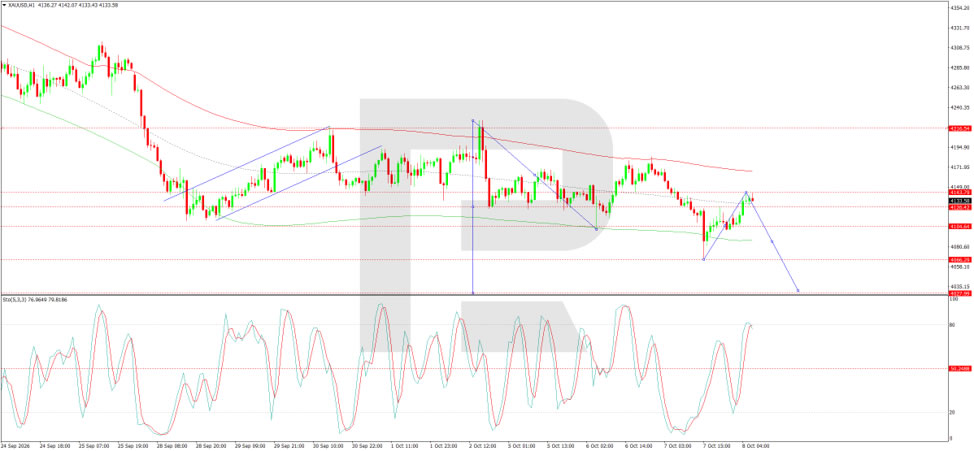
On the H1 chart, the market completed its local downward move with a test of the $4,066 area, triggering an upward correction. Buyers pushed the price back above $4,104 to test resistance at $4,143. A local consolidation range between $4,126 and $4,143 is currently forming. A rejection from the upper boundary would signal a resumption of the downward move, initially targeting $4,104. A break below this support would open the way for further declines toward $4,066 and subsequently $4,027. The alternative scenario involves consolidation above $4,143, followed by a corrective move toward $4,171. The Stochastic oscillator is currently in the overbought zone near 80 and is showing signs of turning downward, increasing the likelihood that the current correction is ending and renewed downward momentum will emerge in the upcoming session. Selling remains the priority once a reversal from resistance is confirmed.
Conclusion
Gold is attempting a rebound but remains under pressure near its early-August lows, weighed down by hawkish Fed minutes and soaring oil prices that sustain elevated inflation risks. Although all 19 FOMC members supported the September rate hike, markets largely anticipate a pause in October, with the probability of a December rate hike standing at around 78%. Rising oil prices, fueled by reports of potential US strikes on Iran, are adding further uncertainty. Technically, gold remains in a downtrend, with support at $4,104 and downside targets at $4,066 and $4,027 should the decline resume. A corrective rise toward $4,171 is possible if the price consolidates above $4,143, though the overbought Stochastic suggests the correction may be nearing its end. The near-term outlook remains bearish unless resistance is decisively broken.
Also Read
- Samsung Wallet Taps Solana for USDC Transfers on 82M US Galaxy Devices
- Samsung Brings USDC Stablecoin Integration to Galaxy Phones for Seamless Global Money Transfers
- Crypto investment firm Deus X Capital shuts down as backers pursue separate strategies
- Ripple’s Bullish Signal : SEC Filings Reveal First Steps Toward XRP ETF Options – FXLeaders