



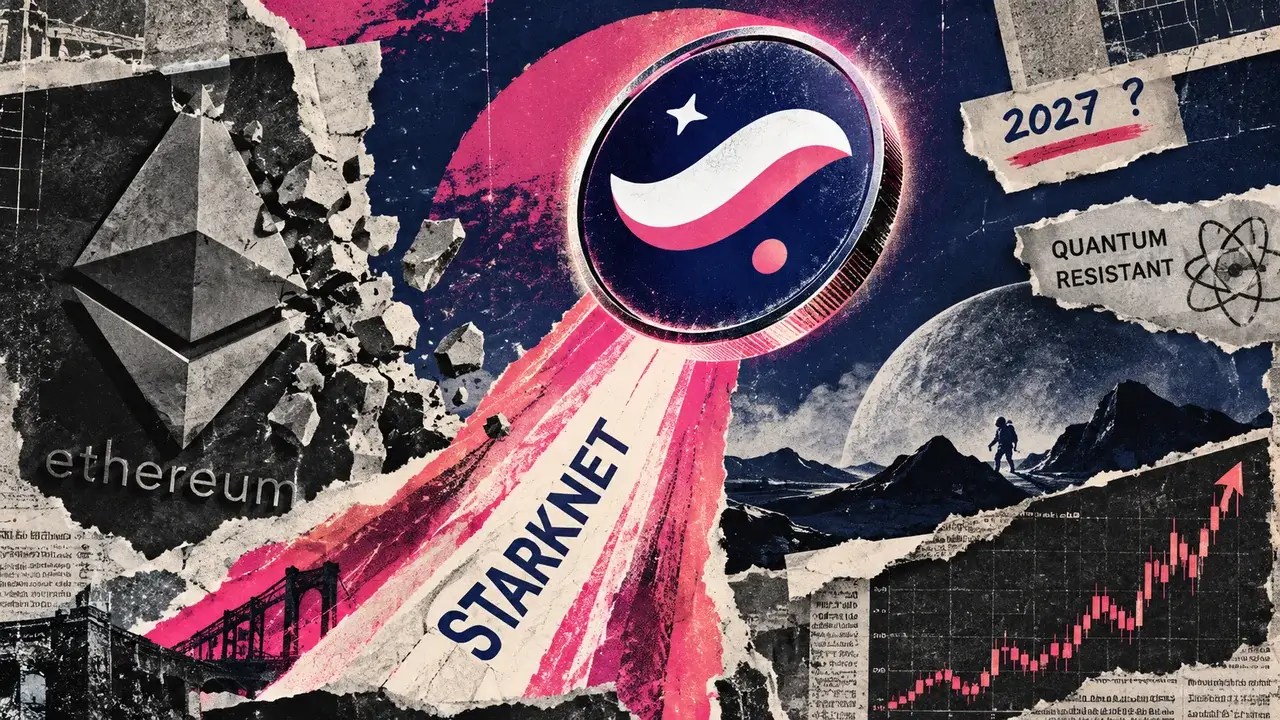
Starknet’s native STRK token surged over 100% in a week as the project weighs the possibility of launching an independent Layer 1 blockchain, according to recent market data.
A CoinGlass snapshot taken at 20:28 UTC on October 11 revealed STRK trading at $0.1190, reflecting a 17.7% increase over 24 hours and a 116.7% gain over seven days.
On October 8, Starknet announced it was actively evaluating a transition to a standalone Layer 1 chain, with a target completion date of 2027 for what it calls the world’s first fully quantum-resistant blockchain. Should the plan proceed, it would significantly reduce Starknet’s reliance on Ethereum for security and consensus mechanisms.
Starknet Explores Ethereum Independence to Enhance Quantum Security
StarkWare CEO Eli Ben-Sasson has positioned the potential shift as a proactive measure in light of escalating concerns around quantum computing and artificial intelligence threatening current cryptographic standards used in blockchain systems.
Speaking via social media platform X, Ben-Sasson emphasized that the quantum threat may emerge sooner than anticipated and that rapid advancements in AI add further urgency to preparing for post-quantum cryptography. His comments follow growing discussions within the broader crypto ecosystem after notable progress in AI-enhanced mathematical research.
His focus centers on readiness for a cryptographically relevant quantum computer, though he stops short of claiming AI can already compromise existing blockchain signature schemes.
Starknet utilizes ZK-STARK proofs built on hash-based cryptography, which differ fundamentally from the elliptic curve methods susceptible to quantum attacks. Additionally, the network supports customizable account logic, allowing users to implement alternative signature protocols without requiring systemic changes.
In June, StarkWare outlined a phased approach addressing weaknesses in legacy hashing functions, outdated smart contracts, and inherited dependencies from Ethereum. While the initial stages fall under Starknet’s jurisdiction, full implementation hinges partly on Ethereum’s own quantum-resistant upgrades.
Know what’s moving crypto.

Currently functioning as an Ethereum Layer 2, Starknet executes transactions off-chain but relies on Ethereum for final settlement and data availability. This structure exposes its bridging mechanisms and data anchoring processes to Ethereum’s evolving cryptographic landscape.
In September, the Ethereum Foundation indicated plans to achieve quantum resistance across its execution, consensus, and data layers by December 2029.
A truly independent Starknet would require robust security frameworks and settlement models to substitute the safeguards currently provided by Ethereum. The October 8 statement signals exploration and forward-looking goals rather than a finalized roadmap or timeline for migration.
STRK Futures See $3.5 Billion Trading Volume in 24 Hours
According to the same October 11 CoinGlass report, roughly $258.5 million in open interest accompanied nearly $3.5 billion in daily futures volume for STRK. Additionally, about $14.8 million was liquidated in futures positions during the period.
Further data from CoinMarketCap revealed around $720 million in 24-hour spot trading volume, corresponding to a circulating market cap of approximately $892 million as of October 11.
The recent rally precedes a scheduled token unlock event set for October 15. Data from Tokenomist confirms this upcoming release, aligning with Starknet’s documented vesting schedule permitting up to 127 million STRK tokens to become accessible monthly for early contributors and investors through March 2027.
At the quoted price point from October 11, the largest monthly allocation equates to roughly $15.1 million in value, representing about 1.27% of Starknet’s original 10 billion token supply. These unlocks enable restricted tokens to enter circulation, though they don’t specify how much might be sold immediately by recipients.