




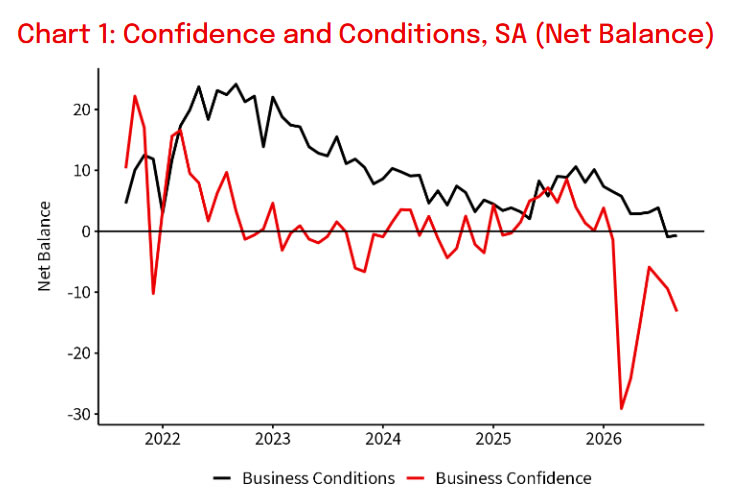
Australia’s NAB Business Confidence Index fell from -9 to -13 in September, marking its third consecutive monthly decline as businesses contended with higher interest rates, global uncertainty and elevated fuel costs. Confidence now sits 18 points below its long‑run average and ranks among the weakest 5 % of readings in the survey’s history. NAB Head of Australian Economics Gareth Spence warned that pessimism is widespread across industries, with confidence 22 points lower than a year earlier. He cautioned that weak sentiment could increasingly affect hiring, investment and spending decisions, raising the risk of softer economic activity in the final quarter.
Business Conditions held unchanged at -1, but the underlying components showed further deterioration in employment. Modest gains in trading conditions and profitability were offset by a 3‑point decline in the employment component to its lowest level in five years. Regional performance also became more uneven. Queensland’s conditions slipped 4 points, bringing its trend reading broadly in line with the weaker eastern states. Western Australia remained the clear outperformer, with trend conditions at +16, compared with 0 in New South Wales, -1 in Queensland and -3 in Victoria. The divergence suggests that business weakness is widespread but not uniform across the country.
Despite deteriorating confidence and employment conditions, capacity utilisation eased only slightly from 82.5% to 82.3%, remaining around one percentage point above its long‑run average. Utilisation rose in five of the eight industries surveyed, with trend readings above average in five industries. Spence noted that capacity utilisation has stayed above average for roughly four years despite weakening business conditions. The contrast highlights an economy facing increasingly subdued business sentiment without a corresponding broad easing of capacity pressures. Elevated input costs and constrained capacity continue to pose inflation risks, while weakening confidence, profitability and employment point to growing downside risks for activity.
Data Summary — NAB September Business Survey
Indicator
August
September
Business Confidence
-9
-13
Business Conditions
-1
-1
Capacity Utilisation
82.5%
82.3%
Components
Component
September Trend
Employment
Fell 3 points to five-year low
Trading Conditions
Small improvement
Profitability
Small improvement
Capacity Utilisation
Above long-run average by around 1 percentage point
Industry Confidence
Weak across almost every industry
Regional Business Conditions
State
Trend Conditions
Western Australia
+16
New South Wales
0
Queensland
-1
Victoria
-3
Source: NAB Monthly Business Survey, September 2026.
Key Takeaways
- Business confidence drops sharply: The NAB Business Confidence index fell from -9 to -13, marking the third straight monthly decline. The figure sits 18 points below its long‑run average and ranks in the weakest 5 % of survey readings.
- Employment conditions weaken: While overall business conditions stayed at –1, the employment sub‑index slipped three points to its lowest level in five years, signalling potential headwinds for hiring and year‑end activity.
- Capacity pressures persist: Capacity utilisation slipped slightly from 82.5 % to 82.3 %, still hovering about one point above its long‑run average even as business sentiment deteriorates.
- Western Australia outpaces the rest: Western Australia’s trend condition reads +16, far ahead of the modest or negative figures in New South Wales (0), Queensland (‑1) and Victoria (‑3).
- Economic outlook remains mixed: Deteriorating confidence and employment hint at softer economic activity, yet persistently high capacity utilisation and input costs indicate that inflationary pressures have not broadly abated.
Also Read
- Cleveland Fed’s Hammack Urges Faster Rate Increases Despite October Pause Expectations
- IMF Warns AI Disruption to Reshape 40% of Global Jobs, With Youth Facing Earliest Impact
- BiggerZ Unveils Provably Fair Originals Featuring 100% RTP and Eliminated House Edge
- Moscow Exchange Begins Bitcoin Trading Tests Ahead of December Launch