



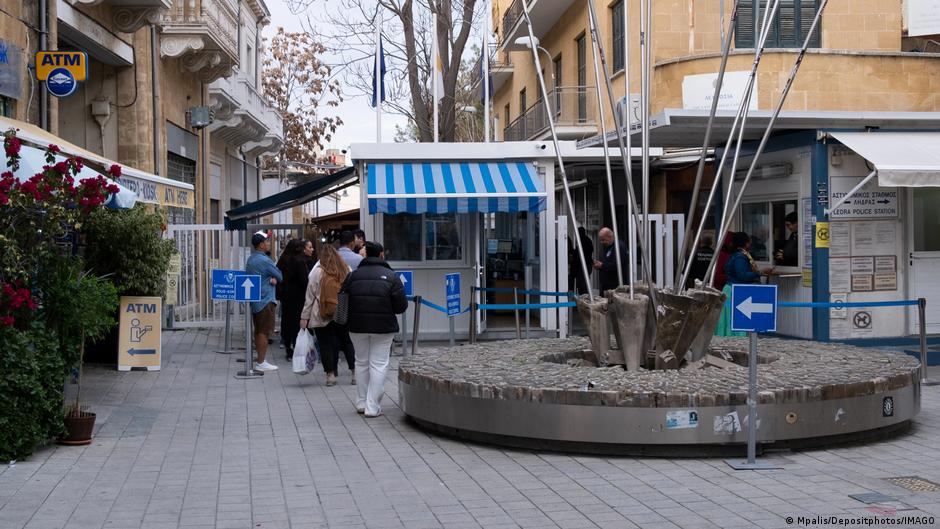
[CYPRUS READIES FOR SCHENGEN JOINERS BUT GEOPOLITICAL OBSTACLES REMAIN]
< p>Cyprus has emerged as the de facto leader within the European Union in the race toward Schengen integration.
Alongside Ireland, Nicosia remains the only EU member state still excluded from the continent’s border‑free travel zone.
Following decades of preparatory work and the adoption of more than 120 technical recommendations, the European Commission issued a positive assessment in July, affirming the republic’s technical readiness.
These recommendations, originating from EU evaluations dating back to 2021, addressed critical domains such as border management, visa regimes, access to European security databases, and cross‑border police cooperation. Implementing them required substantial digital upgrades alongside legislative reform and administrative restructuring.
On 1 October, Deputy Minister for Migration and International Protection Nicholas Ioannides declared that every European Commission recommendation had now been fully implemented.
Reservations from Austria and the Netherlands exposed
Although a positive technical assessment suffices in theory, it does not automatically guarantee accession.
Joining the Schengen Area demands a unanimous decision by the EU Council, following consultation with the European Parliament.
According to reporting by DW, Austria and the Netherlands have already voiced informal reservations, citing security concerns related to the Green Line—the ceasefire demarcation that has split the island since 1974—and the exceptional status of the British Sovereign Base Areas.
While neither nation has formally blocked Cyprus’s inclusion, their reservations carry considerable weight.
Both countries previously objected to proposals expanding the Schengen perimeter to Bulgaria and Romania.
The significance of the Green Line
The principal impediment is the Green Line, a roughly 180‑kilometre ceasefire boundary established after Turkey’s 1974 intervention. It divides the internationally recognised Republic of Cyprus from the Turkish‑controlled northern sector of the island.
Monitored by the United Nations Peacekeeping Force in Cyprus (UNFICYP), the line is governed by special EU regulations governing nine sanctioned crossings.
This arrangement creates a fundamental challenge for Schengen candidacy, because the Republic of Cyprus does not enjoy effective control over the entire corridor. Meanwhile, Nicosia explicitly rejects any scheme that would transform the Green Line into an external border, whether through law or symbolism.
“The obstacle raised by several Schengen members is that Athens lacks full control of the Green Line. Even if Cypriot controllers manage the checkpoints, large swathes of land remain unmonitored,” explains Dr Nasisa Hadjigeorgiou, associate professor of transitional justice at the UCLan Cyprus School of Law.
“To be deemed capable of full control, something must change—either the Cyprus issue resolves, or a tightly regulated physical border must be erected. There is no alternative,” adds Hadjigeorgiou.
British Sovereign Base Areas complicate the picture further
The British Sovereign Base Areas of Akrotiri and Dhekelia, retained under UK sovereignty upon Cyprus’s 1960 independence, constitute another major hurdle.
Collectively, these territories cover about 254 square kilometres (approximately 98 square miles), representing nearly three percent of the island’s surface and retaining British rule.
The core difficulty revolves around the Dhekelia base, which sits adjacent to both the territory administered by the Republic of Cyprus and the self‑declared Turkish Republic of Northern Cyprus—a polity lacking international recognition.
“Checks are performed by British authorities at the Pergamos and Strovilia crossing points within this zone,” clarifies Dr Hadjigeorgiou.
“That arrangement is problematic because the area is overseen on one side by the occupying forces and on the opposite side by the British Sovereign Base Areas. Consequently, Britain effectively controls who may enter and depart the Schengen area at home, whereas normally the Schengen members themselves set these boundaries.”
Recent discussions indicate that Nicosia and the British bases have initiated talks to upgrade border‑control procedures at Pergamos and Strovilia to meet EU standards.
Diplomatic outreach intensifies
Meanwhile, Nicosia has accelerated diplomatic engagement to secure the necessary consensus.
On 1 October, Deputy Minister for Migration Nicholas Ioannides convened bilateral meetings with representatives from Austria, the Netherlands and Finland at the sidelines of the EU Justice and Home Affairs Council in Luxembourg, placing Cyprus’s accession to Schengen on the agenda.
The upcoming MED9 summit of nine Mediterranean EU members in Croatia on 7 October saw its leaders endorse the European Commission’s positive review and urge prompt conclusion of Cyprus’s entry pathway.
Nonetheless, anonymous sources reveal that despite these favorable developments, Cyprus’s entry remains uncertain. They warn that the EU is likely to await a resolved settlement to the island dispute before rendering a decision that could otherwise entail added political and logistical complications.
Also Read