



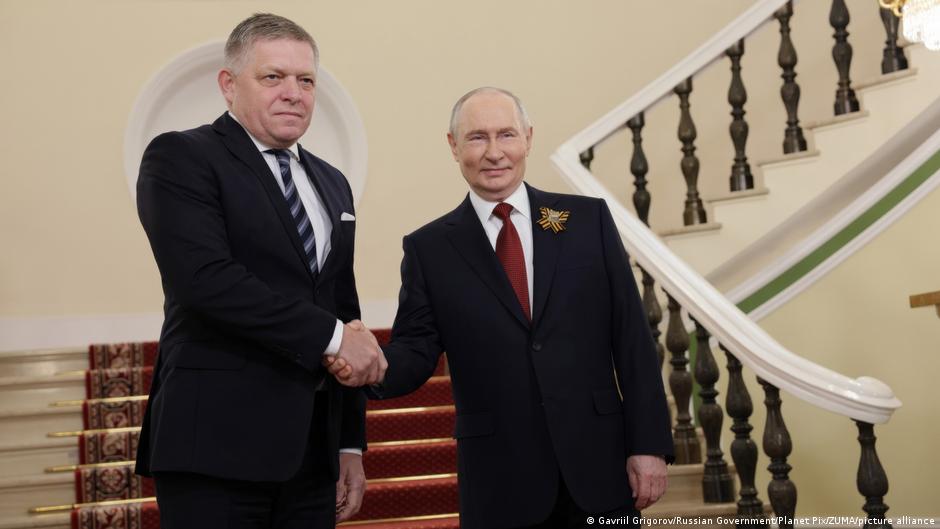
When Prime Minister Robert Fico met with Vladimir Putin in the Kremlin last May, he signaled that bilateral ties should transcend energy cooperation. Fico informed the Russian president that steps were underway to restore military attaché positions at their respective embassies.
Five months later, that arrangement is materializing. Slovakia has deployed two military officers — Brigadier General Slavomír Staviařský and his deputy, Colonel Ivo Gahir — to Moscow, while preparing to receive a Russian military attaché in Bratislava. The move restores military-diplomatic representation for the first time since Russia’s full-scale invasion of Ukraine in February 2022.
What Does Slovakia Stand to Gain?
The decision has drawn sharp criticism from opposition figures, who question the strategic benefit. They warn that Russia could exploit the arrangement to expand its intelligence operations on Slovak soil.
“A single additional military attaché does not fundamentally alter the broader strategic picture; the appointment’s primary significance lies in the political signal it transmits,” Martin Poliačik, a former Slovak MP affiliated with the opposition Progressive Slovakia party, told DW.
“NATO allies should be concerned both about the activities of the incoming Russian officer and the political environment in which he will operate,” he added.
The appointments were first reported by Slovak news outlet Aktuality.sk on October 8. Both officers appear on the Defense Ministry’s published roster of military diplomats serving abroad. According to public broadcaster STVR, Staviařský has been stationed in Moscow since early August.
Opposition defense experts cited by Aktuality.sk identified the incoming Russian officer as Maxim Verežan. Verežan has reportedly received Slovak approval, though he was not yet listed among accredited military attachés as of the report.
Aktuality.sk reported that the Defense Ministry did not respond to inquiries regarding Verežan’s expected arrival in Bratislava.
Espionage and Disinformation Fears Resurface
The prospect has revived memories of a 2021 Russian espionage scandal involving Sergei Solomasov, then the deputy military attaché at the Russian embassy in Bratislava. Solomasov was filmed recruiting and paying Bohuš Gárbar, a contributor to the pro-Russian website Hlavné správy.
Solomasov was expelled the following year. Gárbar was subsequently convicted of espionage and bribery.
Opposition experts told Aktuality.sk that a Slovak attaché in Moscow would face intense surveillance and gather limited actionable intelligence, while the reciprocal Russian posting could facilitate espionage within Slovakia. They warned the incoming officer could conduct influence and disinformation operations, questioning what tangible benefit Slovakia would derive.
Government Defends the Decision
The government and its allies have defended the renewal of military contacts as a necessary channel for intelligence gathering and diplomatic engagement.
In a statement carried by STVR, Slovak military intelligence stated Staviařský’s mandate is to assess the security and military-political situation and keep the Defense Ministry informed.
Richard Gluck, a member of Fico’s Smer party who chairs parliament’s defense and security committee, noted that American, British, and French military diplomats remain in Moscow.
“We were losing a significant amount of information,” Gluck told STVR, arguing that withdrawing Slovakia’s military diplomatic presence from Moscow had been a mistake.
‘A Very Serious Step’
Retired Lieutenant General Pavel Macko, however, emphasizes the context in which the previous contacts were severed.
“This is a very serious step taken by the Fico government,” said Macko, a former Slovak deputy chief of defense and the highest-ranking Slovak general in NATO’s command structures.
“Nothing has changed since 2022 — if anything, the situation has deteriorated,” he continued. “Russia’s adversarial activities continue to grow in Slovakia and the region. The Russian war of aggression against Ukraine continues with high intensity, as do hostile hybrid activities against Slovakia and its neighbors.”
Macko cited a foiled plot to burn down a Ukrainian-owned drone factory in eastern Slovakia and suspicions linking incidents in Munich and Leipzig to Russian operations based in Slovakia.
Macko also warned that political influence over Slovakia’s intelligence services and the government’s pro-Russian orientation could further erode intelligence-sharing and trust among allies, despite the presence of “a significant number of very professional and trustworthy officers.”
Election-Year Calculations?
Poliačik, meanwhile, suggested political motives underlie the timing of the restoration, with Prime Minister Fico eyeing re-election next year.
“Fico’s best chance of building a credible narrative for the next election is to claim that everyone else is dragging us into war while he alone seeks peace,” Poliačik told DW.
“I believe he will argue that he is best positioned to negotiate with Putin to end the war, and that this requires an exceptionally close relationship,” he added, noting Fico has sought to downplay the substantial role Slovak arms manufacturers play in supplying Ukraine with ammunition under commercial contracts.
Poliačik drew a distinction between Slovakia’s formal commitments and confidence in its political leadership. In his view, Western partners have grown accustomed to Fico’s conduct.
“Slovakia is formally fulfilling its NATO commitments,” he said.
“Formal compliance does not, by itself, settle the question of political trust,” Poliačik added. “Predictability, however, is not the same as reliability.”
Edited by: Aingeal Flanagan
Also Read
- Tuesday’s Top Analyst Upgrades and Downgrades: Nvidia, Apple, Netflix, Meta, Galaxy, SoFi, Viking, AT&T and Others
- IMF Flags Escalating Cyber Risks and Potential AI-Driven Market Correction in Global Outlook
- Nuremberg Airport Closed as Fighter Jets Escort Flight from Corfu amid In‑Flight Emergency
- MI5 Head: Iran Shifting Tactics to UK Military Targets; RAF Fairford Incident ‘Not Unique’