



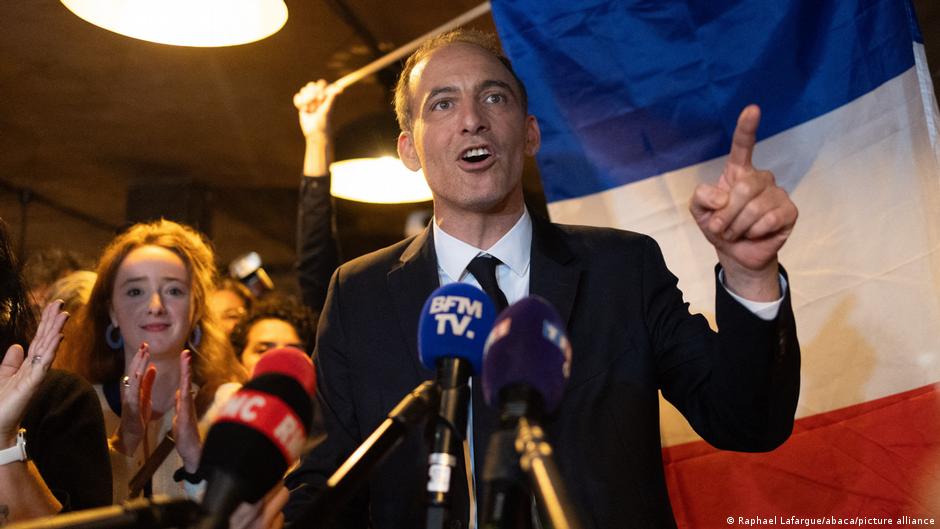
The historically working-class Parisian neighborhood of Belleville has undergone significant gentrification in recent years. It was in this transformed setting that Raphael Glucksmann, a member of the European Parliament for France’s center-left Socialists, celebrated his victory in the party’s presidential primary on October 11.
While a two-round voting process had been expected, the 46-year-old son of philosopher and essayist André Glucksmann secured a decisive victory in the first round, capturing 66% of the vote. He will now represent the Socialist party as their candidate in France’s 2027 presidential election.
As he departed the Cantine de Belleville restaurant, Glucksmann was targeted in a flour-bombing incident by an unidentified assailant. The following morning, he publicly called upon his rival, left-wing populist Jean-Luc Melenchon, to condemn violent actions carried out by his supporters, though it remains unconfirmed whether the attacker was affiliated with Melenchon’s La France Insoumise (LFI).
This incident has brought to the forefront the key challenge facing Glucksmann’s presidential campaign in the weeks ahead: how can he attract Melenchon’s supporters if he remains unwilling to collaborate with their candidate?
Gluckmann’s rapid rise
“Where do you stand on Melenchon?” was the central question dominating the Socialists’ primary campaign. While party leader Olivier Faure advocated for keeping the door open to cooperation with LFI, Glucksmann called for a definitive break with the far left. Consequently, his decisive victory is viewed as a mandate for clear demarcation.
Other primary candidates questioned Glucksmann’s political experience. Ségolène Royal, a former presidential candidate, compared his bid for the Élysée to that of an “intern” seeking to run a company, arguing that Glucksmann lacked any experience in government or local administration.
Despite his primary victory, Glucksmann faces an uphill battle. A poll by Toluna Harris Interactive released the day after his win projected that he would secure between 10% and 11% of the vote. In contrast, the same poll placed Melenchon at 18%, suggesting the far-left candidate would be far more likely to reach the runoff. However, since the survey was conducted before his primary win, it does not account for any potential momentum his nomination might provide. Still, even 10% would represent a significant improvement over the Socialists’ performance in the 2022 election, when their candidate Anne Hidalgo secured just 1.75% of the national vote.
Adding to the complexity is the fact that the Socialists are relying on a non-party member to lead them out of irrelevance. Raphael Glucksmann actually belongs to a small center-left party called Place Publique.
France students demand better schools
To view this video please enable JavaScript, and consider upgrading to a web browser that supports HTML5 video
Melenchon’s youth appeal
Glucksmann faces significant challenges, particularly in engaging young voters. In a September Ipsos survey that positioned Glucksmann as the social-democratic candidate and Édouard Philippe as the sole centrist option, Melenchon led among voters under 25 with 41% support. Meanwhile, 20% of this age demographic backed far-right nationalist Marine Le Pen. While France’s youth electorate is politically fragmented, Melenchon continues to dominate the left-wing spectrum.
The 75-year-old politician is currently rallying alongside students whose protests have garnered international attention. At a rally near Clermont-Ferrand in central France, he expressed solidarity with the movement and reiterated his calls for lowering the voting age to 16 and abolishing Parcoursup, France’s national admissions system for higher education.
In an analysis for the Fondation Jean-Jaures, a Socialist-aligned think tank, political scientist Antoine Bristielle distinguishes between a core group of committed LFI voters and the broader left-wing electorate. Melenchon’s most loyal supporters, he notes, are often young, educated city-dwellers facing significant financial pressure, with four in ten households in this group relying on a net monthly income of less than €2,000 ($2,200).
Bristielle estimates that just under a third of the left-wing electorate in his study prioritize a left-wing victory over loyalty to any specific party. Almost half of the individuals in this group are under 35 and would consider voting for the Socialists, the Greens, or LFI. While redistribution and an active government are important to them, most favor politicians who are willing to compromise.
Glucksmann’s youth efforts
The pattern recently observed in Germany, where young women are more inclined to vote for the left and young men for the right, does not apply in France. Political scientists Anja Durovic, Nonna Mayer, and Noémie Piolat found that in the 2024 European and parliamentary elections, young French women were not significantly more likely to vote for the left or less likely to vote for the far right than men of the same age. It remains to be seen whether this pattern will be replicated in the 2027 presidential election.
Glucksmann proposes easing the burden on earned income by reducing France’s CSG social security tax while increasing taxes on inheritances exceeding €2 million. He also positions himself as a strong advocate for European integration, contrasting with Melenchon, who has labeled the EU a neoliberal institution. Glucksmann’s political profile combines social policy advocacy with foreign policy stances that could also appeal to voters from the camp of the current president, Emmanuel Macron.
France’s Ukraine policy is one such critical issue. Glucksmann advocates for decisive support for Kyiv. In contrast, Manon Aubry, a member of the European Parliament for Melenchon’s LFI, states that her party supports military aid only under specific conditions: the provision of aid must first undergo democratic debate, it must not facilitate attacks deep within Russian territory, and it must not compromise France’s own defense capabilities. In 2024, LFI MPs voted against the French–Ukrainian security agreement.
The tension between the left-wing parties was once again evident following the flour attack in Belleville. LFI MP Sébastien Delogu posted a statement of support on X for the taxi driver who had to clean his vehicle.
For Glucksmann to have any chance of winning the presidency, he must win over a significant portion of voters from Melenchon’s camp. This is likely to prove a far more difficult task than simply distancing himself from Melenchon.
This article was originally written in German.