



Businesses are increasingly turning to convenient digital platforms to serve their customers more effectively.
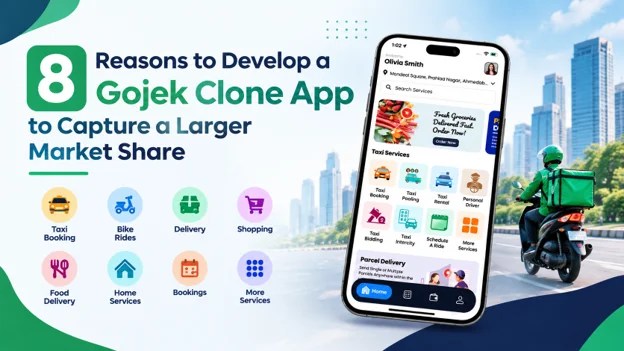
Developing a multi-service application—often modeled after the Gojek “super app” concept—allows companies to bundle a wide array of on-demand services under a single brand. Through one interface, users can access transportation, food and grocery delivery, courier logistics, and home services.
Rather than relying on a single vertical, entrepreneurs can address diverse consumer needs simultaneously, expanding service offerings as demand grows. A well-architected platform streamlines operations, elevates the user experience, and unlocks multiple revenue channels.
Here are eight strategic reasons why this model positions businesses to capture a larger share of the on-demand economy.
1. Reach a Broader Audience with a Multi-Service Model
A multi-service app consolidates varied offerings into one platform, eliminating the limitation of catering to a single customer need. This approach enables a business to target multiple market segments concurrently using a unified digital infrastructure.
For example, a user might book a ride today, order groceries tomorrow, and schedule a home repair later in the week—all within the same ecosystem. This versatility drives diverse customer acquisition and encourages repeat engagement. Success, however, hinges on aligning service categories with immediate local demand and securing a reliable network of service providers.
2. Create Multiple Revenue Streams
Dependence on a single service line caps revenue potential. A diversified model allows entrepreneurs to tap into several income sources within one ecosystem.
Key monetization avenues include:
- Commissions on bookings and orders
- Delivery and convenience fees
- Subscription plans for service providers
- Corporate and B2B partnerships
- In-app advertising and featured listings
A robust technical foundation is essential to manage these models effectively. Ultimately, profitability depends on transaction volume, operational costs, pricing strategy, and customer retention rates.
3. Expand Offerings Without Building Separate Applications
The super app architecture allows businesses to layer new service categories onto an existing platform rather than developing standalone apps for each vertical.
For instance, a launch focused on ride-hailing can seamlessly integrate food delivery or courier services once market conditions support expansion. Users retain a single account, while the business manages all verticals through a centralized backend. This reduces friction for customer acquisition and enables cross-promotion. Before scaling, however, companies must verify that their software can handle new workflows and provider management requirements efficiently.
4. Enhance User Convenience via a Unified Interface
Consolidating daily tasks into a single application significantly reduces user friction. Customers can manage bookings, track orders, and access services without switching contexts.
- Transportation: Book rides, track drivers in real-time, and access trip histories.
- Delivery: Browse menus or catalogs, place orders, and monitor delivery progress.
- Home & Personal Services: Discover, vet, and book specialists for various needs.
A cohesive UI/UX minimizes the cognitive load associated with navigating disparate service types. Integrated payment gateways, transparent pricing, reliable notifications, and responsive support further refine the experience.
5. Accelerate Growth with a Scalable Tech Stack
Sustainable growth requires a technology foundation that supports rapid deployment of new verticals without treating each as a ground-up development project. Effective multi-service architecture shares core modules—user accounts, payment processing, notification engines, analytics, and admin dashboards—across all service lines.
This modularity allows businesses to launch new categories, onboard providers, and enter new geographic regions rapidly. However, software scalability must be matched by operational readiness: reliable supply networks, consistent quality control, and compliance with regional regulations are equally critical.
6. Strengthen Brand Equity Through a Cohesive Experience
A super app enables entrepreneurs to establish a distinct digital brand identity across multiple touchpoints. Customers associate a single brand with the fulfillment of diverse needs, reducing the mental overhead of managing multiple provider relationships.
This unity boosts brand visibility and fosters loyalty; a positive experience in one vertical increases the likelihood of adoption in others. Long-term differentiation relies on consistent service quality, transparent pricing, and trust—factors that outweigh the novelty of the multi-service format itself.
7. Reduce Time-to-Market with a White-Label Framework
Custom development from scratch demands extensive design, coding, and QA cycles. A white-label or ready-made super app solution provides a pre-built, tested framework that can be customized to specific brand and operational requirements.
This approach lets founders focus on go-to-market strategy, brand development, and service curation rather than core infrastructure engineering. Licensing terms and customization flexibility vary by provider; evaluating a live demo is essential before committing to a partnership.
8. Key Criteria for Selecting a Technology Partner
Choosing the right platform provider is a pivotal strategic decision. Vendors offer varying degrees of readiness, from core customer/provider apps to comprehensive admin panels and dispatch systems.
Entrepreneurs should assess potential partners against several benchmarks:
- Feature Parity: Does the out-of-the-box solution cover required workflows for all target verticals?
- Customization & Ownership: What level of source code access or white-labeling is permitted?
- Scalability: Can the architecture handle projected load and future vertical additions?
- Security & Compliance: What data protection standards and regional compliance measures are implemented?
- Support & SLA: What are the post-launch maintenance terms, update cycles, and response guarantees?
- Total Cost of Ownership: Transparent pricing covering licensing, customization, hosting, and ongoing support.
A thorough due diligence process—including demo reviews, reference checks, and contract analysis—ensures the selected partner aligns with both immediate launch goals and long-term product roadmap.
Conclusion
Adopting a multi-service platform strategy allows businesses to address a wider total addressable market and diversify revenue through a single digital ecosystem. Success requires careful service selection, a frictionless user experience across all verticals, and a resilient operational model.
For new entrants, a white-label super app solution offers a pragmatic entry point, significantly de-risking the technical execution. A comparative evaluation of features, licensing flexibility, and vendor stability is recommended to ensure the chosen platform supports both launch velocity and sustainable scale.
Frequently Asked Questions
What is a super app?
It is a single mobile application that aggregates multiple on-demand services—such as ride-hailing, food and grocery delivery, logistics, and home services—into one unified interface.
Can a multi-service app generate revenue from different verticals simultaneously?
Yes. The model supports blended monetization, including transaction commissions, delivery fees, provider subscriptions, B2B contracts, and advertising inventory.
Is a white-label solution suitable for startups?
It is often ideal for early-stage ventures seeking to minimize upfront capital expenditure and development risk. The critical factor is the platform’s flexibility to accommodate unique branding and workflow customizations.
What core features should a multi-service platform include?
Essential modules comprise customer apps (iOS/Android), provider/driver apps, a comprehensive admin dashboard, booking and dispatch management, integrated payment processing, push notifications, ratings/reviews, and business intelligence reporting.
What due diligence is required before choosing a provider?
Verify the live product via demo, audit the feature list against requirements, clarify source code ownership and licensing terms, confirm delivery timelines, review security certifications, and define post-launch support SLAs.
Also Read
- Celebrating the Community: Notting Hill Locals Honoured in Live Frieze Exhibition
- Jon Stewart Mocks JD Vance’s Anti-Immigrant Rhetoric as ‘Sloppy Word Choice’
- Cardi B’s Tiny Desk Concert Delivers an Unforgettable Performance of Artistry and Energy
- Star Trek: Outposts Unknown Launches on Steam, Opening a New Era in the Final Frontier