




Canada’s CPI Reaches 3.1% Amid Gasoline Surge; Core Measures Ease
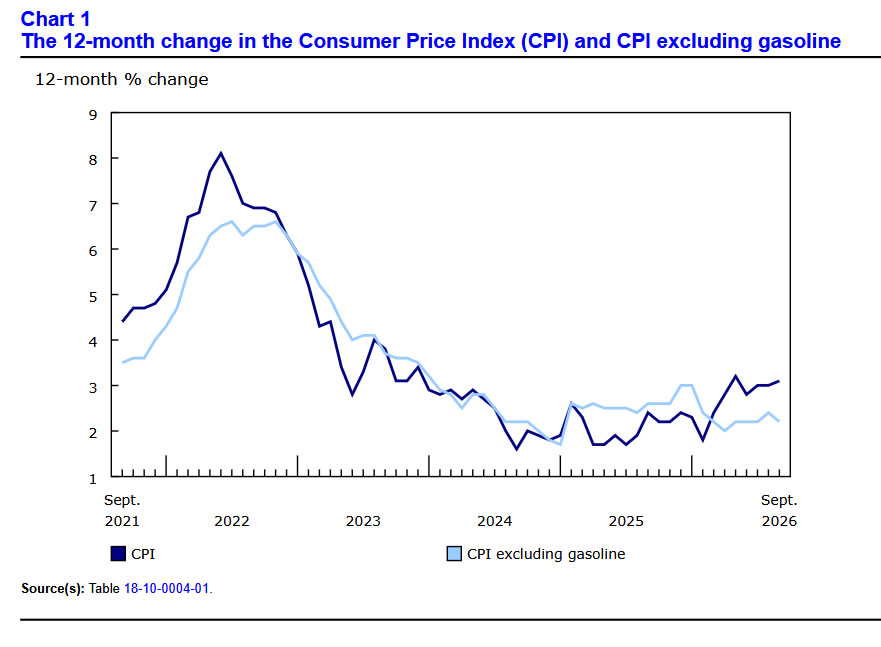
Canada’s headline CPI climbed from 3.0% year‑over‑year in August to 3.1% in September, missing the market forecast of 3.2%. The rise was powered largely by soaring gasoline prices. Month‑over‑month growth came in at 0.1%, continuing a slight dip in August and trending lower than the expected 0.2%. Statistics Canada reports gasoline inflation leapt from 22.8% year‑over‑year to 27.8%, and total energy prices rose from 15.4% to 19.0%, driven by sharp crude oil prices amid the Middle East conflict. Notably, CPI excluding gasoline eased from 2.4% to 2.2%, underscoring how much of the headline jump stems from energy costs rather than broader price pressures.
Importantly, all three Bank of Canada core inflation gauges eased and fell short of expectations. CPI‑common dropped from 2.6% to 2.4%, CPI‑median slipped from 2.0% to 1.9%, and CPI‑trim moderated from 1.9% to 1.8%. Grocery prices softened markedly, declining from 2.8% year‑over‑year to 1.7%—the steepest annual gain since May 2024—thanks to lower rates on fresh vegetables and sugars and modest upticks in beef. In contrast, shelter costs advanced from 1.5% to 1.8%, bolstered by rising fuel oil, home‑insurance premiums and maintenance expenses, while rent stayed flat at 2.8%.
The September release signals that core‑inflation trends are cooling even as headline CPI remains above the Bank of Canada’s 2% goal. All three BofC measures—and fast‑falling grocery indices—have softened, indicating that broad‑based inflation momentum has waned. Though CPI‑common holds at 2.4%, it confirms that lingering underlying pressures persist. The divergent nature of energy‑driven versus general consumer price trends will be critical in determining whether this month’s headline acceleration continues to pose an inflation risk.
Data Summary
Headline and Core Inflation
Indicator
Aug
Expected
Sep
Headline CPI (% yoy)
3.0%
3.2%
3.1%
Headline CPI (% mom)
-0.1%
0.2%
0.1%
CPI-common (% yoy)
2.6%
2.6%
2.4%
CPI-median (% yoy)
2.0%
2.0%
1.9%
CPI-trim (% yoy)
1.9%
1.9%
1.8%
Monthly headline CPI figures are not seasonally adjusted. Seasonally adjusted CPI increased 0.4% mom in September, following 0.3% in August.
Selected Inflation Components — Year-on-Year
Indicator
Aug
Sep
Energy
15.4%
19.0%
Gasoline
22.8%
27.8%
Fuel oil and other fuels
43.7%
57.8%
CPI excluding gasoline
2.4%
2.2%
Groceries
2.8%
1.7%
Shelter
1.5%
1.8%
Rent
2.8%
2.8%
Source: Statistics Canada, Consumer Price Index, September 2026.
Key Takeaways
- Headline inflation rises but misses expectations: Annual CPI accelerated from 3.0% to 3.1% in September, below the 3.2% consensus. Monthly CPI increased 0.1%, also undershooting expectations for a 0.2% rise.
- Gasoline drives the headline acceleration: Gasoline inflation jumped from 22.8% to 27.8% yoy, pushing overall energy inflation from 15.4% to 19.0%. However, CPI excluding gasoline slowed from 2.4% to 2.2%, highlighting the distinction between energy‑driven headline inflation and broader price pressures.
- All three BoC core inflation measures ease: CPI‑common declined from 2.6% to 2.4%, CPI‑median from 2.0% to 1.9%, and CPI‑trim from 1.9% to 1.8%. All three undershot expectations, providing evidence that underlying inflation pressures moderated despite the higher headline reading.
- Grocery inflation slows substantially: Food purchased from stores increased 1.7% yoy, down from 2.8% and the slowest annual increase since May 2024. Falling vegetable prices and more moderate increases in several other food categories contributed to the improvement. Nevertheless, grocery prices remained 33.0% above September 2020 levels.
- Shelter inflation provides a counterweight: Shelter inflation accelerated from 1.5% to 1.8%, partly reflecting higher fuel oil, home insurance and maintenance costs. Rent inflation held steady at 2.8%, demonstrating that price pressures are not easing uniformly across all categories.
- Underlying inflation diverges from the energy‑driven headline: The simultaneous easing in all three BoC core measures suggests that September’s headline acceleration has not been accompanied by a broad‑based increase in underlying inflation. However, CPI‑common at 2.4% indicates that some underlying pressures persist, while continued energy inflation could create risks of wider price transmission.