



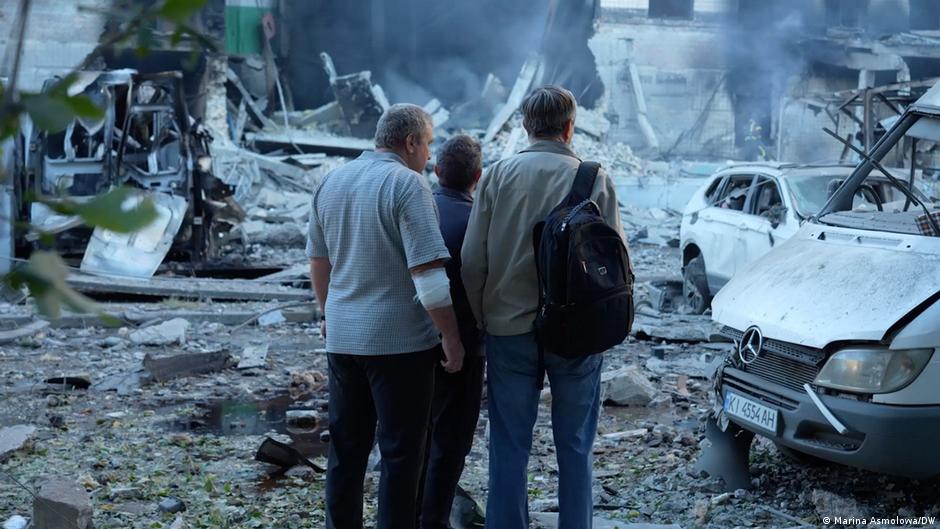
For months, Kyiv remained comparatively calm compared with Ukraine’s active front lines. That has changed. As Russian strikes on the capital intensify, the city is effectively becoming a front line itself.
Kyiv’s four million residents face a critical shortage of shelters, so the subway system has become a nightly refuge. Around 10 p.m., families lay out mattresses and pitch small tents on the platforms. Children huddle against adults, while pets seek safety beside their owners or curl up among strangers in the cold underground corridors.
“We’re alive,” Halyna told DW, clutching her five-year-old son, Roman. “We’ve been lucky again.” Even on nights without air-raid sirens, she brings him to the nearest subway station. Their home in Lukyanivka—a district Russian forces have struck repeatedly over the war’s four years and eight months—no longer feels safe.
“These Sick Monsters Don’t Care Who They Kill”
In September, 14-year-old Daniel Umanskyj was doing homework in his room when a Russian drone struck his apartment building in Kyiv’s central Pechersk district. Neighbor Vlad was in the hallway with his daughter at the moment of impact. “We were late that day—and it saved our lives,” he said. “Daniel’s death is a tragedy.” He added: “These sick monsters don’t care who they kill.” Residents have laid flowers outside the damaged building in Daniel’s memory.
Russian forces also strike places where children gather. In early October, a drone hit a school building in southwestern Kyiv. Fortunately, students and teachers were already sheltering when the attack occurred.
“We have continued in-person instruction because our shelter can hold more than 500 students,” said principal Valentyna Chorna. “Since there is enough space for everyone, pupils in grades one through nine can attend classes.”
Danger at Home, in School, and Everywhere in Between
Whether classes proceed depends not only on parents and administrators, but also on shelter availability and how long air-raid sirens sound. If an alarm goes off in the morning while children are still home, they may miss school entirely.
“This places an enormous burden on parents,” said a colleague from DW’s Kyiv bureau, whose daughter attends school. “You have to go to work while your child stays home alone.”
“Even the walk to school is dangerous, since an air-raid alarm can sound at any moment,” she said. Her daughter’s school is near the Antonov aircraft factory. One day, the girl texted: “You can’t imagine what a huge explosion that was!” “I don’t know whether something was shot down or if there was a strike somewhere,” the mother added. “Things like that truly frighten children.” Staying home carries its own dangers, too.
In September, a Russian drone struck their building. The apartment was undamaged, and her daughter was at school, but the incident underscored how much survival now depends on chance. “When the siren sounds, no one knows who will be spared,” she said.
Kyiv’s Residents Endure
Russian attacks have grown deadlier in 2026. Kyiv’s military administration reports that 140 people were killed in the capital during the first eight months of the year, compared with 172 for all of 2025. If the trend holds, 2026 could become Kyiv’s deadliest year since the full-scale invasion began in 2022.
Strikes on warehouses have caused supermarket shortages not seen since the war’s early months. Emergency power outages resumed in late September, and a Russian attack paralyzed the subway. With energy infrastructure under repeated strike, it remains unclear whether the capital can reliably provide heat, electricity, and water through the coming winter.
Despite efforts to make Kyiv uninhabitable, 72 percent of residents told the Kyiv International Institute of Sociology in September that they are prepared to endure the war for as long as necessary. Authorities continue working to preserve everyday life, including a shortened curfew now running from 1 a.m. to 5 a.m.
Some facilities may continue operating during “yellow” alerts. During “red” alerts, however, everyone must seek shelter immediately—a precaution that could mean ballistic missiles, cruise missiles, or large-scale combined attacks.
Massive Aerial Attack Strikes Ukraine
To view this video please enable JavaScript, and consider upgrading to a web browser that supports HTML5 video
Also Read
- Security Alert: Jihadist Groups Reportedly Call for Attacks During Protests in Portugal and Spain
- Brighton’s Historic West Pier Suffers Further Collapse as Storm Austen Hits South Coast
- Microsoft’s AI Diagnosis Tool Surpasses General Physicians in Complex Cases
- First Lady Melania Trump Facilitates Humanitarian Ceasefire in Occupied Ukrainian City of Oleshky