




[Bank of Canada Expected to Hike Rates Amid Stronger Inflation and Oil Prices]
- Markets price in 80% chance of a 25bp rate hike to 2.50%.
- Higher oil prices and rising inflation expectations support a hawkish outcome.
- Resilient growth offsets trade-related risks.
- BoC decision due Wednesday at 13:45 GMT; Macklem speaks at 14:30 GMT.
Rate hike largely priced in
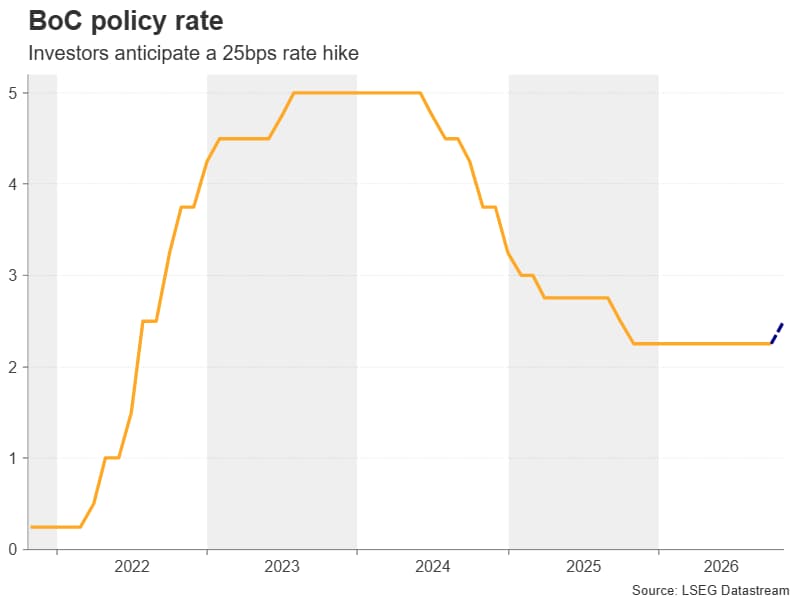
The Bank of Canada is widely expected to raise its overnight rate by 25 basis points to 2.50% on Wednesday, October 28—a first increase in a year. This move aligns with a broader trend among central banks tightening policy amid rising inflation linked to higher energy costs.
The policy rate currently stands at 2.25% following a series of hold‑ins after the Bank’s 25‑bp cut in October 2025. A Reuters poll shows a majority of economists expect a hike, while overnight index swaps imply roughly an 80% probability of a move. Most forecasts also anticipate a further rate increase by the end of March, sharply reversing earlier expectations of rate stability through the end of 2026.
The recent repricing followed comments by BoC Governor Tiff Macklem, who indicated that inflation forecasts are likely to be revised upward in the upcoming Monetary Policy Report. The Bank’s latest business and consumer surveys reveal rising inflation expectations, deepening concerns that higher energy prices could broaden pricing pressures.
With a hike now largely priced in, investors are increasingly watching the Bank’s updated forecasts and guidance, which could determine whether markets strengthen expectations for further tightening beyond this meeting.
Oil-driven inflation remains the key concern
The recent surge in oil prices has become a central issue for policymakers. Brent crude briefly rose above $117 per barrel this month amid ongoing Middle East tensions, raising fears that higher energy costs could spark broader inflationary pressures.
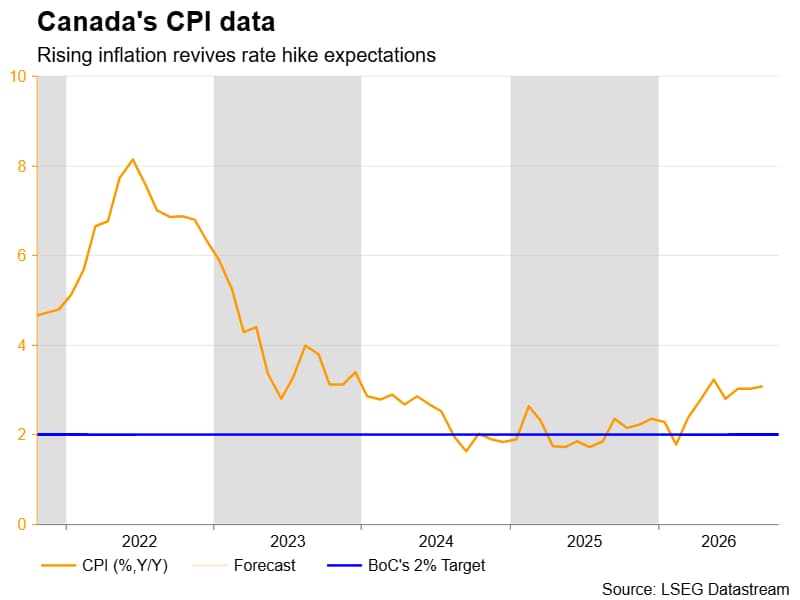
September inflation accelerated to 3.1%, slightly above the upper bound of the Bank’s 1%‑3% target range. Much of the rise reflects higher energy prices, while core inflation pressures have remained relatively contained. The core challenge is whether energy‑driven inflation will spread more widely across the economy. Higher fuel prices push up transportation, production, and operating costs, creating the risk of second‑round effects on prices and wages. The Bank’s Business Outlook Survey shows firms reporting higher inflation expectations, underscoring concerns about longer‑term inflation persistence.
Together, elevated headline inflation, soaring energy costs, and rising inflation expectations strengthen the case for tighter policy and increase the likelihood that the Bank will revise both inflation and growth forecasts upward this week.
Growth remains resilient despite trade headwinds
Despite an increasingly hawkish tone, the economy has proved more resilient than many anticipated. Second‑quarter GDP growth outperformed expectations at 3.3%, while exports have recovered despite trade frictions with the United States following a recent breakdown in negotiations. Consumer demand has also stayed robust, with retail sales up 1.2% in August and preliminary data indicating another 0.7% rise in September.
The resilience in growth and spending indicates the economy has absorbed trade‑related shocks better than the most optimistic forecasts suggested. Recent figures show roughly 2% GDP growth in the third quarter, reinforcing the case for a rate hike this week.
However, policymakers should not ignore emerging signs of moderation. BoC surveys reveal businesses worried about tariff impacts on investment and hiring, and Reuters poll medians anticipate growth will slow to 1.0% in 2026 before rebounding to 1.7% in 2027.
The labour market has softened. Employment fell by 68,300 in September, marking a second consecutive monthly decline, while unemployment edged higher. Wage growth slowed to about 2.3% year‑over‑year from 3.3% a year earlier, indicating labour‑market pressures are far weaker than during the post‑pandemic inflation surge.
USDCAD outlook hinges on guidance
The Canadian dollar has been supported by higher oil prices and rising expectations for a subsequent BoC rate increase. The recent repricing also narrowed the US‑Canada two‑year yield spread, shrinking part of the US dollar’s rate advantage.
Although the Federal Reserve is expected to hold rates steady this week, US inflation remains elevated and markets retain room for further tightening. In contrast, consensus expects the Bank of Canada to add only a limited number of additional hikes after this meeting.
Consequently, a 25‑bp hike accompanied by higher inflation outlooks and openness to another increase by March could reinforce the recent narrowing of the policy gap and push USDCAD below 1.4000 toward the 200‑day moving average near 1.3880. A cautious signal, however, could refocus markets on tighter US policy, allowing USDCAD to rise toward 1.4100 and possibly test the eighteen‑month high near 1.4230.

Also Read
- XRP Ledger Activity Surges to Six-Month High as Transaction Volume Spikes 1,717%
- Strategy (MSTR) Pauses Bitcoin Buying and Spends $205 Million on Preferred Stock
- Five Central Banks, Big Tech Earnings, and Oil Volatility Drive a Week of Cross-Asset Repricing
- Central Banks Are in No Hurry – Action Forex