



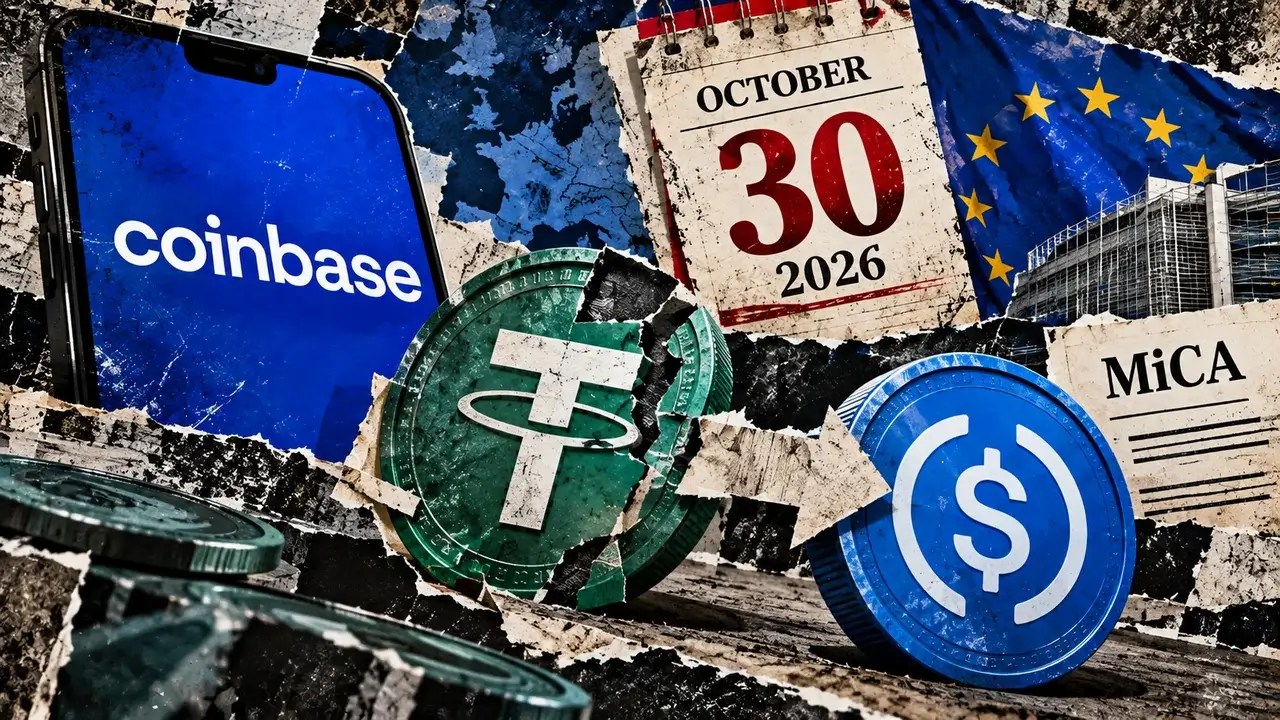
Coinbase will automatically convert 14 restricted crypto tokens held by European customers on October 30, including Tether’s USDT.
The exchange notified affected retail users in the European Economic Area (EEA) that they must withdraw their holdings before the deadline or have balances converted into Circle’s USDC or another supported asset where suitable.
The restrictions cover USDT, PayPal’s PYUSD, World Liberty Financial’s USD1, DAI, PAX, GUSD, GYEN, BUST, UST, RAI, PAXG, MUSD, USDS, and TGBP. Coinbase has already halted purchases, sales, and conversions involving these assets, leaving withdrawals to supported external wallets as the only option for customers wishing to retain them.
The exchange attributed the move to the European Union’s Markets in Crypto-Assets Regulation (MiCA), which requires issuers of qualifying stablecoins to obtain regulatory authorization. Coinbase stated the transitional period for stablecoin issuers expired on July 1, 2026, without an extension, preventing it from continuing to support tokens whose issuers lack the required approval.
The decision could further strengthen Circle’s position in Europe’s regulated stablecoin market by directing balances away from rival tokens, including Tether’s USDT. However, Coinbase has not disclosed the value of affected customer holdings, making the potential scale of conversions unclear.
Coinbase Warns Late USDT Deposits May Become Unrecoverable
The deadline follows an October 8 opinion from the European Securities and Markets Authority (ESMA), which directed authorized crypto firms to cease providing services involving stablecoins that fail to meet MiCA requirements.
The regulator extended its expectations beyond trading to custody, transfers, portfolio management, and other crypto services. It instructed national authorities to address remaining exposures within three months, effectively setting January 8, 2027, as the outer deadline while permitting earlier restrictions.

Coinbase’s October 30 cutoff therefore arrives well ahead of that regulatory limit and introduces additional risk for customers who continue using previously supported deposit addresses.
The exchange warned that it will not credit customer accounts for affected assets sent after the deadline, and that such deposits cannot be traded or transferred and will be excluded from the automatic conversion process.
The company said it may be possible to recover those assets through its unsupported-asset recovery service, although eligibility depends on the token and blockchain network involved. Coinbase offers no guarantee that the funds can be retrieved. Its published recovery terms charge 5% on any recovered assets exceeding $100, plus applicable network fees.
Meanwhile, automatic conversions will occur at prevailing market rates, potentially affecting customers holding assets valued in currencies other than the US dollar. The restricted list includes PAXG, a gold-backed token, and GYEN, which tracks the Japanese yen.
Coinbase also warned that exchanging one crypto asset for another could trigger tax obligations in certain jurisdictions, even where the conversion occurs automatically.
The exchange’s Luxembourg subsidiary, which serves EEA customers under a MiCA authorization, said it will continue reviewing restricted tokens as their regulatory status changes. Issuers that subsequently obtain the required approvals could regain access to Coinbase’s European customers, though the exchange said any future restoration of support will not reverse conversions completed under the October 30 deadline.
Also Read
- Galaxy Digital Sees Bitcoin Accumulation Opportunity as Market Signals Bottom
- EUR/USD Extends Losing Streak as Fed Hawkish Bets, AI Investment Flows, and Geopolitical Tensions Prop Up the Dollar
- USD/JPY Tests Key Resistance as Fed and BoJ Meetings Loom Large
- AI Credit Risk Soars as Lenders Demand More Than Just an AI Tag, JPMorgan Warns