



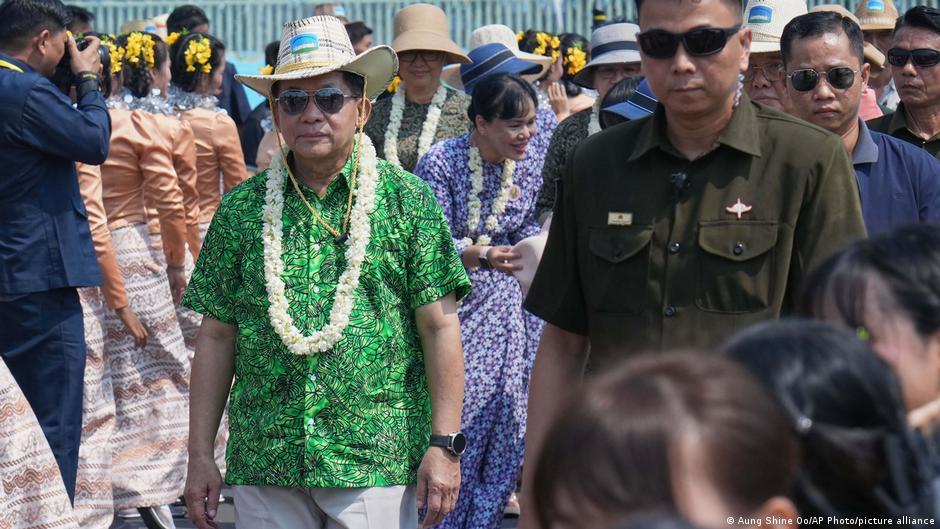
Since September, the United States has quietly resumed talks with Myanmar’s military‑backed government. State Department official Michael Vance has held two rounds of discussions, first in Naypyitaw and later in Tokyo earlier this month.
U.S. objectives include curbing online scam operations, securing the release of imprisoned American businessman Adam Castillo, and seeking access to Myanmar’s rare‑earth deposits, a sector currently dominated by rival China.
At the same time, several Southeast Asian nations are reassessing their policy of isolating Myanmar’s military leaders, and have already re‑established direct diplomatic contacts.
The European Union, however, continues to reject the legitimacy of the military junta in the war‑torn country. It remains unmoved by the 2025‑2026 election that installed chief Min Aung Hlaing as president, with the military still wielding control over the political system.
Human Rights Watch’s Elaine Pearson on Myanmar election
To view this video please enable JavaScript, and consider upgrading to a web browser that supports HTML5 video
EU’s sanctions still in force
In response to Myanmar’s February 2021 military coup, the EU suspended direct financial aid, imposed targeted sanctions, and sharply reduced diplomatic engagement with the military authorities.
Current EU sanctions target 105 individuals and 22 entities linked to the military. The measures were extended for another 12 months in April.
Simultaneously, Brussels provides humanitarian aid to displaced communities and Rohingya refugees and supports civil‑society groups.
Thailand-Myanmar border clinic helps people fleeing war
To view this video please enable JavaScript, and consider upgrading to a web browser that supports HTML5 video
The EU has also refrained from withdrawing Myanmar’s preferential trade status, citing concerns over the impact on workers—especially the young women employed in the garment sector. Bilateral trade last year reached roughly €4 billion ($4.46 billion), up from €3.4 billion in 2019.
Brussels supports ASEAN’s peace deal
The civil war sparked by the 2021 coup has claimed an estimated 100,000 lives. Rebel groups still control or contest large parts of the country, and more than four million people have been internally displaced, according to United Nations data.
The EU “continues to uphold its policy of non‑recognition of the current military regime,” citing “ongoing violence and attacks against its own population,” an EU spokesperson told DW.
Simultaneously, the bloc is closely monitoring developments in the talks and positions of the United States, Japan, ASEAN members, and other major actors engaged with representatives of Myanmar’s military regime.
The EU also supports ASEAN’s efforts, notably the Five‑Point Consensus, which has yet to be fully implemented, the spokesperson added, referring to the peace initiative launched by ASEAN in 2021.
Myanmar diplomats reach out to European partners
Following the coup, ASEAN took the unprecedented step of excluding Myanmar’s military leaders from its highest‑level meetings after the junta failed to implement the regional peace plan.
However, ASEAN’s stance is evolving, with some members—most notably neighbor Thailand—signalling growing frustration over the lack of progress toward ending Myanmar’s civil war.
New Thai labor scheme offers hope for Myanmar refugees
To view this video please enable JavaScript, and consider upgrading to a web browser that supports HTML5 video
Thai Foreign Minister Sihasak Phuangketkeow last week welcomed Washington’s renewed engagement and indicated that ASEAN members would hold substantive discussions on Myanmar’s future at their upcoming summit in Manila.
Myanmar’s authorities are also seeking to break their diplomatic isolation. In September, leader Min Aung Hlaing gave an interview to Time magazine—the first with a major Western publication since the coup—apparently as part of an effort to rebuild relations with Western governments.
On October 22, the London‑based human‑rights group Burma Campaign UK accused the British government of a “significant shift in approach” after the UK Foreign Office hosted Win Zeyar Tun, charge d’affaires of Myanmar’s military‑controlled embassy in London, at an ASEAN diplomatic gathering days earlier.
An article published this month by Intelligence Online reports that the regime’s chargé d’affaires in Brussels, Khin Thidar Ay, has also sought contacts with European politicians, including Czech MEP Ondrej Dostal, a member of the European Parliament’s delegation for Southeast Asia.
EU’s isolation ‘has achieved relatively little’
Kristina Kironska, an expert on EU policy toward Myanmar from Palacký University Olomouc in the Czech Republic, told DW that the EU has little reason to follow Washington’s apparent shift toward engagement with the Myanmar junta.
The US strategy “appears to be pursuing specific interests” such as rare‑earth mining and combating cybercrime, she said.
Thailand: Rare earth mining pollutes rivers
To view this video please enable JavaScript, and consider upgrading to a web browser that supports HTML5 video
However, the most significant rare‑earth mining operations are now controlled not by the military but by Myanmar’s ethnic rebels, notably the Kachin Independence Organization in Kachin State. Therefore, “it remains to be seen what the US can achieve through negotiations with the junta,” she said.
The EU has long positioned itself as a champion of democracy and human rights in Myanmar, “so abandoning this now because the US is exploring a new, perhaps more transactional approach would undermine the EU’s credibility,” Kironska told DW.
“At the same time, isolation has achieved relatively little. The question is therefore not whether the EU should engage, but rather with whom and under what conditions,” she added.
Balancing act between Myanmar’s rebels and junta
The EU is forced to weigh risks to its own influence. If Washington, ASEAN governments, and other regional powers increase their engagement with Myanmar’s authorities, the EU risks becoming increasingly marginal in discussions about the country’s political future.
Yet deeper engagement with the military could undermine Brussels’ relations with Myanmar’s democratic opposition and ethnic resistance groups, many of which control substantial territory.
“The key question for Brussels is whether it can remain a credible defender of democratic change while still maintaining a meaningful voice in the negotiations that will shape Myanmar’s future,” said Sabe Soe, director of the NGO Burma Centre Prague, to DW.
One possibility, according to Soe, is for Brussels to keep sanctions on military leaders and their businesses while expanding diplomacy through ASEAN, the UN, and other regional partners. The EU could also condition any easing of restrictions on humanitarian access, improvements in political freedoms, and progress toward peace.
Soe also suggested that the EU could pursue economic engagement in territories administered by revolutionary and ethnic resistance forces, offering an alternative to engagement centred on the military authorities in Naypyidaw.
This approach would allow the EU to remain involved in Myanmar’s future without necessarily recognizing its military‑backed government, she said.
For now, Brussels appears to have little appetite for a fundamental policy rethink. That could change, however, as more governments reopen their doors to Myanmar’s generals.
Edited by: Darko Janjevic
Also Read
- Government Accepts Rs22.85 Billion in GOP Ijara Sukuk Bai Muajjal Auction
- Nanotyrannus Skeleton ‘Jodi’ Commands $47.3 Million at Sotheby’s New York Auction
- US Surgeon Executes First Telerobotic Prostatectomy Between Two US Hospitals
- Saudi Arabia Bolsters Yemen Humanitarian Aid with Major Projects During Presidential Visit