




In space, no sound travels — not a scream, nor a meow. This silence applied equally to Félicette, the Parisian stray who became the first and only cat to complete a suborbital flight in 1963, as it does to the colossal Cat’s Head Nebula, now showcased in striking new imagery from the Hubble and James Webb Space Telescopes.
Rising from the Carina Nebula roughly 7,500 light-years from Earth, the Cat’s Head Nebula is a pillar of gas and dust sculpted by stellar radiation. Its silhouette vaguely resembles a feline sitting with its back turned, glancing over its shoulder to reveal a single crimson eye — a young star embedded deep within the dust, actively reshaping its surroundings.
Structures like these form when intense radiation from hot, young stars illuminates and erodes the surrounding material. They are visually striking and easily identifiable; should this cosmic cat tire of its pose, it need only traverse the Carina Nebula to find a neighboring globule resembling an open box — a fitting refuge for any cat.
In a Halloween-season release, the European Space Agency (ESA) published three distinct perspectives of the nebula: one from Hubble in optical light, and two from Webb’s infrared instruments. The trio of views, presented below, peel back layers of the nebula across different wavelengths, growing progressively more spectral as color fades from the scene.
Hubble’s Optical View

Observing in visible wavelengths accessible to powerful ground-based telescopes, Hubble highlights the dense dust pillar that has withstood the ultraviolet onslaught from nearby stars. The wispy fringes at the column’s right edge mark where stellar radiation is evaporating gas, gradually eroding the structure.
The surrounding glow — spanning blue, yellow, orange, and red — traces where starlight excites different gas molecules, including oxygen, hydrogen, and sulfur, according to ESA. The mechanism mirrors how atmospheric molecules produce colorful auroras when struck by solar particles, albeit on a vastly grander scale.
Webb’s Near-Infrared View

Webb’s Near-Infrared Camera penetrates the thinner outer dust layers to reveal the densest material at the pillar’s core. A multitude of background stars and galaxies emerge, their infrared light cutting through the obscuring matter.
This perspective exposes a more complex, turbulent column, illustrating how stellar radiation carves the nebula’s interior as well as its edges. Webb also captures a disembodied, hand-like structure to the left of the pillar, appearing to reach toward its cosmic counterpart.
Webb’s Mid-Infrared View
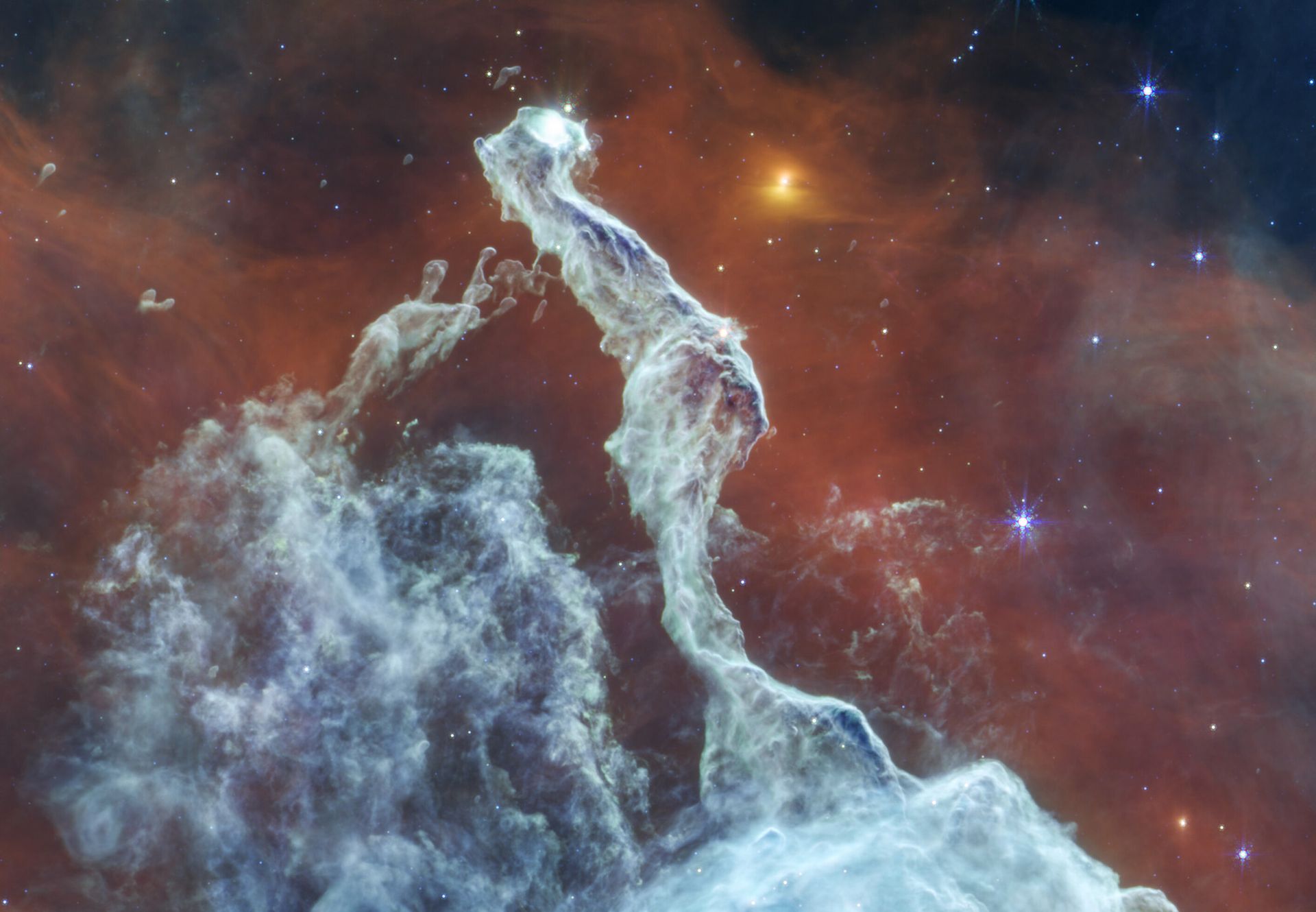
The final image, captured by Webb’s Mid-Infrared Instrument, isolates the nebula’s ghostly core, rendering little beyond smoky, bluish emission. ESA identifies this glow as polycyclic aromatic hydrocarbons — carbon-hydrogen molecules typically associated with combustion processes.
While most starlight vanishes in this wavelength, a puzzling bright orange speck appears to the right of the pillar. Its nature and connection to the nebula remain unknown, according to ESA, presenting a genuine mystery for astronomers to investigate.