



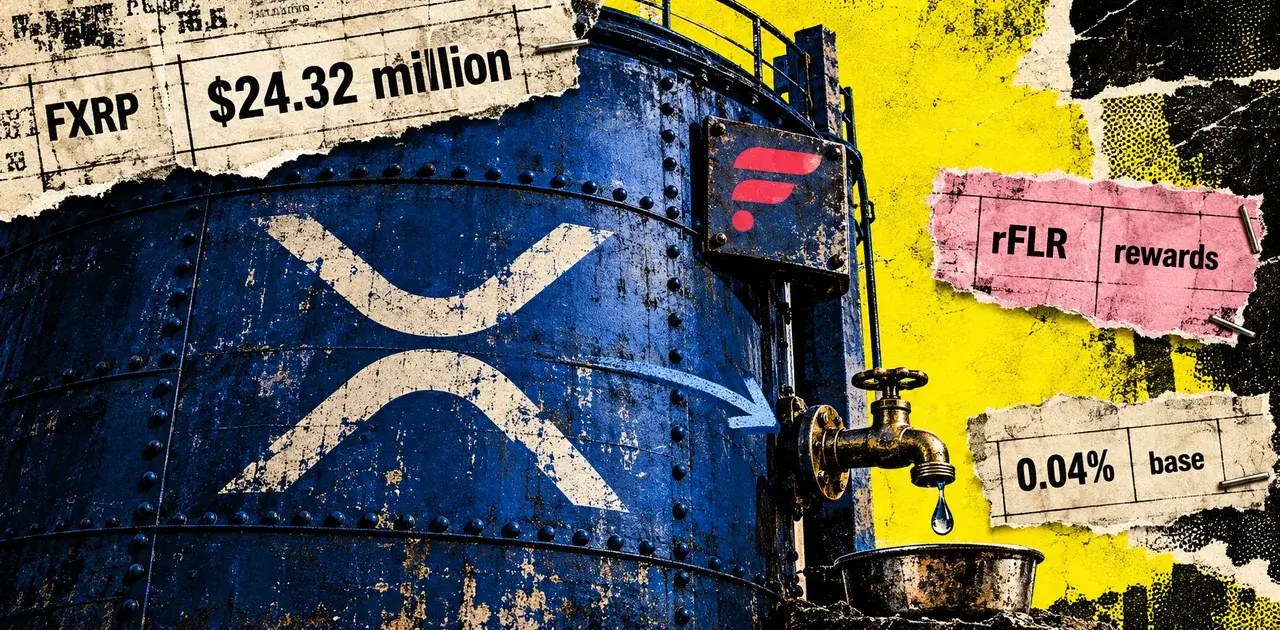
[Kinetic’s $24 Million XRP-Linked Lending Market Posts 0.04% Base Rate, Supply APY Higher with Rewards] On November 1, Kinetic’s FXRP lending market on Flare supplied approximately $24 million, while lenders earned a base annualized rate of roughly 0.04% before any rewards were applied. For XRP holders, the sheer supplied balance provides only a limited indicator of income generated by borrower-funded credit.
Kinetic operates as a lending protocol on the Flare network, where FXRP represents an XRP-linked exposure via the FAssets system. The official market page recorded $24 million in supplied FXRP and $2 million in borrowed amounts during the November 1 observation.
The surrounding stablecoin market revealed a contrasting picture. FlareSignal’s November 1 snapshot showed FXRP utilization at 6.7%, significantly lower than USDT0’s 92.8% utilization. This disparity underscores that metrics for borrowing assets, demand for borrowing them, and the income paid to holders require distinct methodologies.
What the 0.04% rate measures
The FXRP supply APR in this snapshot stood at approximately 0.04%, whereas the FXRP borrower APR was closer to 0.7%. The supply figure reflects a straightforward annualized base rate measured at the snapshot time.
Rewards significantly alter the apparent return. During the November 1 capture, Kinetic’s official FXRP row displayed a 0.59% supply APY alongside a distinct 0.55% rFLR reward component. The reward figure is nested within the yield comparison; summing it with the headline supply APY would inaccurately inflate the total return.
DefiLlama’s isoFXRP pool page independently labeled its supply APY at 0.57% as a 30-day average, decomposing it into a 0.04% base component and a +0.54% reward component labeled WFLR. Differences in rounding and observation windows prevent a precise direct reconciliation with the application’s figures.
Supplied FXRP may also enable collateral borrowing when activated, aligning with Kinetic’s lending documentation which permits asset submission as collateral to secure other assets. Borrowers are required to remain overcollateralized. While this utility offers access to credit, any cash return remains a separate benefit from the base interest earned on the supplied asset.
The USDT0 figure reflects aggregate market debt. Kinetic’s directory distinguishes its assets and infrastructure, yet attributing that debt specifically to FXRP collateral requires granular account-level data.

Supplied FXRP may also support borrowing when enabled as collateral and permitted by market rules. Kinetic’s lending documentation describes suppliers enabling assets as collateral to borrow other assets, with borrowers required to remain overcollateralized. Someone seeking stablecoin liquidity may value an XRP-linked collateral position while having little use for an additional FXRP loan.
The observed reward component was much larger than the quoted base rate.
DefiLlama’s Kinetic adapter calculates base yield from supply rates and rewards from separate emissions and token prices. That separation identifies the economic question behind the headline: how much comes from borrowers paying for credit, and how much comes from incentive distributions? The observed reward component was much larger than the quoted base rate.
Flare’s XRP minting documentation describes sending underlying XRP to the Core Vault on the XRP Ledger, followed by an executor finalizing the FXRP mint on Flare using verified payment evidence. The FAssets system connects that representation to underlying assets and collateral arrangements.
The return journey has conditions too. Under the ordinary holder redemption process, FAssets are burned and underlying payment is initiated through the protocol. Fees and redemption-ticket limits can apply. If an agent fails to pay, compensation can involve collateral after proof of nonpayment.
Kinetic’s Nov. 1 observations show substantial FXRP supplied relative to FXRP loans, with a reward component much larger than base lender interest. For this lending market, the test for lasting demand is continued use of credit and the interest borrowers pay for it. The supplied balance establishes market size; those cash flows would establish a stronger foundation for lender income.
Also Read
- PBOC Deputy Governor Vows to Expand Yuan’s Global Reach Via Hong Kong Hub
- Binance Auto-Deleveraging Risk: How a Profitable Bitcoin Hedge Can Still Be Reduced
- Brent Crude Slides 5% Amid Renewed Middle East Peace Hopes
- Tether Freezes $4.5M in USDT Tied to Mercado Bitcoin Breach; Hacker Holds $46M in Crypto