




Binance’s security breach hit a crypto market already experiencing a contraction in its stablecoin sector. By Nov. 3, DeFiLlama’s dashboard showed stablecoin market capitalization at $293.8 billion, a decline of over $10 billion in 30 days.
Binance’s Nov. 3 report estimated that roughly $6.34 billion in assets were impacted on Oct. 29, with the exchange stating it would absorb the financial loss.
The Oct. 29 incident also rattled decentralized lending after an exploiter‑linked wallet supplied USDT to the Aave protocol.
Aave’s risk provider, LlamaRisk, reported that the wallet deposited 60 million USDT and borrowed 19,762 WETH, valued at about $44.6 million at the time.
LlamaRisk’s Oct. 30 assessment characterized the position as over‑collateralized and subject to normal liquidation procedures, concluding that suppliers were not at risk.
In response, Aave’s guardians froze 175 V3 reserves and 117 V4 reserves. New deposits and borrowing were halted in the frozen reserves, while repayments, withdrawals, and liquidations remained active.
Suppliers could still withdraw existing tokens, but they could not replace them with fresh deposits. The surge in withdrawals drove utilization of large reserves to 92‑100 %, prompting stewards to temporarily lower the upper portion of the interest‑rate curves.
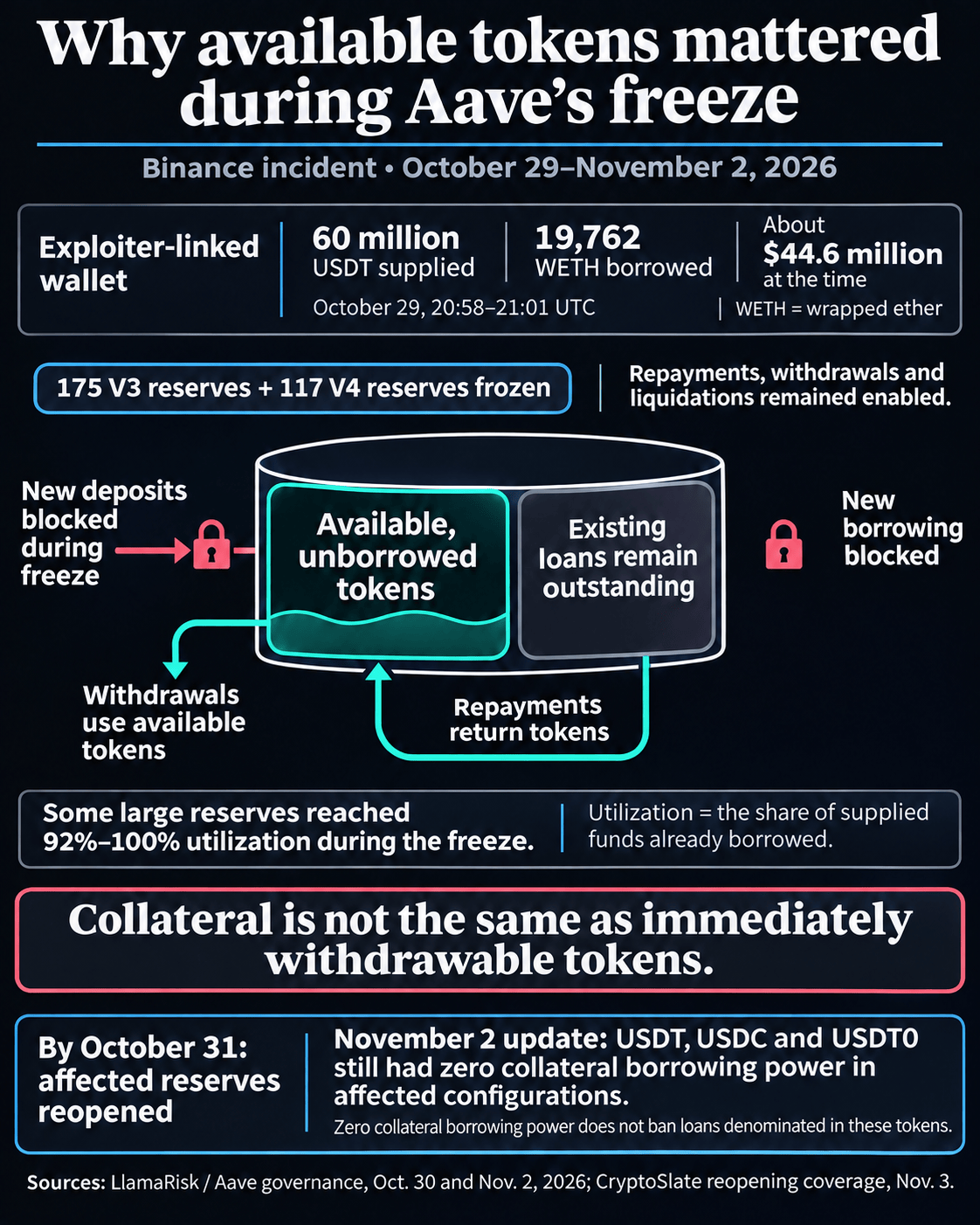
The affected reserves were reopened by Oct. 31. LlamaRisk reported on Nov. 2 that specific non‑stablecoin collateral settings were restored, and the reserves returned to pre‑incident rate curves by Nov. 1.
The wider contraction began before the Binance breach
Among major protocols, Aave recorded the largest dollar decline between Oct. 27 and Nov. 3, with its total value locked falling by about $1 billion to $16.405 billion. Lido followed with a $713 million drop, while JustLend, Morpho, and Sky also saw reductions.
| Protocol | Oct. 27 TVL | Nov. 3 TVL | Decline |
| Aave | $17.435 billion | $16.405 billion | $1.030 billion |
| Lido | $22.557 billion | $21.844 billion | $713 million |
| JustLend | $6.856 billion | $6.419 billion | $437 million |
| Morpho | $11.450 billion | $11.092 billion | $358 million |
| Sky | $5.469 billion | $5.157 billion | $312 million |
Falling token prices can reduce TVL without actual capital outflows, so a lower TVL alone does not confirm a flight of funds or insolvency.
USDT and USDC accounted for roughly $8.4 billion of the 30‑day market‑cap decline, based on DeFiLlama’s rounded figures.
DeFiLlama’s separate historical series, which differs in coverage from the dashboard, fell from $308.8 billion on Oct. 4 to $303.3 billion on Oct. 27.
Issuer redemptions convert circulating stablecoins for fiat, a process distinct from moving tokens off an exchange or between wallets. Freezing stolen tokens also does not automatically remove them from the overall supply.
The practical risk lies in the availability of liquidity where it is needed. Thinner trading pools increase slippage, higher lending withdrawals can lift borrowing costs, and declining collateral prices elevate liquidation exposure.
A healthier outlook would require renewed stablecoin net issuance, a return of lending deposits, lower reserve utilization with more withdrawable tokens, and steadier collateral prices. A rebound in dollar TVL alone would not signal that lending cash had returned.