




Today’s highly anticipated US Nonfarm Payrolls (NFP) report is poised to test the Federal Reserve’s long-term rate outlook, with markets having scaled back expectations for 2027 tightening while maintaining bets on a December rate hike. Despite falling Treasury yields and a sharp equity-market selloff, the US Dollar Index has demonstrated surprising resilience, holding onto critical support ahead of the employment data.
October payrolls are expected to rise by 56,000, following September’s modest 29,000 increase, while the unemployment rate is forecast to remain steady at 4.2%. Average hourly earnings are projected to increase by 0.3% month-over-month. The release arrives against a turbulent market backdrop, raising the key question of whether the labor market data will justify the recent reduction in expectations for Fed tightening beyond December.
- October nonfarm payrolls: forecast +56K, after +29K in September.
- Unemployment rate: forecast to hold at 4.2%.
- Average hourly earnings: forecast +0.3% mom.
Fed Repricing Concentrated in 2027, Not December
The Federal Reserve held its benchmark interest rate unchanged at 3.75–4.00% in October, following September’s increase. While another 25 basis point hike at the December meeting remains the favored market outcome, expectations have fluctuated significantly in recent sessions.
According to CME FedWatch data, the probability of a December hike stood at 70.7% on October 31, climbed to 81.8% on November 4, and subsequently declined to 68.4% in the latest reading. While this retreat from Wednesday’s peak appears substantial, the probability remains only slightly below its late October level. The more meaningful repricing has occurred further along the policy path, where markets have shifted toward fewer cumulative rate increases in 2027.
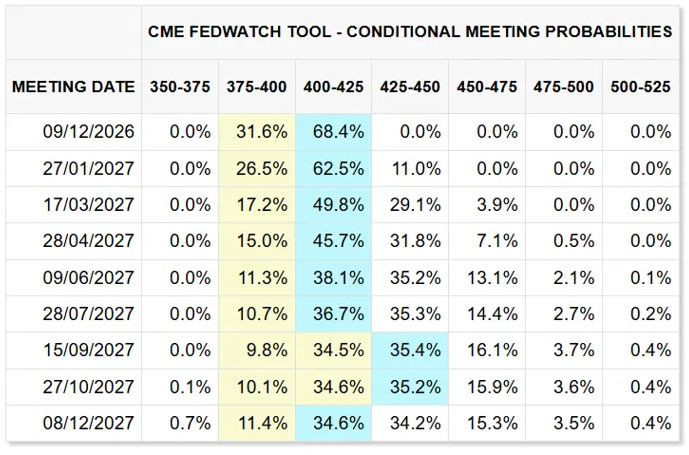
By the March 2027 meeting, the probability of two cumulative hikes has declined from 40.0% to 29.1%, while the probability of just one has increased from 40.2% to 49.8%. The three-hike scenario has also become considerably less likely. This shift extends into the second half of 2027; at the June meeting, two hikes were previously the most likely outcome, but one hike now leads the distribution.
By December 2027, one cumulative hike carries a probability of 34.6%, compared with 34.2% for two hikes. The two outcomes are effectively tied, underscoring how uncertain the eventual policy destination remains. The estimated number of expected hikes by March has declined by approximately 0.28 of a quarter-point increase compared with October 31, with the adjustment growing more pronounced as the horizon extends.
- December hike probability: 70.7% on October 31, 81.8% on November 4, 68.4% on November 6.
- March 2027, two cumulative hikes: down from 40.0% to 29.1%.
- March 2027, one hike: up from 40.2% to 49.8%.
- June 2027: one hike now leads the distribution, where two were previously most likely.
- December 2027: one hike at 34.6% versus two hikes at 34.2%, effectively tied.
- Expected hikes by March: down about 0.28 of a quarter-point versus October 31.
The market is therefore not abandoning expectations for another near-term hike. Instead, it is questioning how much additional tightening will ultimately be necessary. This shift is occurring amid concerns that the post-midterm adjustment in AI investment could reduce some of the demand pressures that have contributed to inflation. However, the available observations do not establish exactly when the longer-term repricing occurred, making it premature to attribute the entire move to the latest equity selloff.
Dollar Holds Up as Treasury Yields Decline
Despite the reduction in longer-term Fed tightening expectations, the Dollar Index has avoided a decisive breakdown. The US 10-year Treasury yield fell toward 4.84% on Thursday, its lowest level in approximately two months, and traded near 4.855% early Friday. Lower Treasury yields would ordinarily reduce some of the Dollar’s interest-rate support, particularly if the decline reflected expectations for less restrictive US monetary policy.
However, German and Japanese government bond yields also fell, limiting the implications for relative interest-rate differentials. The US–German 10-year yield spread widened by approximately 5 basis points over the measured interval, consistent with modest Dollar resilience against the Euro. At the same time, severe equity-market weakness may have encouraged defensive Dollar demand.
The currency evidence, however, is mixed. ActionForex’s daily FX heat map ranked USD as the strongest major currency, followed by CHF, while AUD and NZD occupied the bottom positions. On the weekly measure, CHF led, with USD ranking fourth. Yen showed relatively limited strength on both measures, while Gold was modestly lower early Friday. The Dollar Index itself was also slightly negative for the week.
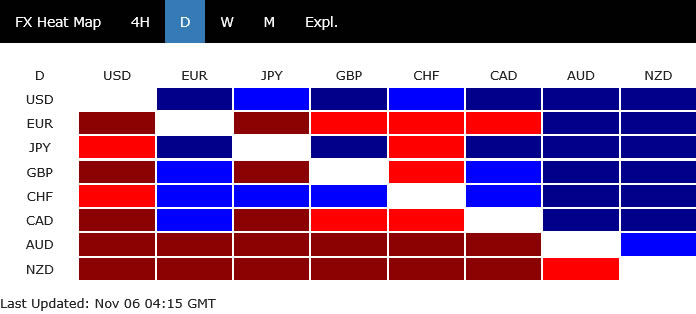
The combination suggests that both relative yield movements and defensive demand may be supporting the Dollar, but neither explanation is sufficient on its own to establish a dominant driver. This is where NFP becomes particularly relevant. A stronger employment report could restore some tightening expectations and lift Treasury yields, providing a more direct interest-rate argument for Dollar strength. Conversely, disappointing employment figures could reinforce the reduction in 2027 rate expectations. Whether the Dollar weakens accordingly may depend on the extent to which renewed risk aversion offsets the impact of lower yields.
NFP Will Test the Fed’s Eventual Policy Destination
The October employment report is scheduled for 13:30 GMT, with forecasts pointing to a 56,000 increase in payrolls, unemployment unchanged at 4.2%, and average hourly earnings rising 0.3% month-over-month. The modest payroll forecast means the release does not need to show particularly strong hiring to exceed expectations. Nevertheless, the composition will matter. Payroll growth, unemployment, and earnings together will provide a more complete assessment of whether labor-market conditions remain compatible with further monetary tightening.
A stronger-than-expected report, particularly if accompanied by firm wage growth, could encourage markets to restore some of the rate increases recently removed from the 2027 outlook. Higher Treasury yields could then provide support for a further Dollar recovery. A broadly in-line report might leave the near-term policy outlook little changed, shifting attention back toward equity-market developments and relative bond yields. A weaker report, especially one accompanied by rising unemployment or softer earnings, could reinforce expectations for a lower eventual Fed rate peak. That would tend to weigh on Treasury yields and the Dollar through the interest-rate channel, although deteriorating risk sentiment could provide an offset.
The reaction is unlikely to depend on payrolls alone. Fed officials have continued emphasizing persistent inflation as a reason for additional restraint. Cleveland Fed President Beth Hammack and Richmond Fed President Thomas Barkin both supported further gradual tightening on Thursday, while expressing different degrees of uncertainty about the appropriate pace. A modest payrolls disappointment may therefore be insufficient to displace inflation as the main policy concern. The most consequential surprise would be one that materially changes the market’s assessment of the balance between inflation risks and labor-market resilience, rather than simply producing a small deviation from the payroll consensus.
ActionForex’s Technical View: Dollar Index, Has the Correction From 102.945 Ended?
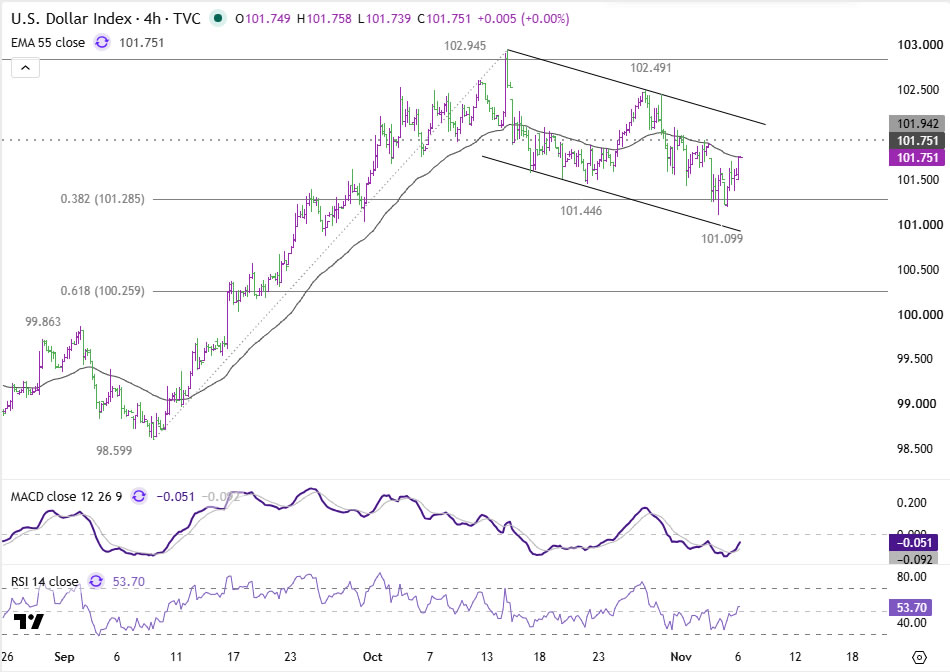
Technically, the main question for the Dollar Index is whether the corrective pullback from 102.945 has completed with three waves down to 101.099. The conditions for a bottom are developing, given support from both the 38.2% retracement of the rise from 98.599 to 102.945 at 101.285, and the daily 55 EMA, currently around 101.232. The subsequent rebound toward 101.75 is encouraging, although confirmation is still needed.
101.75 minor resistance is the first level to monitor. A break there will lean toward the interpretation that the correction from 102.945 has completed, particularly as this level also coincides with the 4-hour 55 EMA. A further break of 102.491 will solidify that case and bring a retest of 102.945 into focus. A decisive break above the latter would extend the larger uptrend from 95.551.
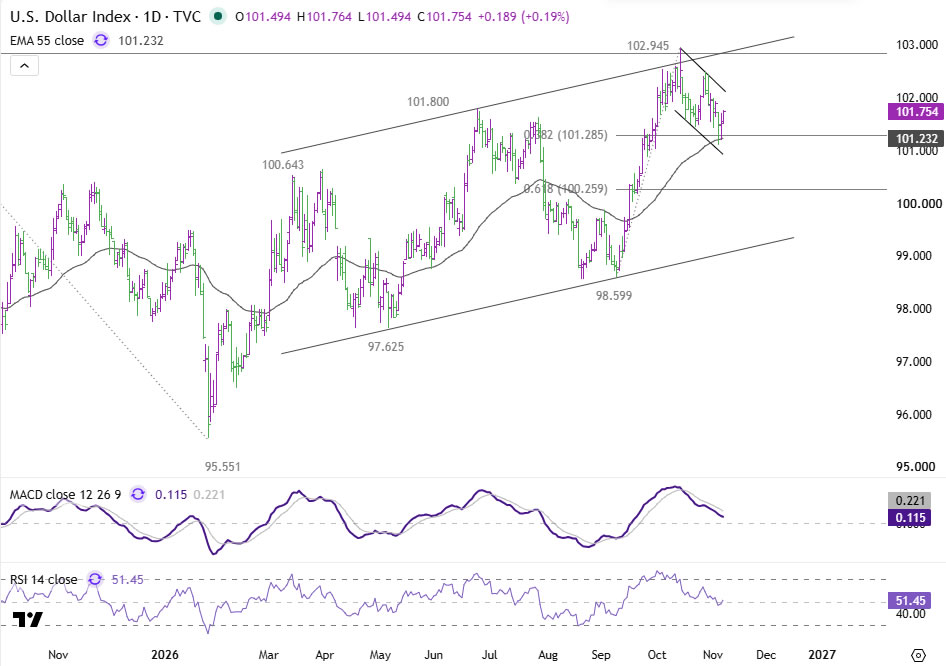
However, the alternative scenario cannot yet be ruled out. The latest decline briefly penetrated the key support area before recovering. A sustained break of the 101.285 Fibonacci level and daily 55 EMA around 101.232 would argue that the fall from 102.945 is probably reversing the rise from 98.599, rather than simply correcting it. In that case, the next downside target would be the 61.8% retracement at 100.259. The distinction between an intraday penetration and a sustained break is important. The Dollar Index has recovered from below the support area, but the durability of that recovery remains to be established.
Payrolls Could Decide Whether Dollar Resilience Becomes a Rebound
The market enters today’s employment report with two competing developments. Expectations for Fed tightening in 2027 have been reduced, reflecting greater uncertainty about how much additional restraint the economy will require. Yet the Dollar Index has held critical technical support despite falling Treasury yields and severe equity-market volatility.
A stronger payrolls report could challenge the recent Fed repricing and help confirm the Dollar’s recovery, particularly if DXY breaks above 101.75 and subsequently 102.491. A weaker report could validate expectations for less tightening, but Dollar weakness would not be automatic if defensive demand persists or international bond yields decline alongside Treasuries. The decisive technical distinction remains whether the 101.285–101.232 support area holds. A sustained break below it would shift attention toward 100.259 and raise the possibility of a broader reversal.
For now, the market has lowered its expectations for the Fed’s eventual destination without forcing the Dollar into a comparable decline. Today’s NFP release will test whether that divergence can continue.
Key Takeaways
- October NFP is forecast at +56K (September +29K) with unemployment at 4.2% and earnings +0.3% mom, releasing at 13:30 GMT.
- The December hike probability is 68.4%, only slightly below 70.7% on October 31, but the 2027 outlook has shifted: March two-hike odds fell from 40.0% to 29.1%.
- The US 10-year yield fell toward 4.84%, a two-month low, yet the Dollar Index held support, helped by a US–German spread widening of about 5bps and possible defensive demand.
- For the Dollar Index, 101.75 and 102.491 are the levels to watch for a completed correction from 102.945, with 102.945 the next target.
- A sustained break below 101.285–101.232 would point toward 100.259 and a broader reversal of the rise from 98.599.