




EUR/USD edged slightly lower on Tuesday, trading around 1.1220 following a modest gains in the previous session. The US dollar continues to strengthen, supported by expectations of a potential US-Iran diplomatic deal, while investors remain focused on the highly anticipated release of US inflation data.
Oil prices dropped to their lowest levels since August, driven by optimism regarding diplomatic efforts to resolve the ongoing Middle East conflict. Donald Trump stated that negotiations are making progress and suggested that new strikes on Iran may not be necessary. Cheaper oil prices help reduce inflationary risks and could eventually offer moderate support to the euro.
The highlight of today’s economic calendar is the October US Consumer Price Index (CPI). Headline inflation is projected to accelerate to 3.9% year-on-year from 3.7% in September, while core inflation is expected to rise to 2.8% from 2.6%. Following the robust employment report, market expectations for a Federal Reserve rate hike in December have increased, with the probability of such a move rising to approximately 82% compared to 76% late last week. Fed officials continue to maintain a hawkish stance, particularly given persistent inflationary pressures within the services sector.
Simultaneously, the euro faces its own set of challenges. Ongoing political and fiscal instability in France continues to weigh on investor sentiment, and reports regarding ECB President Christine Lagarde’s potential early departure add further uncertainty to the outlook for central bank policy. However, declining oil prices and a gradual stabilization of markets following the recent sell-off in the technology sector may help limit further losses in EUR/USD.
Technical Analysis
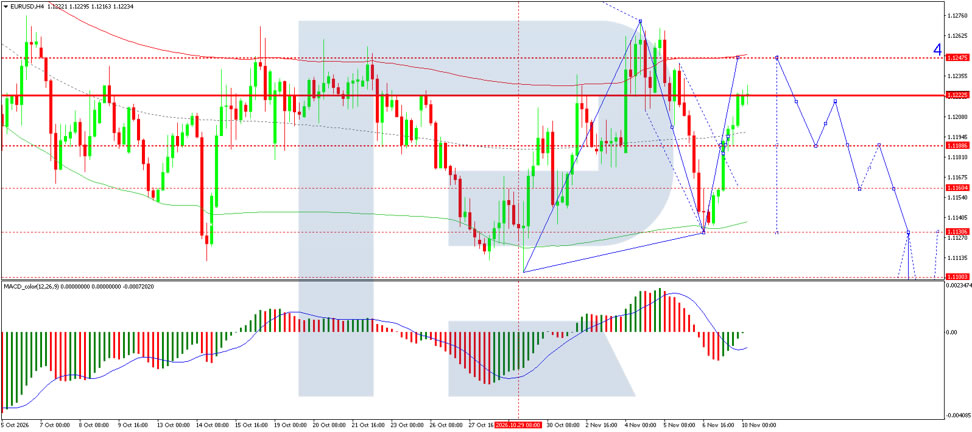
On the H4 chart, EUR/USD continues to exhibit a sideways structure with a downward bias. After declining to 1.1131, the pair recovered and tested resistance at 1.1223. This upward move is viewed as a correction of the preceding downward wave. The nearest target for buyers is 1.1245, which represents the upper boundary of the corrective move. As long as the price remains below this level, conditions remain favorable for sellers to re-enter the market. The MACD signal line is below zero but turning upwards, reflecting a recovery in short-term momentum without confirming a sustained uptrend.
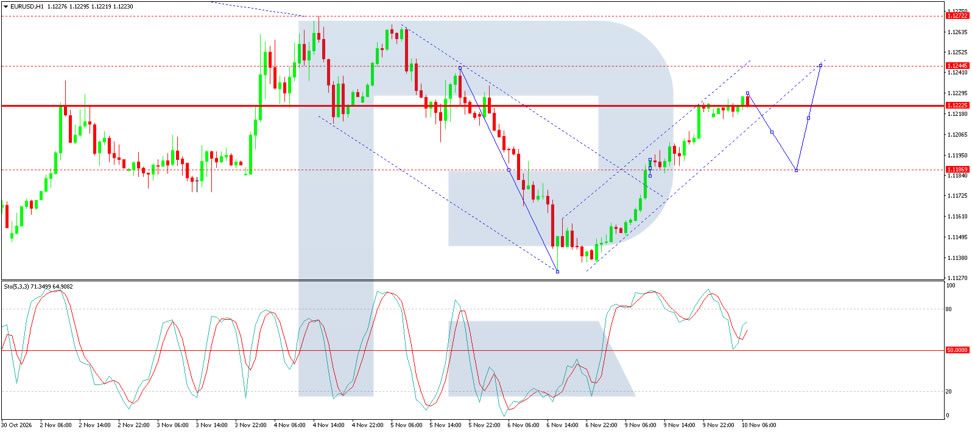
On the H1 EUR/USD chart, an ascending channel has formed following the reversal from the November low. The price is consolidating near 1.1223, indicating a slowdown in upward growth. As of 11 November, the baseline scenario envisages a corrective decline towards 1.1187, followed by a recovery towards 1.1245 if support holds. The Stochastic oscillator is positioned between 50 and 80, with its lines pointing upwards. This supports the possibility of a continued recovery but does not yet confirm the expected pullback.
The price reaction at 1.1187 will be critical in determining the next move. Consolidation below support would disrupt the hourly ascending channel structure and increase the likelihood of a decline towards 1.1160, followed by 1.1131. The deeper target at 1.1100 relates to a continuation of the downward wave beyond the daily scenario. Conversely, sustained consolidation above 1.1245 would weaken expectations of a downward reversal and open the way towards 1.1272. Corrective price action remains the priority for the upcoming session, with the nearest boundaries likely to be tested before a breakout confirms the direction.
Conclusion
EUR/USD is trading slightly lower as markets await the October US CPI release, which could reinforce expectations of a December Fed rate hike, with the probability of such a move currently estimated at around 82%. The dollar is finding support from hawkish Fed commentary and strong recent labour market data, while falling oil prices, driven by optimism over US-Iran negotiations, may support the euro by reducing inflation risks. However, the euro remains weighed down by political and fiscal instability in France, with reports of Christine Lagarde’s possible early departure adding further uncertainty. Technically, the pair remains within a sideways structure with a downward bias, with resistance at 1.1223 and 1.1245, and support at 1.1187. Consolidation below support would increase the likelihood of a decline towards 1.1160 and 1.1131, while sustained consolidation above 1.1245 would open the way towards 1.1272. The upcoming CPI data and the pair’s reaction at key levels will play a crucial role in shaping near-term price action.