




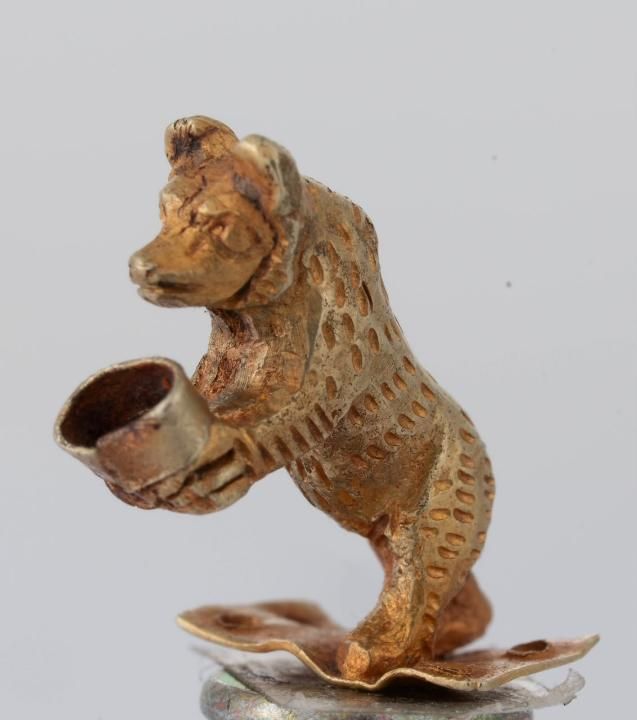
The gold bear would have been worn on a headdress.
(Image credit: Almaty City Administration)
Archaeologists in Kazakhstan have uncovered a unique gold bear figurine within a 2,200-year-old burial mound that ancient looters targeted but failed to fully plunder.
The sculpted bear stands on its hind legs, cradling a pot-like vessel between its front paws. Designed as a headdress ornament, the artifact features holes at its base for attachment to fabric, according to a translated statement from the Kazakhstan government.

The discovery occurred at an Early Iron Age burial mound within the Karagaily burial ground in southern Almaty. Alongside the figurine, researchers found an unexpectedly high concentration of human bones for a single mound.
While other gold animal ornaments have surfaced in the region, this bear figurine is the first of its kind documented in Kazakhstan.
“The sculpted bear figurine is unique to Kazakhstan. No similar finds have been discovered previously,” said Lyazzat Sagyndykova, director of the Almaty Museums Association, which led the excavation. “This discovery allows us to trace cultural parallels across the whole of Eurasia, from the Black Sea region to Altai.”

The figurine dates to the Saka period, named for the nomadic, horse-riding people of Iranian origin who inhabited the Eurasian Steppe and the Tarim Basin of present-day western China. Comparable gold artifacts have emerged from other Kazakh excavations, the statement notes. A headdress element shaped like a leopard previously appeared at the fourth-century B.C. Almaty Kok-Kainar burial ground, while the famous “Golden Man”—a young Iron Age warrior interred in an exceptionally lavish grave—wore a headdress adorned with a gold sheep-shaped ornament.
The specific bear species depicted remains uncertain. Modern Kazakhstan hosts two brown bear subspecies: the Tien Shan or Himalayan brown bear (Ursus arctos isabellinus) in the southeastern Tien Shan Mountains, and the East Siberian brown bear (Ursus arctos collaris) in the eastern Altai Mountains, according to a study published earlier this year.
Preliminary analysis dates the site to the fourth through third centuries B.C. Based on the volume of skeletal material recovered, experts believe the mound—standing roughly 8 feet (2.4 meters) tall and spanning 85 feet (26 meters) wide—may have served as the final resting place for four adults and three children.

“Of particular interest is the unusually large number of human remains in a single burial mound, as such burials are atypical for Kazakhstan,” said Marat Mugalovich Nurpeisov, senior research fellow at the Almaty Museums Association. “As a rule, burial mounds of a comparable size were intended for the burial of one or two people.”
Excavators also recovered fragments of Saka pottery, most scattered by ancient looters who dug a 10-foot (3-meter) pit into the mound.
“Research into the Karagaily burial ground is ongoing,” Nurpeisov added. “To clarify the circumstances of the burial and determine the exact number of individuals interred, further analyses are planned, including the involvement of anthropologists.”
Upon completion of the investigations, select artifacts will go on display at the Almaty Museum.
Also Read
- How AI Is Teaching Robots to Learn New Skills on Their Own
- Stone-Age Children Imprinted Fingerprints on Ancient Artistic Creations
- Physicists propose new quantum device to measure how Earth twists space-time
- Systemic Vulnerabilities: Is Executive Misconduct a Growing Risk in the Semiconductor Industry?