



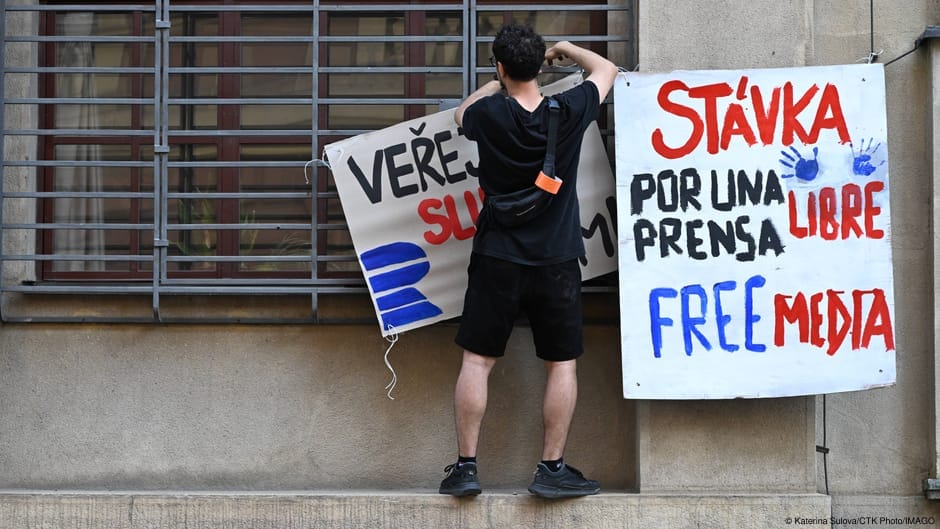
Hundreds of thousands of demonstrators are expected to take to the streets of Prague this weekend to voice their opposition to the Czech government’s controversial plan to push a public media funding reform bill through parliament during a surprise overnight session late last month.
The ruling populist coalition, led by Prime Minister Andrej Babis, fast-tracked the initial reading of the proposed legislation, securing parliamentary approval in the early hours of October 24 at 04:36 a.m.
While the proposed legislation has already sparked widespread demonstrations and labor strikes nationwide, the upcoming rally scheduled for Sunday in Prague’s iconic Letna Park is poised to be the largest demonstration the country has seen in years.
The Core of the Proposal
At the heart of the government’s proposal is the complete elimination of the license fee system that currently funds Czech Television (CT) and Czech Radio (CRo). Under the new plan, both public broadcasters would transition to receiving direct allocations from the state budget.
The three-party ruling coalition—comprising Prime Minister Babis’s centrist ANO party, the far-right SPD, and the radical conservative Motorists—defends the change, arguing that the license fee represents an unfair and regressive tax, particularly impacting their less affluent voter bases.
The coalition argues that direct state funding, despite an estimated 15% budget reduction for CT and CRo in the first year, will force the broadcasters to operate more efficiently. They further point to similar transitions in other European Union nations as evidence of the model’s viability.
Outcry and Criticisms of the Bill
However, critics have angrily dismissed these justifications as hollow pretexts.
Opposition parties, civil society groups, and international media watchdogs accuse the government of attempting to strip public broadcasters of their editorial independence. They argue that the critical and investigative reporting of CT and CRo has long been a thorn in the side of the ANO and SPD parties.
Analysts point out a crucial distinction: while public media models in other EU countries include robust statutory guarantees for long-term financial stability and editorial independence, the Czech government’s proposal offers neither safeguard.
Both CT and CRo have issued stark warnings that the proposed budget cuts will inevitably lead to severe reductions in programming quality and substantial staff layoffs.
Earlier this summer, when the draft bill was first published and met with initial public outcry, Vaclav Stetka of the European New School of Digital Studies described the proposed “dramatic budget cuts” as an act of cultural vandalism.
Furthermore, the decision to fast-track the legislation and restrict extensive parliamentary debate has drawn widespread condemnation from democratic advocates.
“The confrontational approach, the attempts to limit parliamentary debate, and the government’s hostile rhetoric towards journalists and critics have all fueled the public backlash,” explained Otto Eibl, a political scientist at Masaryk University in Brno.
Escalation and Nationwide Backlash
The public backlash was swift and immediate. As the vote proceeded, crowds picketed the parliament building through the night, refusing to let the issue fade.
Since that late-night session, a wave of rallies has swept through cities and towns across the country. These protests, heavily led by student groups, have drawn broad support from labor unions, religious institutions, and representatives of educational and cultural organizations.
Adding to the pressure, staff members at CT and CRo initiated a strike in early November, temporarily disrupting national television and radio broadcasts.
However, Sunday’s upcoming demonstration is poised to significantly escalate the scale of the resistance.
The timing is highly symbolic, occurring just two days before the anniversary of the Velvet Revolution, the historic non-violent protests that ultimately dismantled communist rule in Czechoslovakia in 1989.
The massive Sunday rally is being organized by the civil society group Million Moments for Democracy, which previously mobilized an estimated 300,000 people in 2019 and brought over 200,000 protesters to the streets earlier this year.
Historical Roots of the Public Backlash
The government’s sudden push to fast-track this legislation reflects a strong impatience to fulfill a key campaign pledge ahead of the October 2025 election. It also highlights the persistent political ambition of Prime Minister Babis, who was previously blocked in his first term (2017–21) from taking control of Czech Television’s governing council.
Analyst Vaclav Stetka notes that this persistent assault on public media reflects a broader political culture across post-communist European states, where governments have repeatedly struggled to accept independent media.
“The political elite has never truly accepted the independence of public media,” he asserted.
In the Czech Republic, however, public broadcasters have achieved a unique and revered status, widely recognized as fundamental cornerstones of the nation’s democracy.
This revered status was forged during the historic “Czech TV crisis” of 2000–2001. During that crisis, mass public protests and the occupation of CT’s studios by staff successfully forced the government of the day to back down from an attempt to seize political control of the broadcaster.
“The fight over public service media has become a powerful symbol of the defense of liberal democratic values and institutions,” Eibl added.
Government Response and Shifting Rhetoric
As public anger has mounted, the government has attempted to de-escalate the situation. Prime Minister Babis announced that a revised proposal will be drafted, one that would move public media funding off the direct state budget and formally guarantee editorial independence, opening it up for open debate.
However, critics remain highly unimpressed, pointing out the complete lack of concrete details in the announcement and noting that other key coalition members appear determined to push the original bill forward.
The organizing group, Million Minutes for Democracy, has insisted that public pressure and protests must continue.
“Words are worth nothing,” the group declared. “While citizens stand up for independent media, the government continues to act as if it owns the country.”
Political Risks and Broader Implications
With little sign of public opposition dissipating, the government now faces a critical political crossroads.
While the coalition possesses the parliamentary majority required to override potential vetoes from the upper house Senate and President Petr Pavel, doing so will come at a severe political cost.
Indeed, forcing the legislation through could carry significant political fallout.
Opinion polls indicate that political support for the ruling coalition has already weakened. Furthermore, analysts warn that if the protests expand to encompass broader public grievances—such as the rising cost of living and housing affordability, similar to recent student-led movements in France—the government’s standing could deteriorate dramatically.
“The real risk for the government is that the media issue becomes a lightning rod for broader public dissatisfaction,” explained Martin Vokalek of the Prague-based EUROPEUM Institute for European Policy.
Prospects of Violence and Protest Culture
Prime Minister Babis is acutely aware of the potential risks associated with the highly symbolic dates and large gatherings.
Consequently, the Prime Minister announced that he will abstain from attending the highly symbolic Velvet Revolution anniversary celebrations on November 17, hoping that his absence might help defuse the tense atmosphere.
Despite the high tensions, there is widespread consensus that the protests are highly unlikely to descend into violence.
Analysts point out that public anger remains tightly focused on the public media proposal and is being channeled through the same civic, peaceful traditions that defined the country’s major historical turning points.
“I would not expect French-style scenes,” Vokalek noted, emphasizing that the country’s “large, peaceful, and civic protest culture”—which lent its name to both the Velvet Revolution and the 1993 Velvet Divorce from Slovakia—remains deeply ingrained and strong today.
Also Read
- Fatal Shooting at Washington DC Gym Leaves One Dead and Four Injured
- Nvidia Faces Leadership Transition as CEO Jensen Huang Steps Down Amid Investigation
- Inside JetBlue’s New BlueFirst Cabin: The Standout Features and the Trade-Offs
- UK Secures UFORCE Manufacturing Expansion Through £113 Million National Wealth Fund Investment