



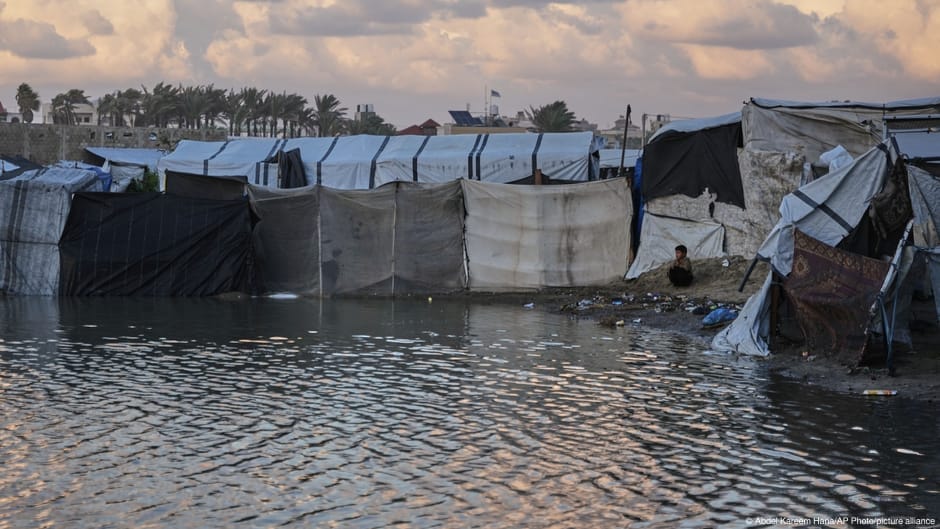
Heavy autumn rains and sharply falling temperatures are compounding the humanitarian crisis for civilians across Gaza. Torrential downpours over the weekend killed at least six people, among them children, according to UNICEF. Local authorities reported that floodwaters inundated at least 70,000 tents and affected more than 200,000 people.
“Over the past two days, we’ve been trying to shore up our tent with sand and rubble to keep the water from seeping in,” Rawan Al-Omari, a mother of two, told DW by phone.
She and her children are sheltering in a single tent west of Jabalia in northern Gaza. “The whole area around us has turned to mud, so even stepping outside the tent has become difficult,” said the 33-year-old. “Everything is exhausting.”
The rains also soaked the tent and every possession belonging to 45-year-old Radi Amin and his three children.
“For three days straight, we tried to dry our clothes while the children shivered in the cold,” he told DW. “It was only on Wednesday, once the sun came out and the air finally warmed, that our belongings began to dry.”
Amin said the downpour had been “a stark reminder of just how dire our situation truly is.”
Meanwhile, humanitarian teams have begun clearing clogged sewer lines and stormwater basins at 60 sites, reaching an estimated 30,000 families, the UN Office for the Coordination of Humanitarian Affairs (OCHA) reported on Wednesday.
OCHA’s partners cautioned, however, that there is nowhere near enough room to relocate people from flooded zones or damaged buildings. “Israeli authorities are restricting Palestinian access to any area behind the so-called ‘Yellow Line,’ which leaves most of Gaza off-limits,” the agency said.
The war that followed Hamas’s attacks on Israel on October 7, 2023, has laid waste to most of Gaza’s infrastructure and housing. According to Gaza’s Health Ministry, more than 74,600 people have been killed in the territory. Israel now controls roughly two-thirds of Gaza, an area delineated by a military boundary known as the Yellow Line.
Hamas continues to administer much of the remaining coastal strip along the Mediterranean, where most of Gaza’s roughly 2 million residents live. The majority have been displaced several times and now shelter in tents, displacement camps or homes considered unsafe. Germany, the EU, the United States and others classify Hamas as a terrorist organization.
Rebuilding Gaza frozen by dispute over disarmament and Israeli troop presence
Under the US-brokered ceasefire of October 2025, US President Donald Trump established the Board of Peace (BoP) to oversee the truce’s implementation along with Gaza’s postwar governance and reconstruction. A joint assessment by the World Bank, the United Nations and the European Union, published in April 2026, estimated that Gaza’s recovery and rebuilding would cost some $71.4 billion (€64.2 billion) over the coming decade.
Yet progress has been minimal, as negotiators remain deadlocked over the terms for Hamas to disarm and for Israel to withdraw its forces. Even with the truce in place, Israel has continued to carry out airstrikes across Gaza. On Thursday, it struck Nasser Hospital in Khan Younis, targeting alleged Hamas members.
For Nathan Brown, a professor of political science and international affairs at George Washington University in the United States, the winter flooding lays bare the impasse in Trump’s peace plan.
“The Board of Peace’s failure to advance reconstruction, or even to secure reliable relief, stems fundamentally from Israeli objections rooted in the insistence that Hamas disarm completely first,” he told DW.
Until Israel’s recent elections, Brown noted, the Board of Peace had shown little appetite for challenging that position: “Now it is willing to speak out, albeit not in very confrontational terms.”
On Monday, the Board of Peace issued a statement declaring that Israel’s measures to improve conditions ahead of winter fell short. “We call on the leadership of the current Government of Israel to act immediately to authorize and facilitate the entry of all the winterization and humanitarian supplies needed.”
The same day, Israel’s Coordinator of Government Activities in the Territories (COGAT) said that, among other deliveries, 12 sewage vacuum trucks for the International Committee of the Red Cross had arrived in Gaza, and that 91,000 tents along with more than 8,200 truckloads of tarpaulins, blankets and winter clothing had entered the enclave in recent months.
The Board of Peace also urged Hamas to honor its commitments under the ceasefire, including surrendering its weapons and transferring governing authority. Hamas swiftly rejected the criticism, accusing Israel of obstructing the peace plan and withholding desperately needed humanitarian supplies.
The United Nations and numerous international agencies have accused Israel of systematically preventing the import of prefabricated shelters into Gaza. The UN said roughly 150,000 tents were waiting outside Gaza, ready to be dispatched once the necessary approvals were granted, a claim Israel rejects.
Israeli Prime Minister Benjamin Netanyahu, who is serving as caretaker leader while a new government is formed following the October 27 elections, denied that Israel bore responsibility for the worsening conditions and blamed Hamas instead.
He cautioned that “so long as Hamas remains in power, it will exploit every dual-use item entering Gaza to entrench its terror regime and expand its military arsenal.”
Civilians pay the price of a man-made crisis
For Gaza’s population, the deadlock as winter approaches means continued hardship.
“Children and families are facing devastating conditions, with around 1.2 million people, including more than 560,000 children, living in critical or catastrophic shelter conditions,” Ahmad Alhendawi, regional director of Save the Children, told DW.
He added that supplies of winter clothing in Gaza remain critically insufficient.
Gaza’s children bear lasting scars three years into war
To view this video please enable JavaScript, and consider upgrading to a web browser that supports HTML5 video
“With available supplies covering less than 1% of what is needed, hundreds of thousands of children will face winter without adequate clothing, blankets or heating, leaving them exposed to hypothermia and respiratory illnesses,” Alhendawi said.
In addition, Nestor Owomuhangi, the UN Population Fund’s (UNFPA) representative to Palestine, told DW that around 400,000 people in Gaza continue to live in areas at high risk of flooding, including an estimated 10,000 pregnant women.
“For women and girls already enduring displacement and hunger, the rain threatens their health, safety and dignity,” he said, adding that “with around 180 babies born every day, mothers and newborns urgently need dry, warm shelter.”
Also Read
- Globe Textile Mills Files Quarterly Financial Results for Q3 FY2025
- Pope Leo XIV Warns Digital Age Threatens Authentic Family Connections
- Costco Recalls Kirkland Signature Real Heavy Whipped Cream Over Potential Cleaning Chemical Contamination
- Storm Charles Unleashes Floods and Chaos Across Southern Europe