



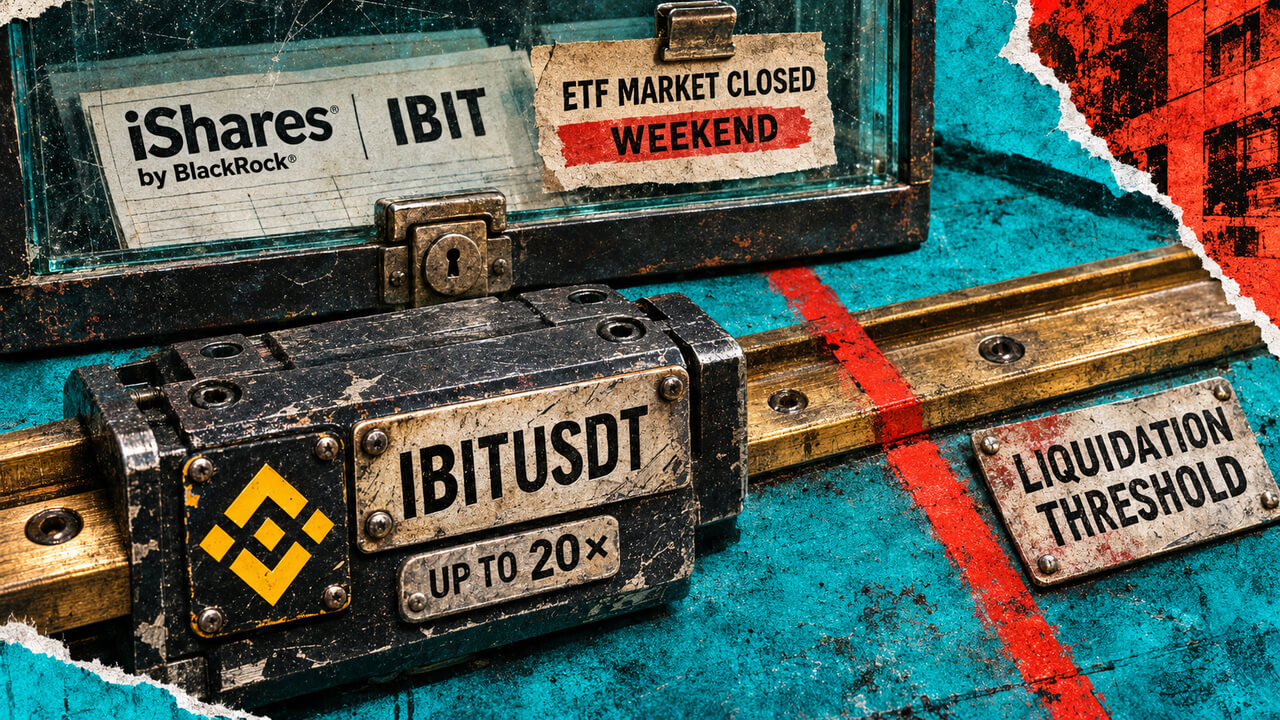
On November 18, Binance Futures introduced a new perpetual contract linked to BlackRock’s iShares Bitcoin Trust ETF (IBIT), expanding its suite of institutional-grade crypto-linked derivatives.
Denoted as IBITUSDT, this contract provides eligible traders with continuous, round-the-clock exposure to the Nasdaq-listed fund. Settling in Tether’s USDT, the product launched with a maximum leverage option of up to 20x.
According to the official listing notice, the contract was scheduled to open at 09:45 UTC, with trading activity subsequently recorded on the exchange’s public futures ticker. Crucially, the perpetual contract continues to trade after the underlying fund’s market closes. During these extended hours, Binance’s mark price can fluctuate significantly, potentially triggering liquidations.
This structure allows traders to speculate on the rise or fall of IBIT’s value without needing to hold the underlying ETF shares or direct Bitcoin holdings, leveraging the fund’s correlation with Bitcoin’s price movements.
Binance’s TradFi regulatory documentation highlights that users from regions such as the United Kingdom, Hong Kong, Taiwan, and certain European Economic Area countries face restrictions on trading these products. The 20x leverage represents the maximum cap at launch, though Binance’s standard margin rules impose lower leverage ceilings for larger positions.
Understanding Binance’s After-Hours Pricing Mechanism for IBIT Exposure
The price index serves as Binance’s primary reference for the underlying asset, directly feeding into the mark price. This mark price is the key estimate used by the exchange to determine whether a trader’s position has hit its liquidation threshold.
During standard equity trading hours, Binance constructs its reference index using third-party price quotes. To ensure stability, the exchange applies a smoothing algorithm during premarket and after-hours sessions, assigning lower weight to new quotes during the overnight period, as outlined in its pricing methodology.
In the absence of live vendor quotes—such as during weekends, holidays, or scheduled maintenance periods—Binance turns to the futures order book, where buy and sell orders for the perpetual contract are actively placed by traders.
The exchange calculates an average of two key metrics from the order book: the impact bid and the impact ask. This resulting average is then smoothed by prioritizing more recent data points. Consequently, the index can continue to fluctuate even while the ETF’s official share price remains frozen at its last closing value.
The mark can reach a position’s liquidation threshold while the ETF market is closed.
Shows the documented pricing mechanism. Live prices, exact smoothing settings and position-specific thresholds are outside its scope.
The index feeds the mark, which Binance calculates separately from the latest executed trade.
If adverse price movements erode a position’s collateral to a point where it can no longer remain open, Binance can execute forced liquidation even while the underlying ETF market is closed. Under the exchange’s liquidation rules, this process is triggered when the mark price reaches the specific liquidation threshold of the position.
To manage volatility, Binance typically restricts the weekend and holiday divergence between the mark price and the reference index to a maximum of 3% in either direction for equity-linked perpetual contracts, though this limit can be adjusted under extreme market conditions.
Traders can possess accurate predictions regarding where IBIT shares will reopen on Monday, yet still face forced liquidation over the weekend if Binance’s mark price crosses the liquidation threshold beforehand.
Also Read
- Pakistan Open Market Currency Rates: USD, EUR, GBP and Major Currencies – 19 November 2026
- Jeff Walton: How the $1 Trillion AI Credit Complex Could Catalyze Bitcoin’s Next Move
- Bitcoin Debuts Testnet5, Giving Miners a Live Dress Rehearsal for Four Proposed Rule Changes
- Seyffart on Bloomberg: Wall Street’s Q3 Bitcoin ETF Holdings Reach $4.2 Billion