



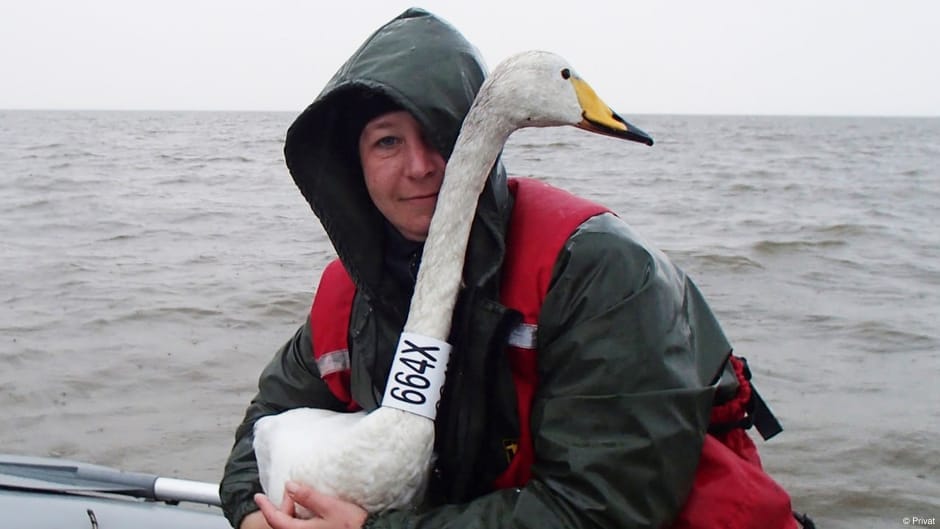
Boris Rosenfeld holds a photograph of himself with his daughter Sofia and struggles to hold back tears. “That was the last time we saw her,” he says. “Then she left for Moscow, and this entire case began.”
He lives in Israel; Sofia is in Russia. For more than a month, she has been detained on charges of financing extremism. The case stems from two donations totaling 2,000 rubles—about $30—to the Anti-Corruption Foundation (FBK), founded by the late opposition leader Alexei Navalny and later designated extremist by Russian authorities.
On October 7, a Moscow court sentenced her to three and a half years in a penal colony.
A biologist devoted to Arctic birds
Rosenfeld is a prominent ornithologist who has spent her life studying and protecting Arctic birds. “Sofia was an avid young naturalist from childhood. She loved birds, horses and dogs,” her father said, leafing through a photo album.
Sofia was a teenager when the family moved to Israel, but she returned to Russia a few years later and now holds both Russian and Israeli citizenship.
She studied biology at Moscow State University and built a significant scientific career in Russia. Her colleague Alexandra Panyutina, who also now lives in Israel, said Rosenfeld was dedicated to her work from an early age.
“Birds and the Arctic are the defining passions of her life,” she said.
Rosenfeld was among the first Russian researchers to develop a systematic approach to monitoring migratory bird populations. To support her research, she even helped develop a special aircraft.
“They could fly at almost the same speed as the birds and observe them from low altitude,” says Dmitry (name changed), a colleague. “It quickly became clear that this was a unique method.”
Protecting birds in Russia and beyond
Rosenfeld is regarded as one of the leading figures in Russian ornithology. Her work has extended far beyond Russia, and she has been deeply involved in international research projects. Cross-border cooperation is essential in migratory bird conservation.
Helmut Kruckenberg, head of the German Institute for Wetlands and Waterbird Research (IWWR), said Rosenfeld is highly respected in the international scientific community.
“She has done an enormous amount for nature conservation and for the protection of Siberian and Arctic species,” he said. “What is happening to her is simply beyond comprehension for us.”
More than 225 cases over FBK donations across Russia
In summer 2021, when Russian authorities designated Navalny’s Anti-Corruption Foundation as an extremist organization, Rosenfeld was on a remote Arctic expedition without a phone or internet access. She therefore did not immediately cancel her regular donations to the FBK; she did so only after returning to Moscow.
Her friend Olga (name changed) described Sofia as a person of absolute honesty. According to Olga, Rosenfeld’s donations to Navalny’s foundation reflected a genuine desire to fight corruption. Through her work in Russia’s regions, she had seen plenty of it firsthand.
“She was never involved in political activism. Her donations were solely intended to support anti-corruption work,” said her father, Boris Rosenfeld. “It’s unthinkable.”
For him and others close to her, the sentence came as a shock. Prosecutors had requested five years, but friends and colleagues expected she would receive a fine at most.
There were reasons for that expectation. According to calculations by the independent outlet Mediazona, about 85% of convictions in the 225 cases involving donations to Navalny’s foundation have so far resulted in non-custodial sentences. Yet Rosenfeld received three and a half years in a penal colony.
A year of court hearings and travel restrictions
Just a few months after Rosenfeld defended her doctoral dissertation in October 2025, her home was searched. She was also placed under travel restrictions. She continued to work but had to cancel her annual summer expedition to the Arctic.
Even on the day of sentencing, her conversations with colleagues focused largely on science. “We discussed how the work could continue in Sofia’s absence,” Olga said. “But no one really believed she would end up in prison.”
Leaving Russia was never an option
“The only thing we think about now is how to bring her here,” Boris Rosenfeld says, looking at pictures from Sofia’s last visit.
Friends and colleagues who spoke to the media say his daughter never considered leaving Russia, even as the prospect of prison loomed. “Sofia would never have left. She simply can’t imagine life without geese,” says Dmitry.
Now her family, friends and colleagues are campaigning to have her sentence overturned. More than 1,000 people have signed an appeal to Russia’s Presidential Council for Human Rights.
Boris Rosenfeld is also hoping for support from Israel, but so far Israeli consular officials have not been granted access to his daughter in detention.
The two continue to write to each other, and he is trying to keep his spirits high. “She writes that she’s trying to adjust to life in prison, and that it’s hard,” he says. “But she’s a strong person.”
Also Read
- CACI’s SkyValor Extends Drone Detection to 75 Kilometers, Giving Defenders Time to Respond
- United States and Germany Deepen Science and Technology Cooperation at Sixth Joint Committee Meeting
- The Internet’s Reliability Crisis: Convenience Over Caution
- Iran’s Araghchi Envisions Diplomatic Path to De-escalation with US