




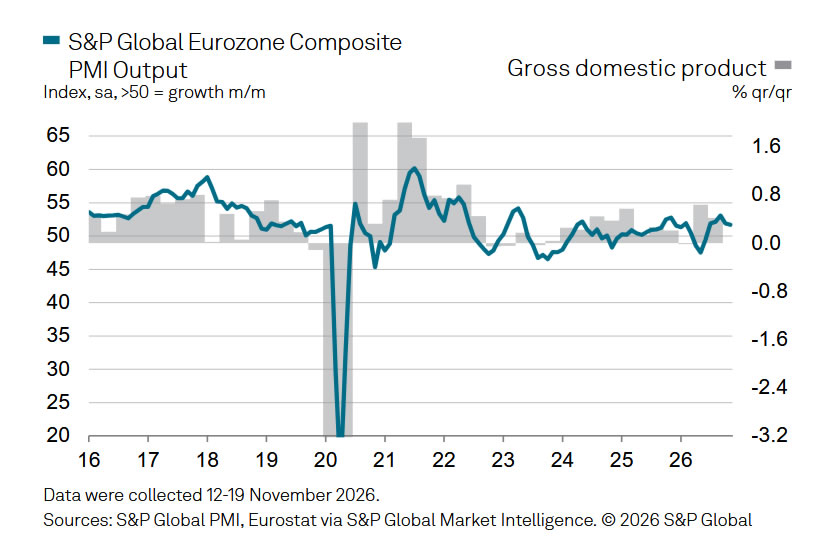
Eurozone private-sector activity maintained a modest growth pace in November. The Flash PMI Composite held steady at 51.7, marking the fifth consecutive month of expansion. The manufacturing PMI edged higher to 52.9 from 52.7, slightly above consensus at 52.8, while the services PMI slipped to 51.2 from 51.4, missing forecasts of 51.8 and hitting a five-month low. A firmer reading for manufacturing output, which rose to 53.3 from 52.8, helped offset the softer services performance and kept overall momentum broadly unchanged.
The standout development was the widening split between Germany and France, which reached its widest level in six years. Germany’s Flash PMI Composite climbed to 55.0 from 53.4, the highest reading in 56 months, as both manufacturing and services activity strengthened. The German manufacturing PMI rose to 55.0 from 54.2, while manufacturing output jumped to 57.4 from 55.4, reaching a 63-month high. Services momentum also improved, with the services PMI advancing to 54.0 from 52.5. By contrast, France’s Flash PMI Composite fell to 46.2 from 46.6, a six-month low. French manufacturing PMI dropped to 47.9 from 49.5, and manufacturing output plunged to 44.5 from 48.5, marking the weakest reading in 21 months. Although French services activity edged up to 46.6 from 46.2, it remained firmly in contraction.
Underlying conditions across the eurozone were mixed. New orders rose for a fifth straight month, with growth picking up slightly, but business confidence fell for a fourth month to its lowest level since May. Employment was little changed overall, as the strongest manufacturing job creation in three and a half years was offset by continued losses in services. Input-cost and selling-price inflation both eased to three-month lows, though price pressures remained substantial, particularly in Germany.
The latest results point to an increasingly Germany-dependent recovery, with growth supported by Germany’s manufacturing-led expansion and investment in defense and AI-related technologies. France’s deepening downturn, alongside slower growth elsewhere in the eurozone, highlighted the uneven nature of the region’s economic performance. While easing inflation offers some relief, persistent price pressures combined with ongoing expansion could reinforce expectations of further ECB tightening. The sustainability of the eurozone’s growth will hinge on whether Germany can maintain its current momentum while France and services activity across the region stabilize.
Data Summary — Eurozone Flash PMI, November 2026
Eurozone
| Indicator | Nov | Exp. | Oct |
|---|---|---|---|
| PMI Composite | 51.7 | — | 51.7 |
| PMI Manufacturing | 52.9 | 52.8 | 52.7 |
| PMI Services | 51.2 | 51.8 | 51.4 |
| Manufacturing Output | 53.3 | — | 52.8 |
Germany
| Indicator | Nov | Oct |
|---|---|---|
| PMI Composite | 55.0 | 53.4 |
| PMI Manufacturing | 55.0 | 54.2 |
| PMI Services | 54.0 | 52.5 |
| Manufacturing Output | 57.4 | 55.4 |
France
| Indicator | Nov | Oct |
|---|---|---|
| PMI Composite | 46.2 | 46.6 |
| PMI Manufacturing | 47.9 | 49.5 |
| PMI Services | 46.6 | 46.2 |
| Manufacturing Output | 44.5 | 48.5 |
Key Takeaways
- Eurozone growth held steady for a fifth month, as stronger manufacturing output offset softer services activity.
- Germany’s PMI Composite reached a 56-month high while France’s fell to a six-month low, widening their performance gap to a six-year extreme.
- Employment was broadly unchanged and confidence weakened, while easing but still-substantial price pressures complicated the outlook for economic growth and ECB policy.
Also Read
- XRP Ledger Led RLUSD Transfers Even as It Held Less Than a Third of Supply
- Binance Imposes New Monthly Fees and Account Closures for EU Users in France, Italy, Poland, and Spain
- Crypto Market Breadth Collapses as Bitcoin and Altcoins Slide Without Safe Havens
- BlackRock’s staked Ethereum ETF can delay redemptions if unstaked ETH runs short