




UK private sector activity expanded at a more moderate pace in November, with the composite Purchasing Managers’ Index (PMI) declining from 52.9 to 52.3, marking a two-month low. Despite this slowdown, the index remained above the 50.0 threshold, signaling expansion for the fifth consecutive month. The services sector PMI fell from 52.8 to 52.0, missing market expectations of 53.0 and reaching a five-month low. Meanwhile, manufacturing PMI edged down to 52.7, also slightly below the forecast of 53.0. However, manufacturing output strengthened significantly, rising from 53.6 to 54.2—the highest level in 27 months—highlighting a growing divergence between factory production and service sector activity.
The manufacturing resurgence was driven by robust demand linked to artificial intelligence data centre construction, defense spending, and the food and drink sector. New orders in manufacturing accelerated, contrasting with a deceleration in services new business. Notably, services export orders recorded their sharpest decline since February 2021, reflecting weakened demand from European customers. Although overall output continued to grow, employment contracted for the second consecutive month, with job losses concentrated in the services sector as companies sought to manage elevated payroll costs and enhance productivity. In contrast, business confidence improved for the second straight month, reaching its highest level since February, supported by stronger investment plans and optimistic sales expectations.
The survey indicates an increasingly manufacturing-led economic expansion, though weaker services momentum and ongoing job losses suggest that underlying growth remains uneven. Inflationary pressures eased, with input cost inflation slowing to a three-month low and selling price increases dropping to their weakest pace since July. Nonetheless, both cost and price metrics remain elevated by historical standards, reflecting persistent energy, logistics, and wage pressures. The combination of resilient industrial production, improving business confidence, and softer services demand suggests that UK economic growth is holding up, although sustained expansion will depend on whether manufacturing strength can continue to offset weakness in other sectors.
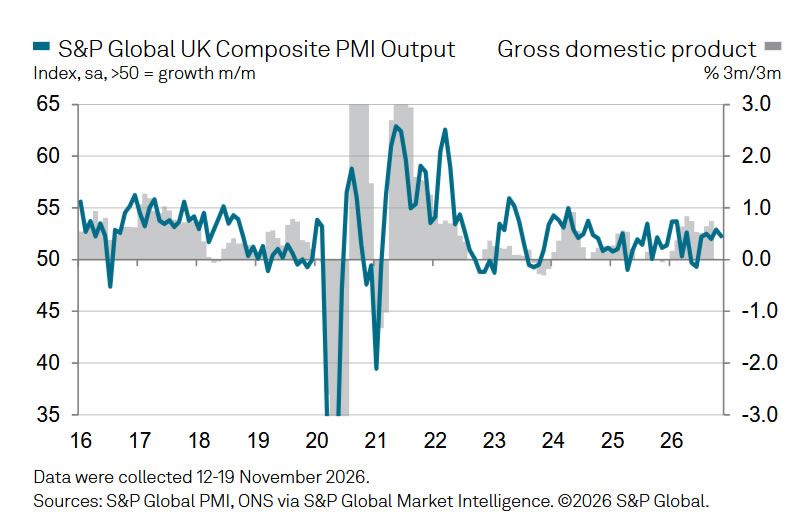
Data Summary — UK Flash PMI, November 2026
| Indicator | Nov | Exp. | Oct |
| PMI Composite | 52.3 | — | 52.9 |
| PMI Services | 52.0 | 53.0 | 52.8 |
| PMI Manufacturing | 52.7 | 53.0 | 52.8 |
| Manufacturing Output | 54.2 | — | 53.6 |
Key Takeaways
- UK private sector growth slowed as services activity hit a five-month low, while manufacturing output accelerated to its strongest pace in 27 months.
- AI data centre investment and defence-related demand supported manufacturing, but employment contracted as services firms faced elevated payroll costs.
- Business confidence improved to its highest since February, while easing inflation pressures remained historically elevated amid persistent energy and wage costs.
Also Read
- XRP Ledger Led RLUSD Transfers Even as It Held Less Than a Third of Supply
- Eurozone Composite PMI Stays at 51.7 as German Growth Accelerates to Four-Year High and France Slides Further
- Binance Imposes New Monthly Fees and Account Closures for EU Users in France, Italy, Poland, and Spain
- Crypto Market Breadth Collapses as Bitcoin and Altcoins Slide Without Safe Havens