



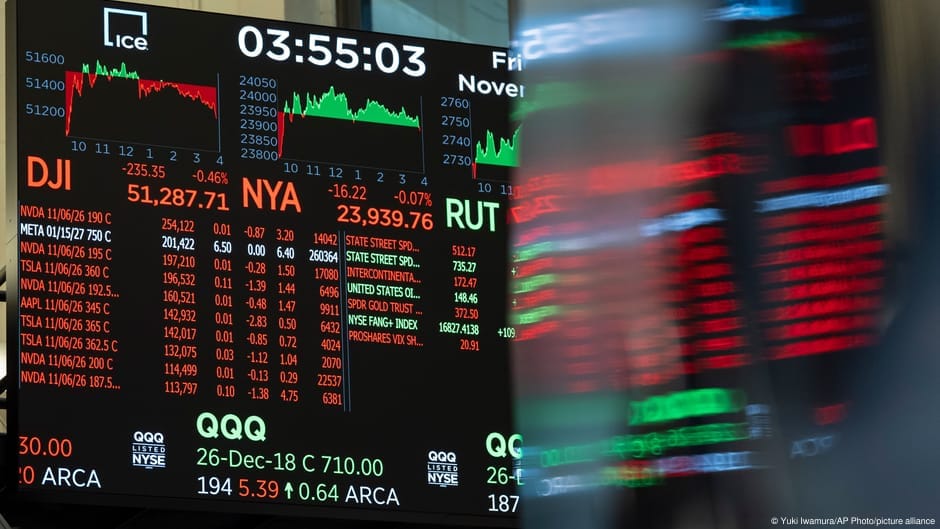
The technology-heavy Nasdaq index rebounded sharply this week following a sharp sell-off that had hammered technology and artificial intelligence (AI) shares.
After enduring its worst week since the March 2020 pandemic crash, the Nasdaq surged nearly 1,700 points, or 7%, at Monday’s open.
The AI rally gained further momentum after Nvidia reinstated Chief Executive Jensen Huang on Monday, just 11 days after his resignation prompted by a scandal involving extramarital affairs, including an alleged relationship with a Chinese spy.
The chipmaker’s shares jumped more than 30% on the news, opening near $170 (€155.5) and recouping most losses incurred since the allegations surfaced last month.
Will Anthropic put profits over security?
To view this video please enable JavaScript, and consider upgrading to a web browser that supports HTML5 video
How Passive Investing Drives the AI Trade
Recent volatility in AI, memory chip, and other technology stocks has rattled even seasoned, optimistic investors.
Yet investors seeking refuge from the U.S. stock market, which has captured the bulk of AI enthusiasm alongside Taiwan and South Korea, are finding fewer havens.
Economists attribute this partly to the mechanics of index funds, including exchange-traded funds (ETFs), which manage the pensions and savings of hundreds of millions of passive investors.
These indices have become increasingly exposed to the AI boom.
Riding Winners Works — Until It Doesn’t
Most major index funds are designed to ride winners, automatically increasing holdings in line with a company’s market capitalization. As a firm grows larger, the fund’s stake expands accordingly.
Shares of Nvidia, Microsoft, Apple, Alphabet, and other U.S. tech giants have surged on this dynamic, particularly since the launch of ChatGPT in late 2022.
The United States holds an outsized weight in global equity benchmarks. Nine of the top ten constituents of the MSCI All Country World Index (ACWI)—which comprises over 2,400 companies across 47 developed and emerging markets—are U.S. big-tech firms.
The sole non-U.S. entrant is Taiwan Semiconductor Manufacturing Co. (TSMC), which produces roughly 90% of advanced AI semiconductors.
Collectively, these ten holdings account for nearly a quarter of the index.
Despite its global mandate, U.S.-listed companies represent nearly two-thirds of the MSCI ACWI’s value, while constituting only about one-fifth of its constituents.
Don’t Concentrate All Chips in AI Stocks
“A well-diversified portfolio should reasonably reflect the entire global economy,” Gerd Kommer, founder of Munich-based asset manager Gerd Kommer Invest, told DW.
“That condition fails when 70% of a portfolio is concentrated in a single country—the United States. The global economy is more resilient than any national economy.”
Kommer, dubbed Germany’s “ETF pope,” argued investors require exposure across all economic sectors, with no single sector exceeding a quarter of the portfolio.
Yet even investors shunning U.S.-dominated global funds find the AI trade looming large in other major benchmarks.
For instance, the top ten constituents of MSCI’s Emerging Markets Index constitute 37.5% of its value, with TSMC alone representing nearly 16%. Technology, chip, and internet firms comprise eight of the largest holdings, alongside two banks—one Chinese, one Indian.
How Fund Flows Fuel Investor Hubris
This dynamic matters, according to Dimitri Vayanos, a finance professor at the London School of Economics who researches how passive investing inflates the prices of the largest firms.
“My model indicates that index-fund inflows exert a stronger price impact when the largest stocks belong to the same industry,” Vayanos told DW.
When optimism drives a stock higher, index funds amplify that upward pressure by mechanically buying more.
Professional investors often counter by shorting overvalued stocks, a practice that typically pulls prices back. However, shorting a mega-cap tech giant carries far more risk than shorting a small company.
“Being short 1% of SpaceX entails far greater risk than a 1% short position in a small firm,” Vayanos noted.
The problem intensifies when the largest firms cluster in one sector, as they do today. With short-sellers sidelined, the biggest stocks climb further, creating what he terms an “amplification-overpricing spiral.”
Lower AI Exposure Outside the U.S. and Asia
To reduce AI exposure, investors may need to pivot to developed-market funds excluding the U.S. and Southeast Asia, though these have delivered lower returns over the past decade.
In the MSCI Europe, Australasia and Far East (EAFE) index, the top ten holdings represent roughly 14.5% of the index—about 40% less concentrated than the ACWI.
EAFE’s largest holdings include healthcare leader Roche, energy major Shell, HSBC, and Nestlé, the world’s largest food and beverage company.
However, its largest constituent, ASML, remains deeply tied to the AI supply chain. The Dutch firm supplies the lithography equipment essential for chipmakers such as TSMC, Samsung, Intel, SK Hynix, and Micron.
Are AI companies becoming more powerful than governments?
To view this video please enable JavaScript, and consider upgrading to a web browser that supports HTML5 video
An AI Crash Would Reverberate Globally
If Monday’s AI-driven rebound sustains, equities could surge further in coming months. However, history suggests the bubble will eventually burst, inflicting heavy losses on both institutional and passive investors.
Kommer warned that an AI bubble burst would “in all likelihood drag down the global stock market,” with the heaviest damage concentrated in technology and AI shares.
Retail investors “with heavy portfolio weights in tech and AI stocks” would suffer most, he said, including “many who have layered individual AI-related stocks atop their equity ETFs.”
Vayanos maintains it is “certainly safer to hold an ETF than individual stocks.”
Yet as index providers add mega-IPOs like SpaceX and Anthropic to benchmarks within weeks of listing, and capital continues flooding into passive funds, he cautioned that “conditions are present for the effects of our theory to be even stronger.”
Also Read
- UK Imposes Sanctions on Yemen HouthiMilitia and Four Senior Officials Amid Allegations of Detention Abuse
- Report Urges Overhaul of PIP Assessments to Better Support Claimants
- ABHI Microfinance Bank Debuts on Pakistan Stock Exchange After Successful IPO
- Saudi Arabia Secures Quarterfinal Spot Following Victory Over Uzbekistan