



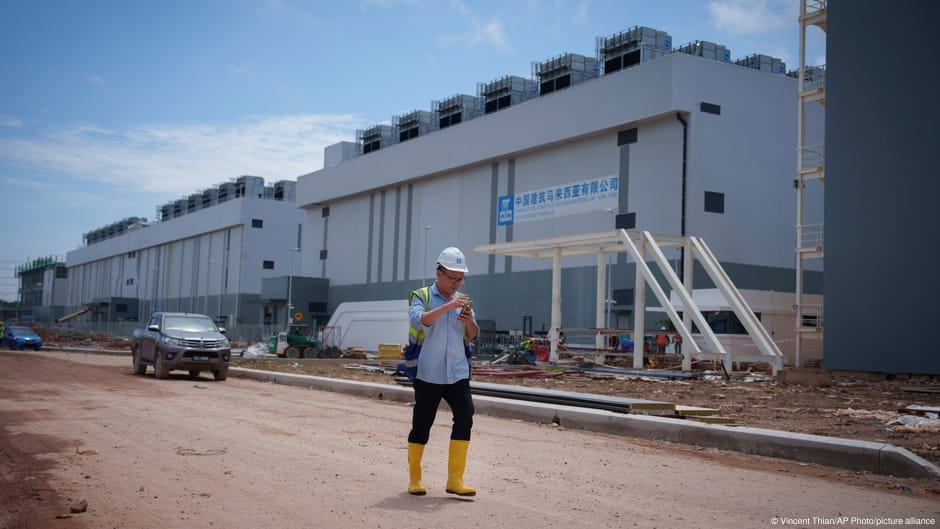
Since February 2025, approximately €510 billion ($559 billion) has been allocated to AI infrastructure in Malaysia. Fitch Solutions, a consulting firm, has established 125 data centers nationwide to support the global digital economy. The growth is concentrated in Johor, Malaysia’s western state, where 16 of the 27 newly built data centers are situated, according to the country’s Digital Ministry.
The Kuala Lumpur administration anticipates that the investment will generate many new employment opportunities, with up to 90 % of the positions expected to be filled by Malaysian residents. The data center locations benefit from inexpensive electricity for high‑consumption computing and robust connections to international submarine cable networks.
Amazon, Google and Microsoft along Strait of Malacca
Leading U.S. technology firms have also expanded their operations along the Strait of Malacca. Amazon and Oracle have committed $6 billion each, whereas Microsoft and Google have each pledged $2 billion. In early November, Alphabet, Google’s parent, revealed an additional $15 billion investment.
“Malaysia’s goal is not merely to develop an economy that leverages artificial intelligence, but also to foster creative applications of AI,” said Digital Minister Gobind Singh Deo in a statement notably published in Chinese, a language that is not officially recognized in Malaysia.
Trump’s ASEAN Play: The new front in the US-China chip war
To view this video please enable JavaScript, and consider upgrading to a web browser that supports HTML5 video
The rapid expansion of data centers in Southeast Asia reflects a broader contest for technological dominance in artificial intelligence. The United States has limited the export of high‑performance chips, including those from domestic leader Nvidia, to China, and has also sought to prevent the sale of advanced lithography equipment manufactured by Dutch firm ASML.
Chinese companies rent access to US chips
Because Chinese semiconductors have not yet achieved comparable technological maturity, certain Chinese firms have adopted an alternative approach: they legally acquire or lease computing capacity in other nations. This enables them to rent access to U.S. chips installed in overseas systems—such as those in Malaysia—and develop AI models remotely.
In October, the Institute for Progress (IFP), an independent Washington‑based think tank, warned that Southeast Asia was emerging as an offshore hub for Chinese AI operations. It estimated that by year‑end, roughly 24 % of China’s total computing capacity derived from remote access to overseas data centers—three‑quarters of which were located in Southeast Asia—and projected this share to reach 31 % by the end of 2027.
The IFP noted that, although U.S. AI chips hosted in overseas data centers represent a substantial source of computing power for China, quantifying this resource is challenging.
The IFP explained that Chinese entities can obtain GPU services as a cloud offering or lease overseas data center capacity directly from developers or via intermediaries. Cloud providers and data center operators rarely disclose customer identities or the specific capacity each client utilizes, and Chinese companies themselves provide limited disclosure.
Alibaba Cloud sets up shop in Malaysia
Alibaba Cloud, a major Chinese technology firm, currently runs six data centers in Malaysia—three in Johor and three within the broader Kuala Lumpur area, with its latest facility inaugurated on November 19.
The company has committed $53 billion to data center investments across South Korea, Thailand, the Philippines, Mexico, and Malaysia. The parent of TikTok also maintains data center capacity in Johor.
The race for transformers
To view this video please enable JavaScript, and consider upgrading to a web browser that supports HTML5 video
In early October, Shenzhen‑based multinational Tencent signed a five‑year, $7 billion agreement with Oracle, securing computing capacity equivalent to 100,000 contemporary AI chips for AI model training. The contract stipulated a 30 % upfront payment.
The agreement collapsed a few weeks later, and both companies have remained silent regarding the reasons. Media reports indicate pressure from governments in Beijing and Washington; Chinese authorities seek to bolster domestic chip manufacturing, while senior U.S. officials reportedly voiced security concerns about the deal with Oracle.
US tariffs on Malaysian imports
In mid‑2025, the United States warned it might impose an additional 25 % tariff on Malaysian imports to curb the circumvention of chip export controls, according to consulting firm Equal Ocean. The Malaysian government swiftly responded by condemning illegal resale practices and instituting licensing requirements for the transshipment of specific high‑end chips.
Washington is intensifying its actions. On the same day that President Donald Trump met with Chinese President Xi Jinping at the APEC summit in Shenzhen, the U.S. Bureau of Industry and Security, a division of the Department of Commerce, introduced new regulations concerning remote access to advanced AI chips and servers.
The stated objective is to prevent foreign actors from using advanced U.S. technology to jeopardize national security and foreign policy interests. The restrictions apply to data centers that supply substantial computing capacity to entities linked to countries in “Country Group D:5” or Macau.
U.S. export regulations define the D:5 group as comprising China, Russia, Iran, North Korea, and several other nations. In the future, companies will be required to perform more rigorous checks to determine the ownership and control structures of their clients.
Washington has also imposed new licensing requirements for advanced semiconductors bound for Indonesia, Malaysia, Singapore, Thailand, and Brazil; subsidiaries of U.S. companies are exempt.
“The United States is not only assessing which countries will receive AI chips in the future but also seeking influence over where the chips are deployed, who operates the infrastructure, and which customers they serve,” noted Chinese industry expert Xu Sanlang. “Consequently, data centers that have been providing remote computing capacity to Chinese clients will need to adhere to these restrictions moving forward.”
This article was originally written in German.