



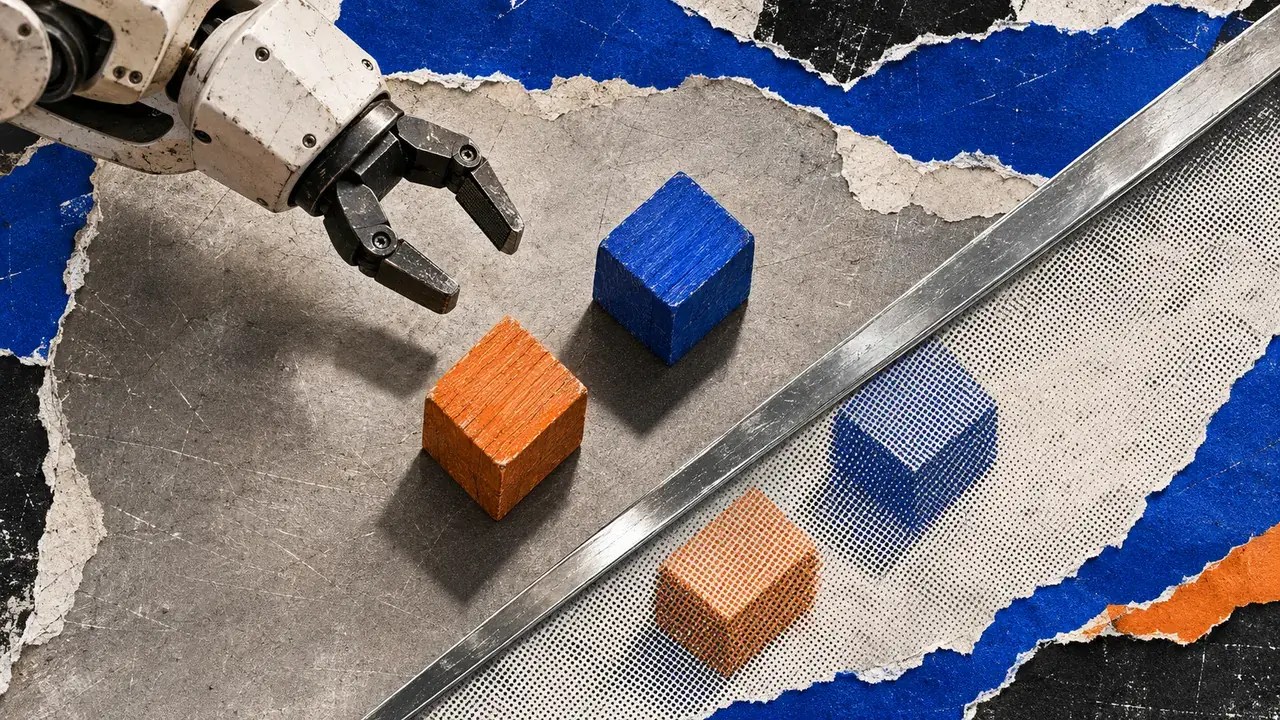
Two artificial intelligence controllers each operated a robot arm that successfully stacked blocks in eight of ten attempts on an ordinary work surface. When the same task was performed on a mirrored tabletop, neither controller managed a single success across ten tries. Both sets of experiments used an identical Franka arm, and each controller worked with the same camera configuration, instructions, and execution budget across all conditions.
The findings appear in a Nov. 24 preprint from researchers at Peking University. The team evaluated two controllers, π0.5 and FastWAM, across four tasks: placing produce, stacking blocks, flipping a bracket, and inserting a cylinder. Each controller attempted every task ten times under each condition, drawing on five starting layouts tested twice apiece. A third condition positioned an upright mirror beside the workspace.
Success rates declined across the broader task set as well. In the physical trials, π0.5 succeeded in 77.5 percent of attempts without a mirror, 52.5 percent with an upright mirror, and 27.5 percent with the mirrored tabletop. FastWAM’s corresponding rates were 60 percent, 30 percent, and 10 percent.
Block-stacking trials on one Franka armBoth controllers succeeded in eight of ten trials without a mirror and zero of ten trials with a mirrored tabletop. Filled squares are successful trials and outlines are failures.No mirrorMirrored tabletopπ0.5FastWAM8 / 100 / 108 / 100 / 10Successful trialFailed trialEach square is one trial, grouped by outcome
Block-stacking trials on one Franka armBoth controllers succeeded in eight of ten trials without a mirror and zero of ten trials with a mirrored tabletop. Filled squares are successful trials and outlines are failures.No mirrorMirroredtabletopπ0.5FastWAM8 / 100 / 108 / 100 / 10Successful trialFailed trialEach square is one trial, grouped by outcome
Five matched starting layouts were tested twice for each controller and condition.
The graphic covers block stacking in two of the three conditions tested on the arm.
Reflections disrupted simulated tasks even without contact
The team’s RoboDojo-Mirror benchmark evaluated five controllers in simulation across eight shared tasks. Every controller’s overall success rate dropped when confronted with a single upright mirror, two mirrors, and a mirrored tabletop. Because the controllers operated under different execution budgets, the researchers benchmarked each one against its own mirror-free baseline.
An upright mirror also functions as a physical obstacle. In a simulated comparison, the researchers swapped in nonreflective panels of identical shape and placement. Across 120 paired trials pitting two upright mirrors against two matching panels, WALL-OSS succeeded only with the panels in 25 pairs and only with the mirrors in two. For Awomo-0.5, those counts were 42 and three across its own 120 pairs. Mirror trials still failed more frequently within the subset of cases where the robot had succeeded in the mirror-free baseline without touching either test surface.
In one simulated tube-pickup task, the gripper closed on empty space and lifted nothing. The team further examined pairs in which the robot contacted a surface in both trials, succeeded with the panels and in the mirror-free baseline, yet failed with the dual mirrors. In those cases, the robot spent a larger fraction of the trial in contact with the mirrors than with the panels. This comparison spanned six matched pairs for WALL-OSS and seven for Awomo-0.5. The researchers noted that the behavior was consistent with the robot attempting to reach its own reflection.
Also Read
- Proposed SEC Custody Rules Could Limit Staking Opportunities for Crypto Clients
- Staking Rewards Boost Ethereum ETF Income, but Exiting May Carry Hidden Costs
- USD1 Stablecoin Briefly Breaks Its Dollar Peg as World Liberty Financial Scrambles to Contain WLFI Sell-Off
- Tether Destroys 4 Billion USDT as Global Circulation Contracts 491 Million