




Stellar (XLM) now supports real‑time USDC salary payments for employers and employees using Zebec, a New York‑based fintech firm that provides streaming‑payment services.
In essence, payments can be initiated on demand rather than in monthly lump sums, making them programmable; however, most services use USDC instead of Stellar’s native XLM token.
Additionally, Stellar’s XLM network now hosts a salary‑payment system that integrates directly with Mastercard debit cards, allowing employees to withdraw funds to local currencies or make in‑store purchases.
Stellar’s Total Value Locked Increases 9.25% With Zebec’s Roll-Out
The offering also provides an automated HR dashboard, which several European institutions have been piloting this month. Zebec employs a multi‑chain strategy, initially launching the real‑time salary system on Solana (SOL) before selecting Stellar (XLM) for its low‑cost global remittance capabilities.
Get paid in stablecoins, spend on Mastercard: Zebec rolls out payroll on Stellar
Zebec (@Zebec_HQ) just put enterprise payroll on Stellar (@StellarOrg). Employers can stream salaries and contractor payments in stablecoins, landing instantly in workers’ wallets. From there, you… pic.twitter.com/0AaF5MwKKq
— BSCN (@BSCNews) June 15, 2026
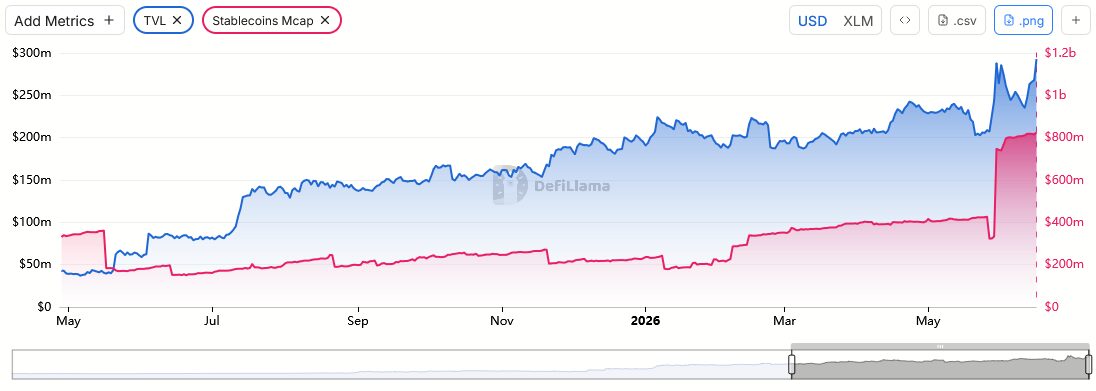
The on-chain metrics reflect this decision: Stellar’s Total Value Locked (TVL) surged 9.25% within 24 hours, according to DefiLlama. However, XLM’s price impact may be delayed; the token is down 4.48%, testing the $0.21 support level, which remains a key demand zone after its recent rally.
Additionally, the stablecoin market capitalization on the XLM network has reached an all‑time high of $807 million. Unlike USDC, which dominates over 60% of the market, the leading token is now USDY, an interest‑bearing asset from Ondo Finance backed by short‑term U.S. Treasuries and bank deposits.
Based on Tuesday’s price action, Stellar’s bulls encounter strong resistance near the $0.23 wick, repeatedly being pushed down to $0.212, which aligns with the exponential moving average.
Why Stellar’s Price Dropped Despite Positive News
Indeed, futures data show that XLM’s bulls have absorbed a $1.22 million deficit in liquidations, according to CoinGlass. Meanwhile, short‑sellers have unwound $522,130 of overly leveraged positions, but this is insufficient for the bulls to spark a recovery at this stage.
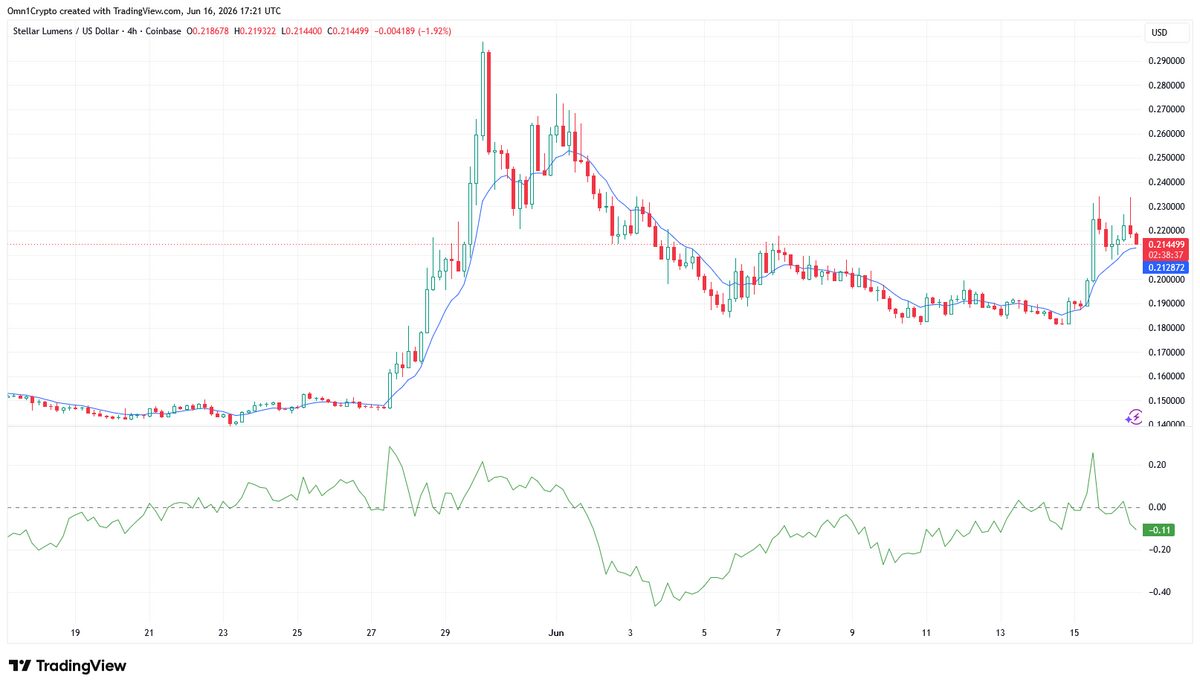
The primary concern involves sell‑offs on shorter time frames among crypto whales—the largest investor cohort. With the Chaikin Money Flow (CMF) currently negative, XLM’s rebound toward its May peak of $0.28 may be delayed until weaker holders are flushed out.
People Also Ask:
What just happened with Stellar?
Blockchain payroll provider Zebec has launched its enterprise payroll platform on the Stellar network, enabling companies to pay salaries and contractors in stablecoins, with employees receiving funds instantly in digital wallets, Mastercard‑linked cards, or after conversion to local currency.
Why is this important?
This represents one of the first genuine enterprise applications of Stellar, allowing multinational corporations and HR departments to process global payroll swiftly and cost‑effectively via blockchain rather than conventional banking channels.
Who is already testing it?
Several European institutions and multinational employers are currently in the final testing phase for salary payments, contractor fees, and employee benefits.
Will this lead to long-term price growth for XLM?
This is a highly positive development for real‑world utility. As more companies adopt Zebec’s payroll solution on Stellar, demand for XLM—used to pay network fees and secure the ecosystem—could increase steadily.