



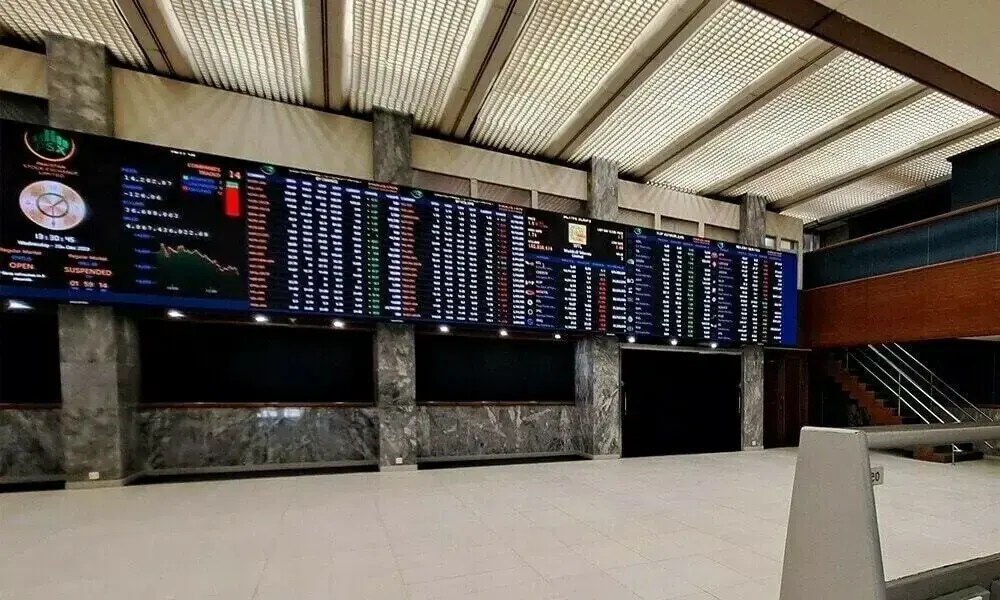
Market sentiment turned positive in the opening moments of trading on Tuesday, as Pakistan’s benchmark KSE‑100 Index surged close to 500 points.
By 9:45 a.m., the index stood at 178,970.18, a gain of 498.32 points or 0.28%.
Key sectors—cement, commercial banking, oil and gas exploration, shipping, and power generation—showed robust buying activity. Heavy‑weight constituents such as HUBCO, OGDC, POL, PPL, PSO, HBL, MCB and UBL performed well, trading in the green.
After a profit‑taking rally on Monday that saw the KSE‑100 dip 450.89 points (0.25%) to 178,471.87, the market now appears to be on a more upbeat trajectory.
Across the region, most Asian stocks eased, although oil prices steadied following the United States’ lift of sanctions on Iran. Global investors remain attentive to potential policy moves by the Federal Reserve to curb inflation this year.
MSCI’s broadest Asia‑Pacific index (excluding Japan) fell 0.5%, while S&P 500 e‑mini futures dipped 0.2%. The Nikkei 225 declined 0.6%, recouping some earlier losses after data revealed strong manufacturing growth in Japan. South Korean equities edged lower by about 2%, whereas Taiwanese stocks opened up 0.9%, setting a new high.
U.S. equity indices moved lower overnight: the S&P 500 down 0.4% and the Nasdaq Composite down 1.3%, pressured by declines in large‑cap technology names such as Alphabet and SpaceX.
Market participants are weighing the likelihood of a faster pace of rate hikes by the U.S. Federal Reserve under the new Chair Kevin Warsh.
Fed funds futures now imply a 54% probability of at least two 25‑basis‑point hikes before year‑end, compared with a 15.2% probability a week earlier, according to the CME Group’s FedWatch tool.
This is an intraday update