



In December 2025, Italy awarded over 1.1 GW of solar capacity through its inaugural auction that barred projects using equipment manufactured in China, covering 88 separate initiatives.
The successful bids averaged €66.38 per megawatt‑hour (≈ $75.80), which is roughly 17 % higher than the price recorded in the unrestricted renewable auction earlier in 2025, according to Italy’s electricity services agency, GSE.
The higher price was a conscious choice to source solar hardware from anywhere except China, underscoring the limited scale of viable alternatives. Even so, over 90 % of EU solar installations still come from Chinese modules, highlighting how slender Europe’s non‑Chinese options remain.
China manufactures more than 80 % of the world’s solar components, controlling the entire value chain from polysilicon to finished panels. This dominance has supplied affordable panels globally, but it has also left governments in Brussels and New Delhi increasingly anxious about relying on a single source.
As Ajay Srivastava, founder of the Global Trade Research Initiative, observed: “China is present in almost every global solar supply chain.” Even panels assembled in India or Vietnam, he noted, typically depend on Chinese‑made cells, wafers or polysilicon higher up the production chain.
EU’s solar industry in crisis despite new 2040 climate goals
To view this video please enable JavaScript, and consider upgrading to a web browser that supports HTML5 video
India’s manufacturing push
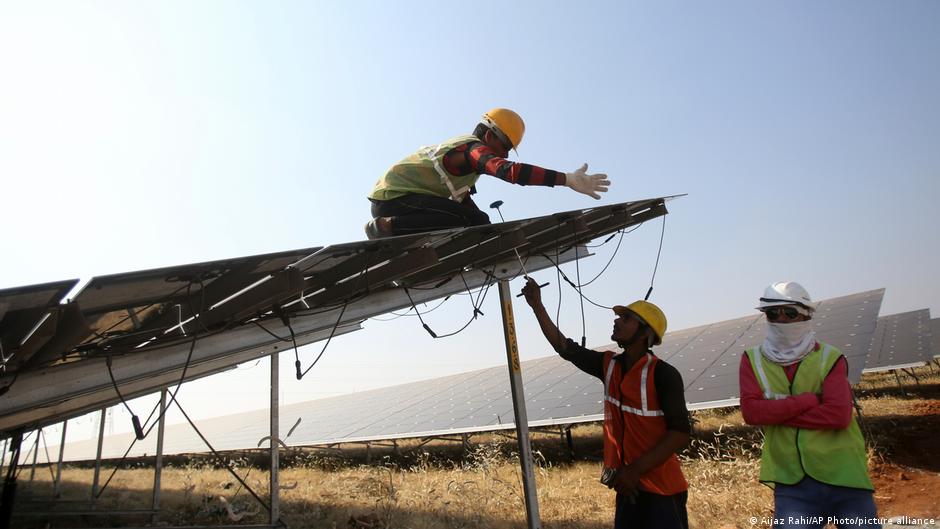
India’s shift from importer to producer has been swift—at least on paper. Early 2026 data shows a module‑manufacturing capacity of 172 GW, with cell capacity climbing to roughly 30 GW, a near‑tripling of earlier levels.
The surge is largely driven by policy.
Sanjay Varghese, a senior executive at Indian firm ReNew, attributed the turnaround to the government’s “Make in India” programme, which combines tariffs and non‑tariff barriers—most notably the Approved List of Models and Manufacturers (ALMM)—with a roughly $2.5 billion Production‑Linked Incentive (PLI) scheme. The combined measures, he said, reshaped the sector almost overnight.
“Five years ago, every solar module installed in India was imported from China,” Varghese observed. “Today, all modules—and roughly half of the cells consumed domestically—are produced in India.”
He expressed hope that India could achieve full domestic control of the value chain—from modules, cells, wafers, ingots and polysilicon to even metallurgical‑grade silicon—within the next five to seven years.
Dries Acke, CEO of SolarPower Europe, noted that India’s capacity already exceeds domestic demand. “That clearly means the country will be looking for export opportunities,” he added.
Where the limits lie
Analysts, however, cautioned that India’s readiness to supplant China should not be overstated.
Jochen Rentsch, head of technology transfer at the Fraunhofer Institute for Solar Energy Systems, highlighted wafers as the critical choke point—approximately 99 % of global photovoltaic wafers are still produced in China. He also warned that Chinese makers can price wafers below cost, rendering it “nearly impossible” for newcomers to compete on price alone.
Although India has achieved near self‑sufficiency in cells and modules, Rentsch noted, it still relies on China for wafers, polysilicon and manufacturing equipment. Consequently, a pivot to Indian panels would merely shift parts of the supply chain rather than fully insulating Europe from Chinese dependencies.
Varghese confirmed the industry’s reliance on China, pointing out that Indian producers still depend on Chinese firms for essential tools and machinery, and that China remains at the forefront of solar technology development.
Europe’s policy gap
Europe’s challenges differ in nature. Germany, for example, aims to source 80 % of its electricity from renewable sources by 2030, a target that will demand massive imports of clean‑energy hardware—most of which remains linked to Chinese supply chains.
According to BSW‑Solar, the German solar association, domestic module output has contracted to a niche market, whereas Germany maintains stronger footholds in inverters, mounting systems, battery storage and upstream manufacturing equipment.
Acke contended that Europe needs its own version of India’s PLI scheme—an output‑based subsidy akin to the U.S. Inflation Reduction Act’s tax credits—to render local manufacturing economically viable.
The EU’s upcoming Industrial Accelerator Act, which is meant to expand the 2024 Net Zero Industry Act, has disappointed advocates such as Acke. It defines “Made in Europe” broadly enough to encompass production by free‑trade partners, rather than insisting on literal European manufacturing.
Solar panel recycling: A hidden goldmine of raw materials?
To view this video please enable JavaScript, and consider upgrading to a web browser that supports HTML5 video
Complicating matters, U.S. tariffs on Indian goods have limited export opportunities, prompting Indian manufacturers to seek greater access to Europe. At the same time, Varghese noted that anti‑dumping and countervailing duties on Indian cells and modules in the United States now exceed 250 %, effectively shutting that market for the foreseeable future.
India’s location does provide some logistical edge. Rahul Sharan, deputy director and shipping specialist at Drewry, an independent maritime research consultancy, highlighted that India’s west‑coast ports enjoy efficient connections to Europe via the Suez Canal, potentially reducing delivery times relative to East Asian competitors.
Nevertheless, he cautioned that logistics alone are unlikely to eradicate the structural cost advantages China has built through scale and integration. Sharan also pointed to the Strait of Malacca—through which over 60 % of global maritime trade passes—as a persistent choke point whose disruption, whether from South China Sea tensions or U.S.–China rivalry, could ripple through solar supply chains far beyond Asia.
A long road ahead
While experts agree that India is currently the most credible alternative to China in solar manufacturing, it is not yet a full substitute. Srivastava emphasized that building genuine manufacturing capability typically requires 10–20 years and that incentive programmes such as India’s PLI often promote assembly rather than deep‑manufacturing processes.
He believes the only realistic route is a coordinated “China‑plus‑one” strategy, in which the United States, Europe, India and other partners invest in parallel supply chains—even if that raises output costs by roughly 10–15 % initially. “At present, however, that political and industrial leadership is missing,” he added.
The green mirage: Is any energy in Tamil Nadu sustainable?
To view this video please enable JavaScript, and consider upgrading to a web browser that supports HTML5 video