




The U.S. Justice Department reports that Rossen Iossifov, a prisoner sentenced for money laundering, allegedly transferred approximately $290,000 in cryptocurrency in January 2024, despite a court order for asset forfeiture to the United States.
This case underscores a critical operational gap between a court’s forfeiture ruling and the government securing control over digital assets, which can still be moved if access credentials remain in the hands of someone with valid authority.
The DOJ’s July 9 announcement outlines Iossifov’s alleged use of multiple exchanges and illicit mixing services to prevent the U.S. from obtaining possession of the funds. Iossifov, owner of Bulgaria-based crypto exchange RG Coins, was convicted of RICO conspiracy and money laundering charges.
Prosecutors allege that Romanian scammers used fake listings on platforms like Craigslist and eBay to defraud at least 900 Americans, converting the proceeds into cryptocurrency. The DOJ’s report raises a key question: Had agents secured the private keys or transferred the crypto into a government-controlled wallet before the alleged unauthorized movement?
According to the DOJ, the transfer occurred before the government obtained practical control. The agency’s failure to act prior to the alleged transfer created a vulnerability in asset recovery processes.

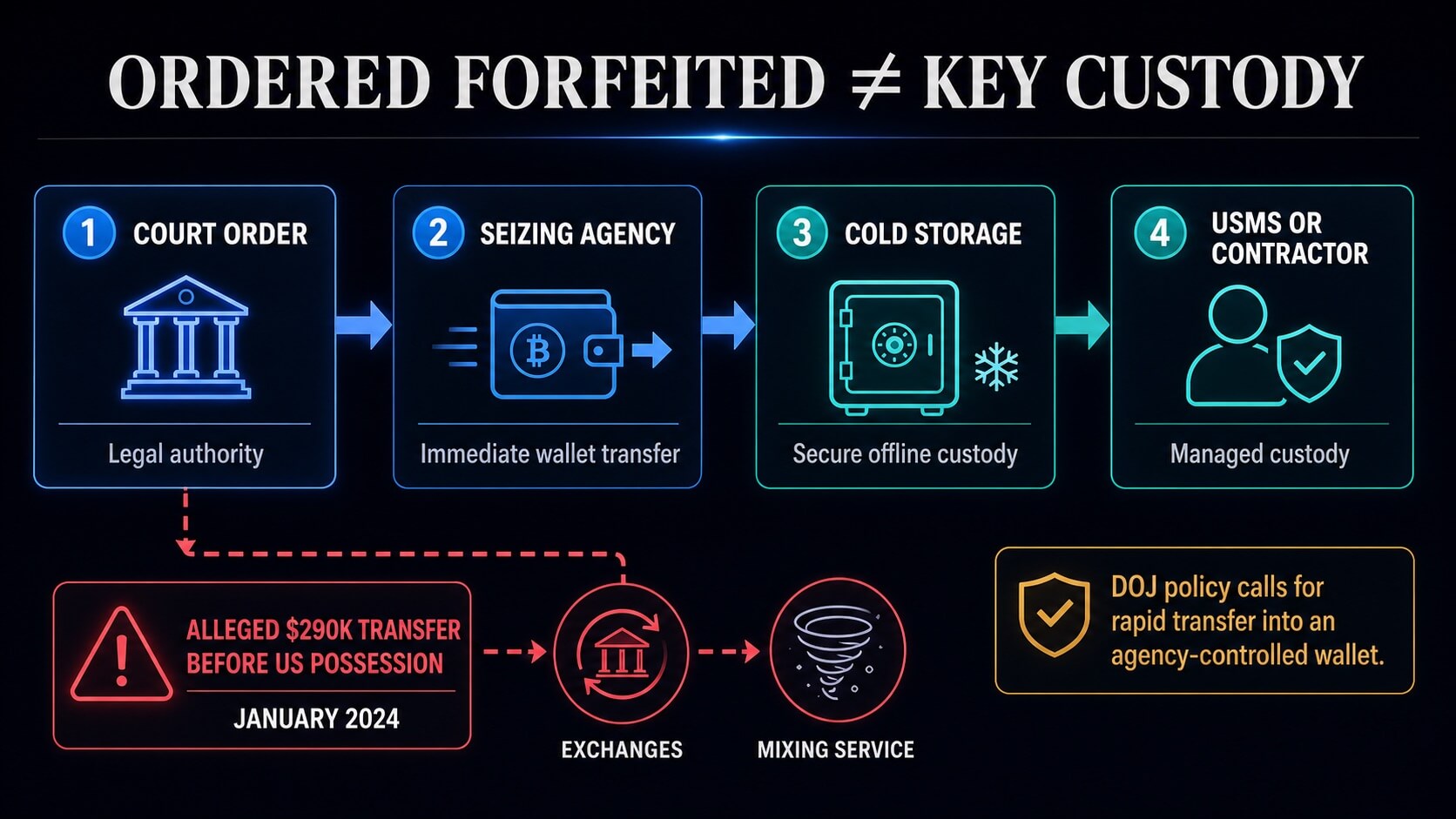
The DOJ’s Asset Forfeiture Policy Manual requires agencies to transfer seized cryptocurrency to a wallet they control immediately, then store it in cold storage before transferring it to the U.S. Marshals Service or its contractor. However, a warrant or forfeiture order alone does not guarantee exclusive control—assets must be physically secured before unauthorized access is eliminated.
In 2024, the U.S. Marshals Service selected Coinbase Prime to oversee the custody and liquidation of high-value digital assets, aligning with DOJ and USMS protocols. Exclusive control over cryptocurrency is only achieved when no other party can authorize transactions using remaining credentials or keys.
The case remains unresolved regarding the specific controls or key management failures that enabled Iossifov to execute the transfer while incarcerated. Court records do not clarify the location of the cryptocurrency, who held the private keys, or the exact services used for the transfer. The DOJ has not identified a prior government-controlled wallet that received the assets before their alleged movement.
Iossifov, sentenced to 121 months in January 2021 (reduced to 111 months in May 2024), faces additional charges including property removal to obstruct seizure and conspiracy to commit money laundering, carrying a maximum sentence of 25 years if convicted. He was also ordered to pay $2.64 million in restitution to victims of the original fraud scheme.
The DOJ’s recent seizures of $580 million highlight evolving tactics in crypto-related fraud, including structured operations with assigned quotas and scripted interactions. These cases emphasize the need for agencies to synchronize court authority with immediate technical control to prevent unauthorized asset movements. The Iossifov case exemplifies critical vulnerabilities in this process, reinforcing the necessity of pre-emptive key custody measures.