



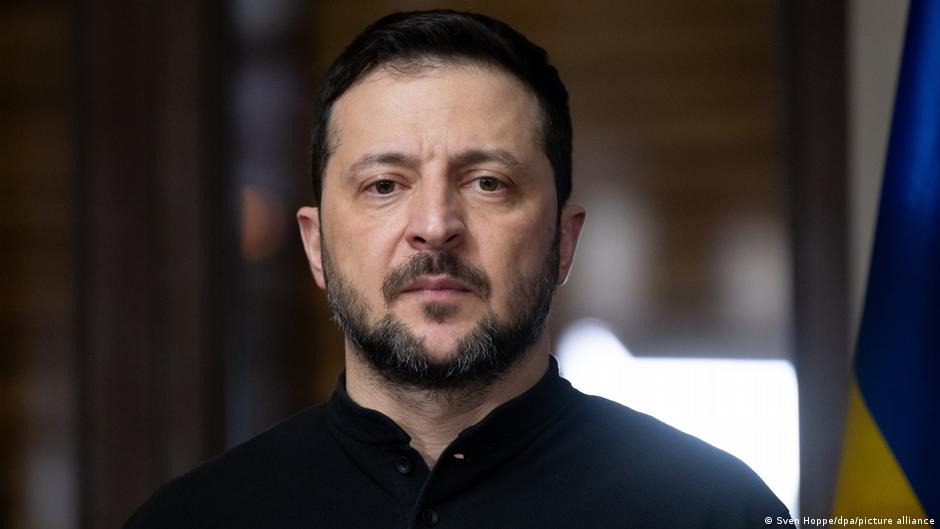
On Tuesday, Ukraine’s parliament voted overwhelmingly to accept Prime Minister Yulia Svyrydenko’s resignation, effectively dissolving the government.
President Volodymyr Zelenskyy announced on Sunday via social media that he had offered Svyrydenko a new role, with reports suggesting she may be appointed as Ukraine’s next ambassador to the United States.
“I am grateful to Yulia for her clear, steady, and effective work as prime minister and for her years of service as part of Team Ukraine,” Zelenskyy wrote on Telegram. “I have offered her the chance to assume a new, significant role in relations with an important partner. I expect that, together with members of parliament, we will implement the necessary changes to the Ukrainian government.”
Zelenskyy posted photographs of meetings with Sergii Koretskyi, head of state‑owned Naftogaz, First Deputy Prime Minister and Energy Minister Denys Shmyhal, Interior Minister Ihor Klymenko, Defense Minister Mykhailo Fedorov, and Kharkiv Mayor Ihor Terekhov.
Ukraine’s Cabinet reshuffle
Speculation has surrounded President Zelenskyy’s decision to reshuffle a cabinet that has been in power for less than a year. Political scientist Ihor Reiterovych of Kyiv’s Taras Shevchenko National University told DW that the reshuffle was initially slated for the autumn or spring, but recent developments have compelled an expedited response.
A primary concern involves Ukraine’s ambassador to the United States, Olga Stefanishyna, who is under investigation by Ukraine’s anti‑corruption authorities for actions prior to her appointment, and there are reports that she may be contemplating resignation.
“It is possible that U.S. officials signaled that a scandal surrounding the ambassador would be unacceptable and that action was required,” Reiterovych explained. “Consequently, President Zelenskyy needed to act. Svyrydenko is a strong candidate, having collaborated effectively on the raw materials agreement with the United States and establishing valuable contacts. Washington is eager to cooperate with individuals with whom it has already worked.”
Reiterovych warned that recent scandals within the armed forces could tarnish Zelenskyy’s reputation as commander‑in‑chief. Investigative reporting has documented cases of torture, abusive treatment of recruits, and concealment of deaths occurring outside combat zones. Simultaneously, inquiries are examining irregularities in conscription and draft procedures, especially after many mobilized men were found medically unfit for service.
Ukraine recruits female prisoners for frontline fighting
To view this video please enable JavaScript, and consider upgrading to a web browser that supports HTML5 video
Rotating personnel could help Zelenskyy shift focus from the military’s pressing challenges, Reiterovych noted. He added that communication difficulties within the cabinet, including with Defense Minister Mykhailo Fedorov, may also be driving his call for change. A comprehensive reshuffle would enable him to remove officials whose removal might otherwise prove diplomatically sensitive.
Zelenskyy’s power play
Svyrydenko hails from the inner circle of Andriy Yermak, former head of the presidential office, who demanded strict loyalty within the government, according to Vadym Denysenko of the analytical unit at Ukrainian news portal DSNews. With Yermak’s exit, Svyrydenko’s role as a policy executor has become less relevant, despite her continued loyalty to Zelenskyy.
Political scientist Oleksiy Haran told DW that he views the reshuffle as a response to Yermak’s resignation. He argued that the presidential office aims to reinforce its control over the executive branch, noting, “Zelenskyy is once again asserting his authority, contrary to the constitution, since government formation is Parliament’s exclusive prerogative and must, at least formally, proceed through Parliament.” He added that Zelenskyy appears intent on demonstrating that he is in charge and has everything under control.
Haran suggested that addressing Ukraine’s energy challenges may also be driving the reshuffle, which is why Koretskyi and Shmyhal — both energy experts — are considered candidates for prime minister, with observers identifying Koretskyi as a leading contender.
“I don’t consider that the primary motive,” Haran said, “but it remains an important factor.”
Zelenskyy prizes loyalty
Volodymyr Fesenko of the Penta Center for Applied Political Research told DW that Zelenskyy typically bundles personnel changes into broader government reforms. “This was the pattern last year, and it appears to be repeating this year,” he said. “The changes extend beyond the cabinet to include appointments in law‑enforcement agencies.”
Denysenko described the reshuffle as a comprehensive overhaul of Zelenskyy’s leadership team.
Reiterovych emphasized that loyalty is the foremost criterion for Zelenskyy in choosing a new prime minister. Although Ukraine operates under a parliamentary system, most observers agree that the legislature will likely ultimately endorse a candidate presented by the president. “The objective is to subordinate parliament once more,” Reiterovych noted. “Voters are expected to approve whatever is presented.” Nevertheless, since all cabinet nominees require parliamentary approval, Ukraine’s parliament may still exercise independence, potentially making this week’s sessions particularly eventful.