![Brent Crude Stabilizes Below as Traders Await Major Geopolitical Catalyst</TITLE]](https://i1.wp.com/www.actionforex.com/wp-content/uploads/2026/07/f-oil137.jpg?ssl=1 "Brent Crude Stabilizes Below as Traders Await Major Geopolitical Catalyst</TITLE]")
Brent Crude Stabilizes Below $90 as Traders Await Major Geopolitical CatalystBrent crude has presented a complex market signal this week. Prices briefly reached USD 87.55 amid intensifying conflict between the United States and Iran, yet the momentum quickly faded despite ongoing military operations across the Middle East. This hesitation should not be interpreted as complacency; rather, it reflects a market that recognizes the increasing danger of the conflict but is waiting for a specific catalyst to fundamentally shift the global oil supply outlook. Until such an event occurs, the USD 89-90 range is expected to act as significant resistance.
Two primary factors have contributed to this stalled rally.
First, the market is experiencing simultaneous escalation and partial retreat from the same actor. While the United States has extended its military campaign for a fifth consecutive day—targeting Iranian missile sites and coastal defenses while maintaining a naval blockade—Washington has also abandoned its proposed 20% Hormuz shipping fee following legal objections from the International Maritime Organization and opposition from the shipping industry. These conflicting signals have left traders hesitant to drive prices aggressively higher.
Second, traders appear to be waiting for a much higher threshold before pricing in a sustained upward trend. So far, military strikes on missile batteries and naval assets have had limited direct impact on oil production or exports. The market is instead monitoring whether the conflict will expand to target infrastructure essential to the global energy supply. US President Donald Trump has heightened these concerns by warning that unless Tehran returns to negotiations, the US could target Iranian power plants, bridges, and energy infrastructure next week. Such an escalation would represent a major shift in the conflict’s nature. Simultaneously, Iranian parliamentary speaker Mohammad Baqer Qalibaf has characterized the situation as an “existential war,” asserting that Iranian security relies on control of the Strait of Hormuz and suggesting Tehran has little incentive to adhere to recent memoranda of understanding. These tensions keep the risk of disruption to Gulf energy exports very much alive.
If such an escalation occurs, the market may react more volatilely than it did earlier this year. IMF economists Azim Sadikov and Jean-Marc Natal warned this week that the global oil market’s spare production capacity has been significantly depleted following months of increased output and inventory drawdowns. Their assessment suggests the world will face the next supply shock from a much weaker position than it held in March. Consequently, while Brent has struggled to break above USD 87 this week, the market’s capacity to absorb new disruptions is increasingly limited.
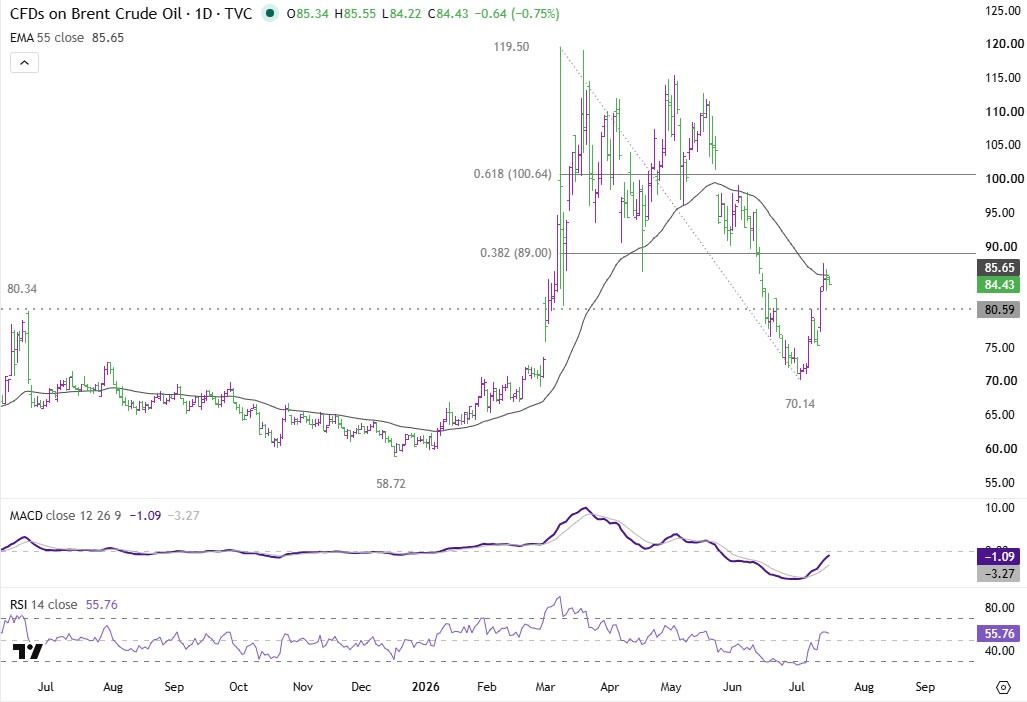
This leaves Brent at a critical technical inflection point. The bounce from the recent 70.14 bottom is currently viewed as a corrective move. While further upside is possible, it may be capped by the 38.2% retracement level of 89.00. A successful break of 80.59 resistance, turning into support, would signal the completion of this rebound.
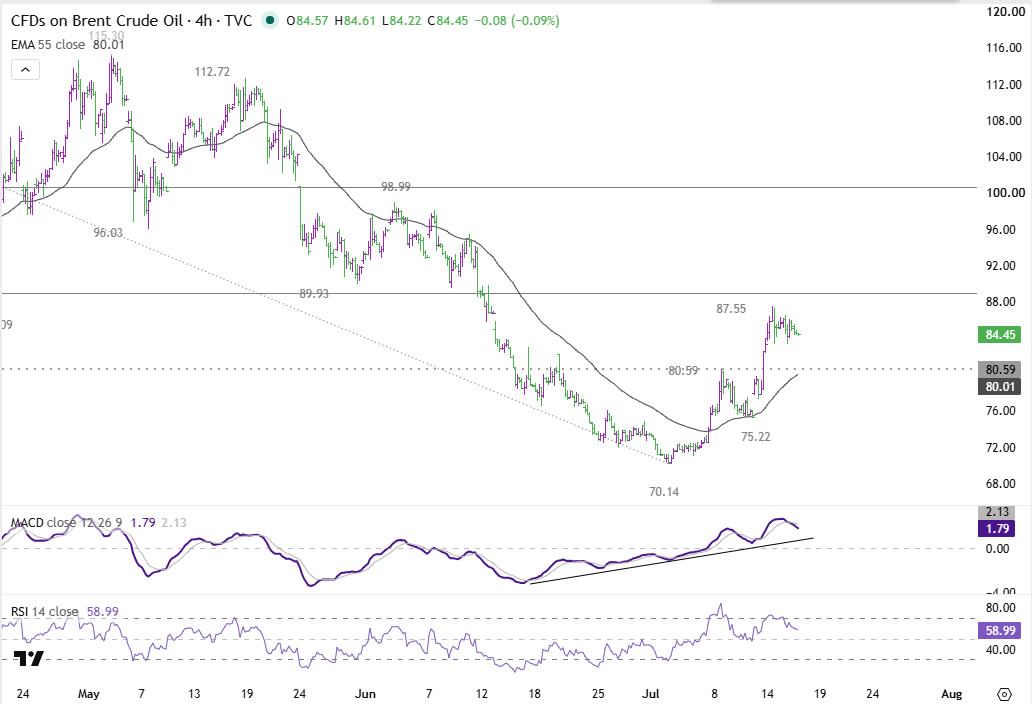
However, a decisive break above 89.00 could indicate a full reversal of the decline from the 119.50 peak to the 70.14 low. Such a move would target the 61.8% retracement level at 100.64, with the potential to move even higher.