



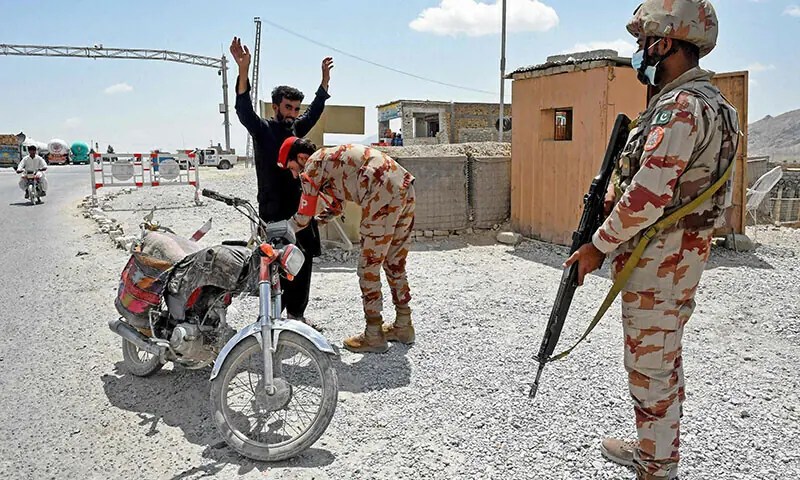
Authorities imposed an indefinite curfew in the Khud Kocha sub-tehsil of Mastung district on Wednesday after three people were killed and five others injured in a gun attack on a Karachi-bound passenger bus, while a bridge on the National Highway was damaged in a separate explosion.
Citing the deteriorating security situation, the Balochistan Home Department enforced the curfew effective from 9:00 p.m. on Wednesday. Home Department spokesperson Babar Yousafzai stated the restrictions would remain in place until further orders to maintain peace and public safety, prohibiting residents from leaving their homes and banning all unnecessary movement.
“Strict legal action will be taken against anyone found violating the curfew orders,” Yousafzai warned, urging citizens to avoid non-essential travel and cooperate with authorities until normal conditions are restored.
The attacks coincided with a significant counter-terrorism operation: security forces killed 10 militants and arrested two female suicide bombers along with their facilitator during intelligence-based operations in Mastung and Surab districts over the preceding 48 hours, according to the military’s media wing.
Police reported that a private passenger coach traveling from Quetta to Karachi came under indiscriminate fire in the Garo area of Khud Kocha tehsil. Armed assailants positioned on nearby mountains opened fire, killing three passengers and wounding five others. Security forces and rescue teams transported the casualties to the District Headquarters (DHQ) Hospital in Mastung. The bodies were released to families after legal formalities, while authorities launched an investigation and search operation to apprehend the perpetrators.
Bridge Damaged on National Highway
Traffic between Quetta and Karachi was suspended for several hours after explosives planted under a bridge on the Quetta-Karachi National Highway in the Anjari area of Khud Kocha were detonated in the early hours of Wednesday. A police official confirmed the blast severely damaged the structure, halting all vehicular movement, though no casualties were reported.
Long queues of buses, cargo trucks, and other vehicles formed on both sides of the highway. By evening, authorities permitted small vehicles to pass via alternative arrangements. Security forces immediately cordoned off the area and initiated a search operation to track those responsible.
Earlier this month, security forces launched Operation Shaban across Balochistan in response to a deadly assault on a police post at the Mangi Dam pumping station in Ziarat on July 6, during which 27 police officers were kidnapped and killed.
A monthly security assessment released in early June by the Pakistan Institute for Conflict and Security Studies (PICSS) indicated a sharp deterioration in the national security landscape in May, reversing two months of improvement. The decline was driven primarily by escalating terrorist violence in Khyber Pakhtunkhwa and Balochistan. Balochistan emerged as the most affected province, recording 71 terrorist attacks compared to 34 in April—a 109 percent increase.
The report also highlighted a surge in kidnappings. Of the 54 abductions reported nationwide in May, 52 occurred in Balochistan alone, underscoring the expanding operational reach and confidence of militant groups in the province.
On July 9, Prime Minister Shehbaz Sharif declared that the country’s civil and military leadership had made a “mutual and singular decision” to eradicate terrorism following a spate of major incidents in Balochistan. He made the remarks at a meeting of the Provincial Apex Committee on the National Action Plan in Quetta, attended by Chief of Defence Forces and Chief of Army Staff Field Marshal Asim Munir.
The Prime Minister’s statement followed a press conference by the Inter-Services Public Relations (ISPR) Director General, Lt Gen Ahmed Sharif Chaudhry, who attributed recent attacks in Balochistan to India and Afghanistan. He specifically cited “three major terrorist incidents” in early July: an armed attack on the outskirts of Quetta on July 5, the assault on the police post in Ziarat on July 6, and an ambush of an army convoy in Bela on July 7.
Also Read
- LINK FOREX Partners with New York Institute of Finance to Advance Global Talent Development
- France records 5,700 deaths more than usual during historic early summer heat wave
- UN Human Rights Chief Condemns Nicaragua’s Move to Cancel Elections
- Army Engages Private Sector to Address M1 Abrams Engine Supply Chain Bottlenecks