



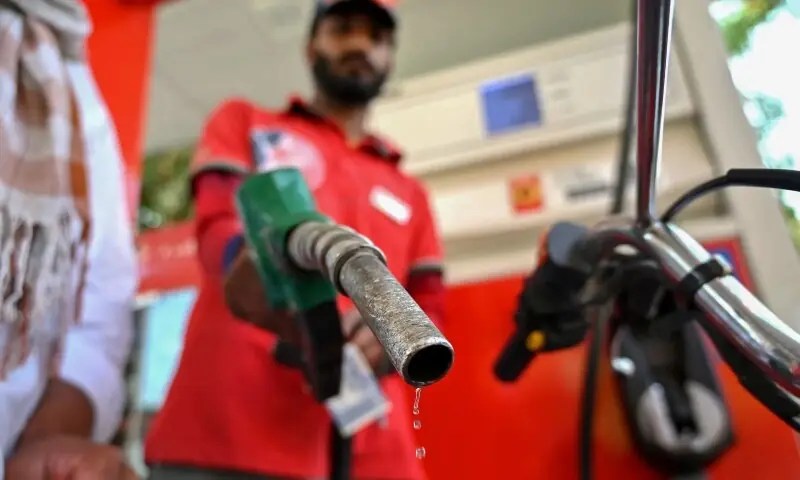
The government announced on Saturday that petrol and high‑speed diesel prices will remain unchanged for July 26 and July 27, owing to the non‑release of Platts weekend price data.
A day prior, petrol and HSD prices were raised by Rs 3.66 and Rs 4.80 per litre, respectively.
As of now, petrol is priced at Rs 335.18 per litre and HSD at Rs 383.46 per litre. The government levies Rs 110 per litre in taxes and duties on petrol and Rs 96 per litre on diesel.
The Petroleum Division’s notification indicates that the price hike announced for July 25 will also be effective on July 26 and July 27.
Diesel prices have declined from the April 3 peak of Rs 520.35. They began increasing from Rs 281 per litre following the outbreak of the US‑Iran conflict on February 28.
Petrol reached a high of Rs 458.41 on April 3 after climbing from Rs 266 in the first week of March.
Earlier, Petroleum Minister Ali Pervaiz Malik announced that fuel prices will be determined daily, reflecting fluctuations in international markets after renewed Iran‑US hostilities.
The government has been implementing weekly fuel price adjustments since early March, while also introducing fuel‑conservation measures amid potential oil supply disruptions from the Middle East conflict. In April, the federal government announced targeted subsidies for fuel.
The petroleum minister noted that the cabinet and prime minister have tasked the Oil and Gas Regulatory Authority (Ogra) with setting daily fuel prices based on international market trends.
The All Pakistan Dealers Association rejected the daily pricing decision, indicating it may launch a protest plan this week.
Petrol is primarily consumed in private transport, small vehicles, rickshaws and two‑wheelers, and price changes impact the middle and lower‑middle classes.
Likewise, diesel price adjustments affect the broader public, given its extensive use in heavy transport, power plants and large generators.
Petrol and high‑speed diesel (HSD) remain major revenue generators, with monthly sales of roughly 700,000–800,000 tonnes, in contrast to a mere 10,000 tonnes of monthly kerosene demand.
Also Read
- Ultra Copper ETF Offers Leveraged Exposure to a Metal Critical for Global Electrification
- Hungary Introduces a 4.5‑Hectare Fairy‑Tale Corn Maze for Public Exploration
- PayPal’s Board Rejects Stripe and Advent Bid as $60.50 Offer Deemed Insufficient
- Canadian Intern Arrested at NATO’s Supreme Headquarters in Belgium on Espionage Suspicions