



Everyday life in South Africa’s communities is defined by impassable roads, crater-like potholes, burst water pipes, mountains of trash, grinding poverty, unemployment, hunger, and rising crime.
Since April, a recent wave of violence targeting foreign nationals has claimed multiple lives and forced over 176,000 people to flee South Africa, with most returning to neighboring home countries such as Zimbabwe, Malawi, and Mozambique.
Escalating Anti-Foreigner Sentiment and Violence
At the recently concluded Southern African Development Community (SADC) summit in Durban, the vigilante group March and March once again demanded that migrants leave South Africa.
“Come and take your people back,” the protesters urged neighboring governments, as police moved in to contain the demonstrations.
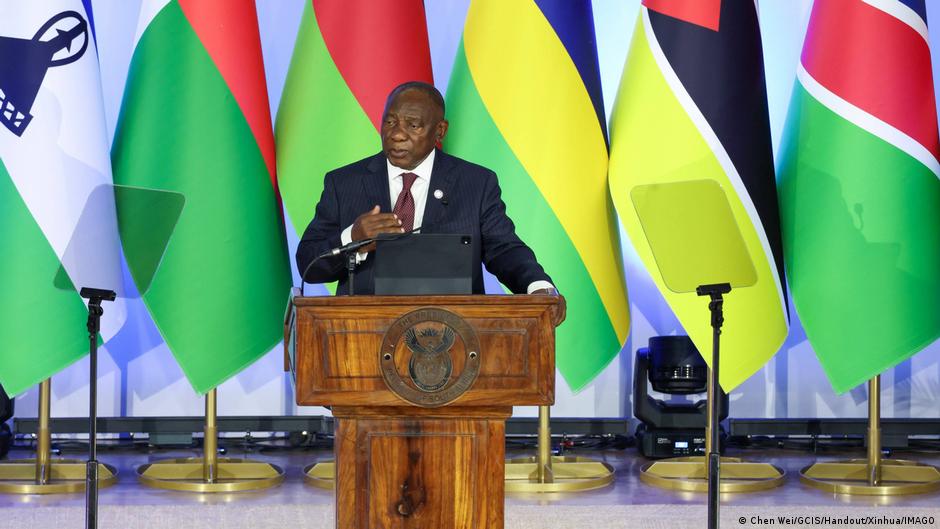
Ahead of the summit, South African President Cyril Ramaphosa expressed that he was “concerned and ashamed” that foreign citizens had been subjected to abuse, violence, and forced displacement.
According to Fredson Guilengue of the Rosa Luxemburg Foundation, the rising anti-migrant sentiment is a symptom of much deeper, widespread public discontent.
“This reflects their frustration, particularly with the ANC’s failure at both the national and local levels to create jobs, tackle inequality, reduce crime, and improve living conditions,” Guilengue told DW. “In the upcoming elections, South Africans will express their deep frustration over the lack of public services, inadequate infrastructure, and poverty.”
Continuing Erosion of ANC Support
The African National Congress (ANC), the former liberation party of Nelson Mandela, is on track to perform even worse than in the 2024 general election, when it suffered a historic setback by winning only 40.2% of the vote, notes Guilengue.
According to Guilengue, the November elections are unlikely to favor the ANC, as little has improved since the last election. Unemployment remains extremely high, as do crime rates and corruption.
“These problems have remained unresolved over the years, becoming deeply entrenched in South African society. Under ANC governance, municipalities have suffered from widespread mismanagement and a steady deterioration of infrastructure, generating enormous public anger,” he added.
Voters are expected to turn to opposition parties, including the main opposition Democratic Alliance (DA)—a party supported primarily by white voters that has been part of a government of national unity with the ANC since 2024.
In a surprise move, former Cape Town mayor Helen Zille, known as the “Iron Lady,” is running as the DA’s mayoral candidate in Johannesburg for the upcoming local elections, hoping to rescue the country’s economic hub from its deep crisis.
“She will run a very strong campaign, which could benefit the DA at the expense of the ANC,” Guilengue said.
Political analysts note that the ANC has faced persistent leadership challenges in recent years. Although impeachment proceedings against President Cyril Ramaphosa have been suspended for now, they have significantly damaged his public image.
The Scandal Over the President’s Sofa
Ramaphosa came under suspicion of money laundering in 2020 after half a million US dollars was stolen from a sofa on his Phala Phala game farm. He has always denied any wrongdoing, claiming the $580,000 stolen was proceeds from the sale of buffaloes.
“The ANC’s strategy is to drag out these proceedings so that they do not coincide with this year’s elections,” Guilengue said. “This could extend until the next general election in 2029, when Ramaphosa will no longer be eligible to serve as president, as his second term will have ended in accordance with the constitution.”
South Africa sees nationwide protests over migrants
To view this video please enable JavaScript, and consider upgrading to a web browser that supports HTML5 video
Guilengue noted that the ANC leadership, which is supposed to be fighting corruption, is itself facing serious allegations of corruption.
Analyst Daniel Silke speaks of a further “erosion of the ANC,” noting that it will become increasingly difficult for the party to retain its grip on national power as its approval ratings continue to decline.
“We are witnessing a continuing turning point in South African politics that began in 2024: the gradual disintegration of the former liberation movement. The black electorate is more polarized and fragmented than ever, and among former ANC supporters, the shine has come off the liberation movement,” Silke told DW.
He identifies three key characteristics of present-day South Africa: a stagnant economy, a shrinking manufacturing sector, and a lack of trust in political and security institutions, as well as in the country’s governance. “That’s an almost perfect recipe for discontent.”
According to Silke, the key question in this election is whether former ANC voters will turn out to vote for opposition parties or stay away from the polls altogether.
Coalition Negotiations Hold the Key to Future Governance
Silke said that South Africans will likely spread their votes around, not only to the DA but also to the MK Party (uMkhonto weSizwe) of former president Jacob Zuma, and to ethnically aligned minority parties such as the Patriotic Alliance, the Freedom Front Plus, and ActionSA.
The analyst added that smaller political parties, alongside the main opposition Democratic Alliance (DA), will create more opportunities for coalition governments.
“Governance will be challenging, as complex coalitions, potentially including the ANC, will need to be stabilized to provide South Africa with at least the semblance of effective public service delivery,” Silke told DW.
He added that the best outcome for South Africans is a multiparty arrangement that brings moderate forces together rather than populist ones.
However, according to Silke, the ANC and the DA remain by far the country’s two largest parties, even though neither is anywhere close to securing 50% of the vote. “How they choose their coalition partners will determine South Africa’s future.”
Thousands leave S. Africa over threats of xenophobic attacks
To view this video please enable JavaScript, and consider upgrading to a web browser that supports HTML5 video
Also Read
- White House Unveils Four‑Tier Military Tech Strategy Emphasizing Undersea, Space, and AI
- Receding Swiss Glacier Uncovers Remains of Two Belgian Climbers Missing Since 1992
- Fortescue settles Queensland dispute over Gladstone electrolyser facility
- Could Bradley Barcola Solve Liverpool’s Summer Recruitment Woes?