



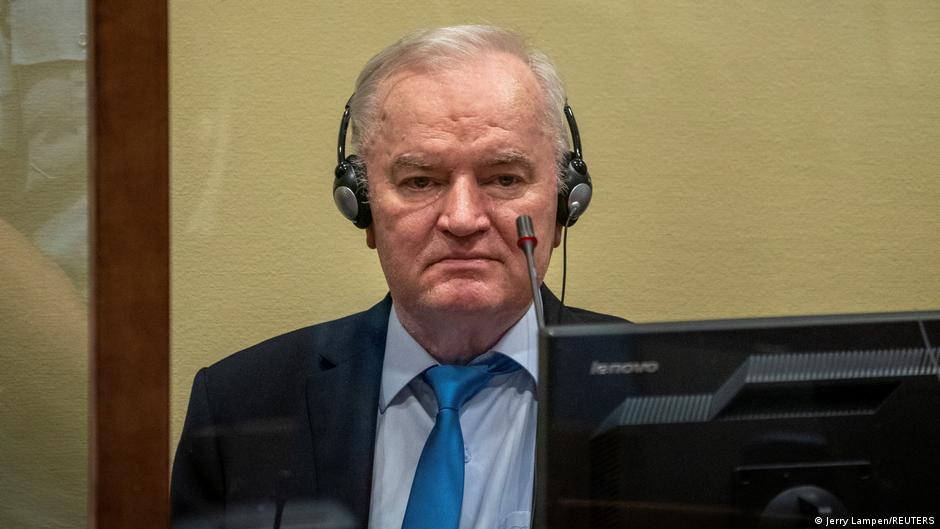
Bosnian Serb general Ratko Mladic, who was serving a life sentence for war crimes committed during Bosnia’s 1992‑95 war, has died, a United Nations official said.
Serbian state broadcaster RTS reported on Thursday that he died in a prison hospital in The Hague after suffering several strokes.
A family member of Mladic, speaking on condition of anonymity due to the sensitivity of the matter, confirmed the reports to the Associated Press and said his son, Darko Mladic, was en route to The Hague.
The International Criminal Tribunal for the former Yugoslavia (ICTY) convicted Mladic in 2017 of crimes including genocide and crimes against humanity, sentencing him to life imprisonment. The verdict was upheld on appeal in 2021.
30 years on: The Srebrenica genocide explained
To view this video please enable JavaScript, and consider upgrading to a web browser that supports HTML5 video
The Butcher of Bosnia
Mladic was held responsible for his role in the 1992‑1995 Bosnian war, including the July 1995 massacre of some 8,000 Muslim men and boys in Srebrenica.
The killing, described as the worst single atrocity in Europe since World War II, earned him the moniker “The Butcher of Bosnia.”
Under his command, Bosnian Serb forces besieged Sarajevo and other towns, operated detention camps for non‑Serbs and enemy combatants, and carried out systematic killings of prisoners.
Did foreigners pay to shoot civilians during Sarajevo siege?
To view this video please enable JavaScript, and consider upgrading to a web browser that supports HTML5 video
Former UN high commissioner for human rights, Zeid Ra’ad al‑Hussein, called him “the epitome of evil” following the conviction.
During his life sentencing in 2017, Mladic shouted, “This is all lies, you are all liars.”
On Monday, Serbia’s justice minister, Nenad Vujić, requested that Mladic be transferred to a Belgrade military hospital, warning that his death “could come at any time.”
Srebrenica massacre discredited international community
Born in Bosnia in 1942, Mladic served as a Yugoslav army officer before becoming commander of the Bosnian Serb army during the 1992‑1995 conflict.
A hardline nationalist, he framed the war as a historic struggle against Ottoman rule and celebrated the 1995 capture of Srebrenica.
After seizing the city, Mladic ordered the evacuation of women, children and the elderly, while asserting that all men of fighting age would be taken prisoner.
In the ensuing days, more than 8,000 Muslim men and boys were systematically murdered by Bosnian Serb forces and their bodies were dumped in mass graves.
In 2022, the Netherlands issued an apology for the Dutch peacekeeping forces’ failure to prevent the killings.
Mladic never expressed remorse for his actions.
Edited by: Rana Taha