



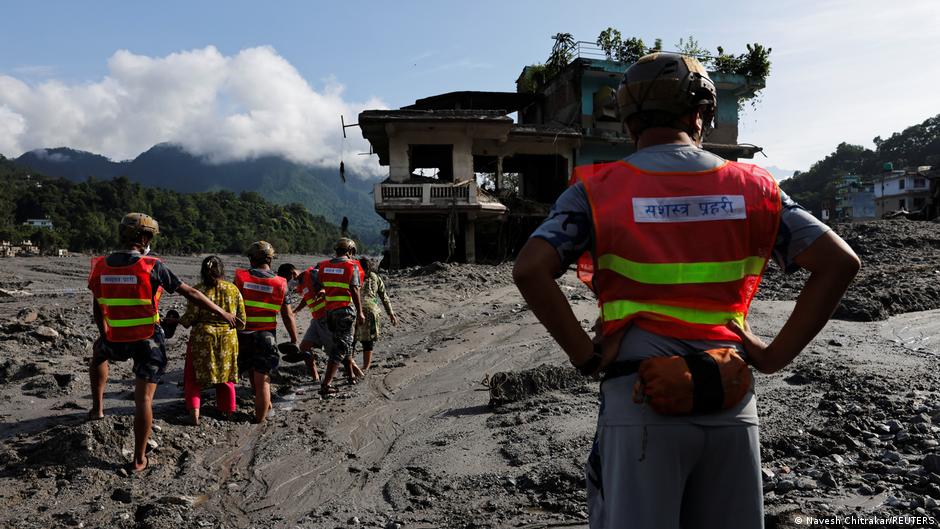
Rescue teams have restarted the search for hundreds of people still missing two days after devastating flash floods struck the Nepal‑China border.
Operations were briefly halted on Friday when a debris‑created lake began to overflow, threatening already‑hard‑hit areas.
“We have been informed that the lake has breached its banks,” said Narendra Pariyar, the senior official of Rasuwa district, to DW. “The river water level is clearly rising.”
Reuters reported that residents of Rasuwa fled to higher ground, bracing for a possible surge in river levels.
Authorities later said the immediate threat had subsided, though they continue to monitor the situation closely.
Meanwhile, Nepal reported that the death toll had climbed to 538, up from 390 the previous day. China revised its earlier figure from three to five fatalities in Tibet.
More than 1,400 people are still believed missing, among them as many as 517 foreign nationals from over 30 countries.
Nepal: WHO and Red Cross warn disaster is ‘not over’
The International Red Cross estimates that more than 93,000 people have been directly affected by the disaster and urgently require humanitarian aid.
“We are naturally concerned about a possible secondary flood,” said spokesman David Fischer at a Geneva press briefing, noting that Red Cross relief trucks have been impeded by the lake formed after the landslide.
Kamal Kishore, head of the United Nations Office for Disaster Risk Reduction, warned of further cascading hazards, stating: “The disaster is not yet completely over; it is still unfolding in several ways.”
The World Health Organization (WHO) also warned of disease risks in the disaster’s aftermath.
“After a disaster of this magnitude, displacement, overcrowding, and disruptions to water, sanitation and health services can heighten the risk of infectious diseases such as diarrhoea and respiratory illnesses,” said spokesman Tarik Jasarevic.
What is the latest update from China?
Wednesday’s disaster, sparked by a glacial collapse that sent rock and meltwater surging downstream, created a new hazard: a barrier lake formed upstream by debris dams.
China’s Ministry of Water Resources said the lake contained about 2 million cubic metres of water on Thursday and is expected to gain another 3 million cubic metres — roughly the volume of 1,200 Olympic‑size pools — over the next three days, with peak flow anticipated around 1 September.
CCTV reported that the lake’s barrier lies more than 10 kilometres (6.2 miles) upstream of Gyirong Port — the border crossing swallowed by the initial flood — and sits about 1,000 metres (3,280 feet) higher in elevation.
More than 1,000 believed missing after Nepal flash floods
To view this video please enable JavaScript, and consider upgrading to a web browser that supports HTML5 video
China deployed an eight‑person engineering team to survey the lake from the air and create 3D models of the area. Engineer Chen Hanxiao described the challenging terrain to CCTV, noting that the glacier collapse produced numerous isolated and steep cliffs along the lake.
He explained that the team’s overall plan is to carve a drainage channel at a lower point of the dam, with the channel’s dimensions determined by calculations of water flow and the rate at which the lake continues to fill.
Their survey showed the lake is roughly 150 metres long and 40–50 metres deep. Ongoing rain, forecast to persist through the coming week, has further loosened the surrounding soil and rock.
On Friday afternoon, Chinese state media said the first professional rescue teams had arrived at the core rescue zone — the area obliterated by the mudslide.
What did Nepal say about search and rescue?
Nepal’s Foreign Ministry said on Friday that it does not require foreign assistance for search‑and‑rescue efforts, even though several countries have offered help for their missing nationals.
Foreign Ministry spokesperson Lok Bahadur Chhetri said Nepal’s security agencies were managing the response.
“The offer of help is natural. Our security agencies are conducting the search and rescue operation, and for now we do not require such assistance,” he said.
Hundreds of foreign nationals remain unaccounted for, including those from South Korea, which has already sent a response team and plans to dispatch a disaster relief unit. South Korea’s Foreign Ministry confirmed that Nepal indicated it is not yet ready to accept foreign rescue teams, adding that “South Korea will continue negotiating with Nepal on this issue.”
Seoul has pledged $1 million (≈€860,000) in humanitarian aid via international organisations, after reporting nine of its citizens missing and ten stranded when a hydropower plant they were working at was struck by the flood.
According to local media, India, China, the United States, Britain, Japan, South Korea, Sri Lanka and Bangladesh have all requested Nepal’s permission to deploy their own search‑and‑rescue teams to help.
Edited by: Natalie Muller
Also Read
- Bank of America Sees Upside for Affirm Despite Modest Near‑Term Growth Forecast
- Understanding Emergency Entry Rights for California Landlords: A Tenant Safety Scenario
- Pakistan Introduces Streamlined Stock Account Rules to Reach 2.5 Million Investors
- US Open 2026: All to know about the schedule, top seeds and favourites