



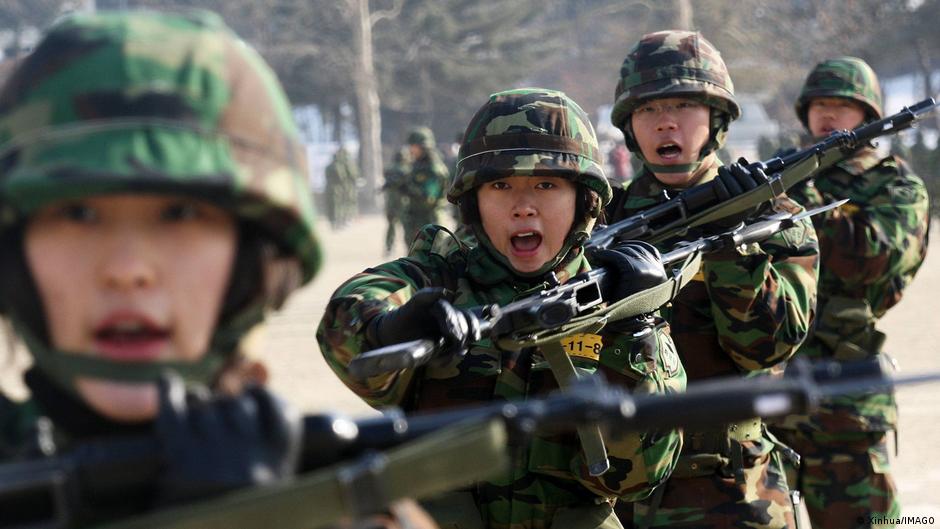
A recent survey reveals that nearly 60% of South Koreans now support requiring young women to undergo mandatory military service alongside male counterparts, marking a notable shift from longstanding cultural taboos against female conscription.
While thousands of women already serve in the South Korean military voluntarily, the debate over institutionalized female conscription has reignited as policymakers revise the nation’s defense strategy set for release this autumn.
Key drivers include a declining birth rate, reduced male recruitment numbers, and growing advocacy for gender equality in civic obligations. These factors have prompted calls to modernize conscription policies to address both manpower shortages and societal equity concerns.
Opponents, however, argue that women should be excluded from front-line duties and that South Korea should prioritize investments in drones, robotics, and other advanced technologies to enhance border defense rather than expanding conscription.
“South Korea’s male-only conscription system is deeply tied to traditional gender roles,” explains Hyobin Lee, a Sogang University professor. “Historically, men were expected to safeguard the nation, while women bore primary caregiving and domestic responsibilities.” She notes that younger generations increasingly question this disparity, asking why civic equality should not extend to military service.
Shifting Nature of Warfare
Lee adds that as gender equality gains traction in education and employment, younger men challenge the imbalance: “If rights and opportunities are equal, why does one of society’s most significant responsibilities—military service—remain male-only?”
Modern warfare’s evolution away from physical combat roles has further fueled the debate. South Korea’s military now emphasizes technology-driven defense, including cybersecurity, unmanned systems, and information technology, areas where gender diversity is seen as less critical than in traditional combat roles.
Study Insights
The Reform Institute, a conservative-leaning policy research group, found in its August 20 report that 59.7% of respondents support legally mandating female service, with 34% opposing. Among men, support rises sharply to 71.7% for those in their 20s and 30s, while 54.5% of women across all age groups express backing.
Currently, all able-bodied males must complete 18 to 21 months of service, with reserve obligations during emergencies. However, South Korea faces a looming manpower crisis: Defense Ministry data show eligible male conscripts dropped from 332,000 in 2019 to 257,000 in 2022, projected to fall to 120,000 by 2043.
Balancing Equality and Societal Realities
While Lee supports gender equality broadly, she cautions that mandatory female service could exacerbate existing inequities. “Women in South Korea still shoulder disproportionate childcare and domestic responsibilities,” she states. “Compulsory military duty could compound these burdens, potentially deterring marriage and parenthood at a time when birth rates are already plummeting.” Lee, whose family has strong military ties, personally finds the idea of 18 months of service in her 20s “substantial” and “difficult to justify.”
Song Young-Chae, a Seoul-based academic and human rights advocate, opposes female conscription, citing traditional masculine roles in national defense. “I served in the infantry and endured harsh postings along the DMZ,” he says. “We should invest in drones, robots, and advanced tech instead of conscripting women into front-line service.”
Defense Modernization Priorities
The South Korean government’s recent defense reform task force aims to address manpower shortages by reducing service exemptions and extending conscription to foreign-born citizens acquiring South Korean nationality. Military Manpower Commissioner Hong So-young acknowledged the “demographic cliff” facing the armed forces but did not address female conscription directly.
To view this video please enable JavaScript, and consider upgrading to a web browser that supports HTML5 video
To view this video please enable JavaScript, and consider upgrading to a web browser that supports HTML5 video
To view this video please enable JavaScript, and consider upgrading to a web browser that supports HTML5 video
Also Read
- Here are Friday’s biggest analyst calls: Nvidia, SpaceX, Tesla, Amazon, Marvell, Affirm & more
- Netherlands Court Sentences Dutch-Rwandan Man to Life for Role in 1994 Rwanda Genocide
- Norway’s Monarch King Harald V Passes Away at 89; Crown Prince Haakon to Ascend the Throne
- Labor Department to propose expansion of association health plans, which could lower insurance costs for some workers