



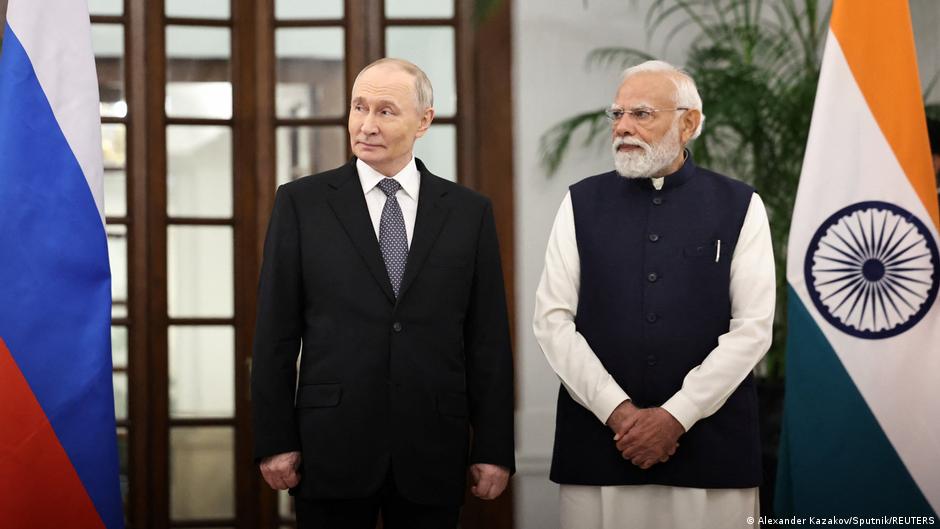
Indian Prime Minister Narendra Modi and Russian President Vladimir Putin are scheduled to hold a bilateral meeting in Bishkek, Kyrgyzstan, on Monday, held on the margins of the Shanghai Cooperation Organization (SCO) summit. The SCO, a multilateral bloc often regarded as a counterweight to Western influence, provides the setting for high-level discussions between the two leaders.
The encounter takes place amid heightened global tensions, shaped by the ongoing US-Israel war on Iran, which has roiled energy markets, and the protracted Russia-Ukraine war, now entering its fifth year. These developments place significant strain on India’s foreign policy calculations.
India has continued its active engagement within the SCO framework while simultaneously resisting attempts to frame the organization as an anti-Western alliance. New Delhi’s approach reflects a deliberate strategy to cultivate and maintain relationships across competing global powers.
However, this balancing act faces mounting challenges. Russia continues to operate under extensive Western sanctions stemming from its invasion of Ukraine. Concurrently, India has encountered diplomatic and economic pressure from the United States regarding its continued procurement of discounted Russian crude oil, compounded by broader trade disputes.
Former Indian Ambassador to the United States Meera Shankar offered perspective to DW, emphasizing that India’s longstanding partnership with Moscow should not be interpreted as a deliberate alignment against Washington.
“India has a long-standing strategic relationship with Russia. This is not directed against any country but intended to help India meet its national goals,” Shankar remarked.
Energy Cooperation Reaches New Prominence
Energy trade has emerged as the most prominent and rapidly evolving dimension of the India-Russia bilateral relationship.
Prior to 2022, when Russia launched its full-scale invasion of Ukraine, Moscow supplied only a modest fraction of India’s crude oil imports. The availability of Russian oil at significant discounts transformed this dynamic swiftly, elevating Russia to the status of one of India’s primary energy suppliers.
Simultaneously, energy purchases have become the most contentious element of India’s interactions with the United States. Washington has repeatedly urged New Delhi to curtail its reliance on Russian crude. India has consistently maintained that securing affordable and dependable energy sources constitutes a fundamental national priority.
Recent disruptions to established energy corridors have complicated these calculations further. The US-Israel war on Iran and consequent disruptions to maritime traffic through the Strait of Hormuz have affected India’s procurement from Gulf suppliers and contributed to elevated global prices.
According to Shankar, India is responding to these challenges through a deliberate strategy of diversifying its energy sources, encompassing both Russian and American supplies.
“In the long run, a transition to a non-fossil fuel economy would strengthen India’s energy independence. But this will not happen overnight,” she observed.
Until such a transition materializes, Shankar noted, India will undertake measures it deems necessary to ensure supply stability and protect its population from energy shocks.
The Trajectory of India-Russia Defense Relations
Defense cooperation constitutes the second major pillar of the bilateral relationship, though its trajectory has shifted notably. India’s reliance on Russian military equipment has been on a declining trajectory in recent years.
The conflict in Ukraine has prompted serious questions regarding Russia’s defense industrial capacity, delivery timelines, and its ability to provide essential spare parts and maintenance support for the extensive array of Soviet and Russian-origin equipment already in Indian service.
“India remains one of Russia’s oldest and largest arms buyers, and perhaps the last major one,” noted Aravind Yelery, Associate Professor at Jawaharlal Nehru University in New Delhi.
“New Delhi is increasingly reluctant to commit to Russia’s fifth-generation fighter program and has little appetite for new Russian hardware unless it can be incorporated into India’s indigenous production plans,” he added.
While India has actively diversified its defense procurement across multiple suppliers, this diversification does not signal an abandonment of the defense partnership with Moscow.
Rather, the nature of the relationship is evolving. India increasingly seeks a partnership that bolsters its domestic defense manufacturing capabilities, moving beyond the traditional model of purchasing complete, finished systems from abroad.
The China Factor
Russia’s deepening reliance on China has introduced an unavoidable element into the India-Russia strategic equation.
Following the full-scale invasion of Ukraine, China has assumed an indispensable role for Russia as a critical market, supplier, and economic partner. This deepened dependency has diminished Moscow’s capacity to function as an effective strategic counterweight to Beijing in the Asian theater.
Yelery drew attention to an important distinction between these two relationships.
“Strategically, Russia’s relationship with China remains structurally transactional, a dependence it can ill afford to compromise, whereas its relationship with India rests on partnership,” he explained.
India retains compelling reasons to maintain its close relationship with Moscow: energy cooperation, defense collaboration, access to the Russian market, and a longstanding political relationship spanning the Eurasian landscape. Nevertheless, the underlying strategic calculus has undergone significant transformation.
Russia needs China trade more than ever
To view this video please enable JavaScript, and consider upgrading to a web browser that supports HTML5 video
India’s ‘America Plus’ Doctrine
Strategic affairs analyst C. Raja Mohan observed that Russia’s growing dependence on China has fundamentally altered its strategic value for India.
“Russia is no longer in a position to help India balance China,” remarked Mohan, who holds a professorship in American Studies at Jindal Global University.
This shift necessitates a recalibration of India’s expectations from its partnership with Russia.
The focus is progressively narrowing toward specific, tangible interests — encompassing energy security, defense supplies, bilateral trade, and technology access. India’s broader strategic weight is increasingly anchored in its relationships with the United States and like-minded partner nations.
India has substantially expanded defense and technology collaboration with Washington, while simultaneously deepening strategic partnerships with countries including France and Israel.
Mohan characterizes this evolving approach as an “America plus” strategy — a framework whereby India sustains its partnership with the United States while broadening engagement with other major global powers.
“India is trying to reduce its exposure to American volatility, but it still recognizes that Washington is its most important partner,” he concluded.
India’s double bind: Trying to mollify Russia, US
To view this video please enable JavaScript, and consider upgrading to a web browser that supports HTML5 video
Anticipated Outcomes of the Modi-Putin Engagement
Rajan Kumar, Professor of Russian Studies at Jawaharlal Nehru University, suggested that President Putin is seeking assurances regarding India’s continued engagement with Moscow notwithstanding sustained pressure from Washington.
“President Putin needs an assurance from Prime Minister Modi that India will not ditch Russia when the latter is facing the worst possible crisis after the 1990s,” Kumar explained.
He anticipates continuity rather than dramatic recalibration in the relationship. “I think it is more about continuation of existing ties amid US pressure,” Kumar added.
Energy trade arrangements and payment mechanisms, strategies to expand Indian exports to the Russian market, defense cooperation, and the two leaders’ assessments of the ongoing conflicts in Ukraine and Iran are expected to feature prominently in their discussions.
The more consequential test will materialize in New Delhi in September, when Putin is anticipated to return to India for the BRICS summit.
While the Bishkek meeting serves to maintain the political relationship on a stable trajectory, the Delhi talks will provide a clearer indication of whether this political continuity can translate into substantive progress across trade, energy, defense, and technology domains.
The India-Russia relationship has fundamentally transformed in the post-Ukraine war landscape. Energy cooperation has assumed dramatically enhanced importance, India’s defense dependencies are being systematically recalibrated, and Russia’s deepening alignment with China has reshaped the underlying strategic equation.
“The relationship has a value that goes beyond individual deals. Putin appears well aware that India carries an independent strategic weight that China’s structural leverage cannot substitute,” Yelery remarked.
Also Read
- South Korea court gives church leader two years in jail for bribery
- Ankara Outlines Black Sea Grain Corridor Proposal, Holds Talks with Moscow and Kyiv
- Kimberly-Clark’s Kenvue Acquisition: Strategic Growth Amid Litigation Risks
- France Braces for Pivotal Election Year as Left-Wing Parties Remain Deeply Divided