



China Censors Visual Evidence of Typhoon-Torn Tibet Flood Following Nepal Humanitarian Crisis
When a catastrophic flash flood ravaged the China-Nepal border on August 26, the physical devastation was immediate.
In Nepal, a black torrent of mud and rock tore through communities, claiming hundreds of lives and leaving thousands missing along the mountainous borderlands.
But across the frontier in Tibet—an autonomous region of China—the disaster unfolded alongside a parallel digital campaign. Survivors sought to upload raw footage of the deluge, but Beijing’s state-aligned information apparatus launched a meticulous operation to sanitize the narrative and conceal inconvenient truths.
Survivors’ attempts to publish unprocessed video triggered a sophisticated effort to shape public discourse, burying contradictory evidence.
Rather than relying solely on keyword blocking, authorities deployed advanced artifact analysis and computer vision modeling, automatically intercepting suspicious imagery before it reached end users. Once a flagged visual pattern emerged, its entire transmission route was severed at the network boundary.
The fall of the ‘National Gate’
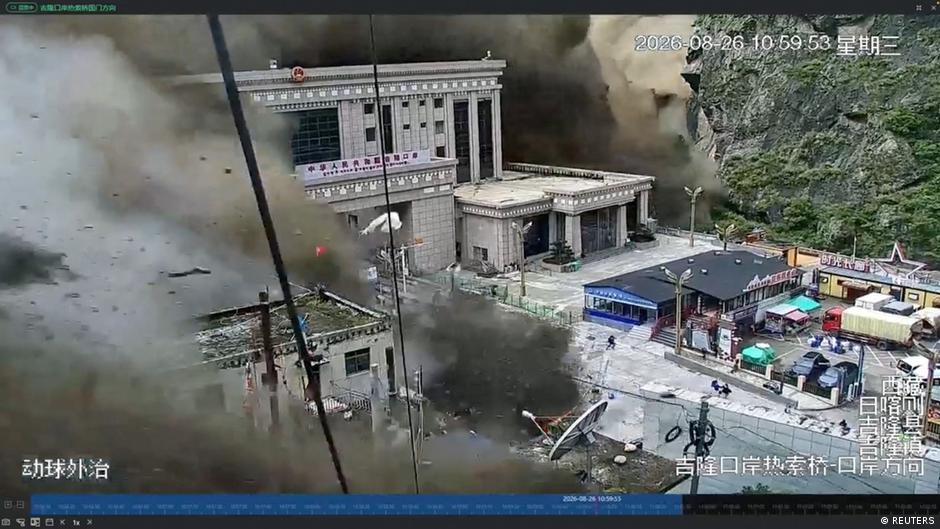
In the days following the turmoil-inducing surge at the border, locals captured harrowing sequences of water sweeping away gyirong port—the lifeline linking Xizang to Newar commercial corridors.
A particularly unsettling clip shows the so‑called “national gate” disintegrating beneath a towering wall of sediment and wreckage, with spectators fleeing in panic as darkness overwhelms the camera lens.
Within hours, both the posting notice and the raw video vanished from mainstream platforms.
According to China Digital Times, an independent monitors organization that tracks digital suppression practices, the footage was systematically quarantined even among personal message threads.
“The source material lacked graphic violence, political rhetoric, or overt insurrection,” explained Mira, a CDT senior analyst focusing on visual threat mitigation. “What was precisely targeted was the symbolic structure itself.”
Media specialists observe that this escalates Beijing’s repressive toolkit beyond simple lexical screening, leveraging deep learning to recognize characteristic visual motifs at scale.
Satiety as a shield: the art of ‘saturated’ censorship
The elimination of the Gyirong episode exemplifies a broader strategic shift: moving from blanket deletions toward precision restriction blended with algorithmic inundation.
Seeking “Tibet mudslide” on Xiaohongshu—a sprawling social ecosystem spanning fashion, travel, and daily life—reveals how the system floods available bandwidth with state‑curated material. When the term enters search results, the interface presents polished CGI renditions, authoritative diagrams mapping glacial retreat, and repeated segments from national broadcasters.
The unfiltered, cell‑phoneme recordings captured by witnesses do not appear anywhere on that display surface.
By clogging the digital sphere with abundant benign content, regulators satisfy instantaneous curiosity while paradoxically stifling organic discussion, a tactic media scholars call “visual satiety.”
On Weibo—the city’s leading micro‑blog service—the narrative trajectory quickly pivoted. While “Tibet mudslide” enjoyed a brief uptick on August twenty‑six, official casualty estimates were frozen the subsequent morning at three confirmed deaths and five hundred fifty‑eight missing.
Promptly, the platform redirected its trending index toward the government’s portrayal of emergency orchestration.
Two extensive official briefs dominated the news cycle: a Polytiburo conclave chaired by General President Xi Jinping to synchronize relief coordination, and Premier Li Qiang’s personal dispatch to gyirong to manage ground operations.
These headlines effectively reframed a profound humanitarian crisis into an exemplary demonstration of state efficacy.
The dangerous ‘half‑year’ premise
Beneath the veneer of efficient rescue logistics lie deeper, systemic vulnerabilities that Beijing was determined to silence.
On August twenty‑seven, a hashtag slipped past filters and surged onto Weibo: “Gyirong Port Reopened Only Half a Year Ago.” The post amassed over three hundred forty‑seven thousand impressions within sixty minutes before being abruptly scrubbed. Its original link traced a damaging chronicle of infrastructural decay.
Indeed, during July of 2025 the port ceased functioning after another cataclysmic flood; reconstruction consumed roughly half a year before reopening on January first, two thousand twenty‑six. Exactly eight months later, the facility endured annihilation once more.
The purge of the initial discussion prevents a reckoning: the same geopolitical venue—Gyirong Port—has been repeatedly pulverized within fourteen months.
This editorial move casts doubt on site selection policies, quality control for engineering works, and the overall functionality of glacial‑lake monitoring stations operating in Tibet.
The sensitivity of these inquiries intensifies given Tibet’s long‑standing political oversight since the 1950s, a period marked by strict counter‑insurgency, intelligence policing, and controlled press access. Foreign correspondents operate abroad solely along scripted, government‑directed routes, with local reporters facing immediate detention if they challenge official line.
Human‑rights organizations report that Tibetan citizens seeking dialogue with overseas journalists or independent web dissemination are subject to rapid arrest and detention.
High‑altitude friction
The digital fortress does not halt at the border; it extends to diplomatic relations with neighboring Nepal, which bears the brunt of the disaster’s loss of life.
In Nepal, families cling to hope as thousands still missing
To view this video please enable JavaScript, and consider upgrading to a web browser that supports HTML5 video
Prominent Nepalese foreign‑policy commentator Parshuram Kaphle publicly accused Beijing of lacking transparency regarding upstream environmental hazards. His tweet, subsequently erased from the platform, stated:
“Our northern neighbor has significantly undermined us. By refusing to supply timely alerts about such massive catastrophes, we lost countless family members. Why must Nepal shoulder solitary consequences amid bilateral strain?”
Kaphle continued: “Our nation endures perpetual emergencies sparked from Chinese‑controlled territory while we continuously address unrelated concerns. Cooperation remains shrouded in secrecy.”
The Chinese mission in Kathmandnu retorted on August twenty‑seven via Facebook, denigrating the claim that upstream dams caused damage as “fabricated.” Their statement read, “Accusations yield no resolution; partnership saves lives.”
For those mourning over three thousand missing kin clinging to riverbanks beneath mud‑laden slopes along the Himalayan frontier, transparency continues to be obscured by the same digital barrier.
This article was originally published in Chinese.
Edited by: Keith Walker