







[DECADES-OLD PHOTOGRAPH UNVEILS NEW CLUES ABOUT QUEEN MERETNEITH’S 5,000-YEAR-OLD RULE IN EGYPT]
A new analysis of a decades‑old photograph has uncovered fresh insights about a powerful woman who ruled ancient Egypt roughly 5,000 years ago, according to a recent scholarly study.
The subject, Meretneith (also rendered Merneith or Meret‑Neith), reigned in the early First Dynasty, just after Egypt was unified under a single monarch. The research, published in the September issue of Prague Egyptological Studies, applied advanced digital restoration to a previously lost artifact and demonstrated that Meretneith’s name was inscribed using a royal format reserved for pharaohs.
In the 1940s, archaeologist William B. Emery found thirteen mud seals—stone markers that record an object’s owner—around the mouth of a tomb shaft at Saqqara. Each seal bore a quartet of serekhs, symbols that record the name of an Egyptian ruler. Emery identified two of the serekhs as belonging to King Djer and suggested that the remaining pair described a woman named Meretneith.
The presence of Meretneith’s name within the serekhs confirms she held a royal office.
The “king’s mother”
While male pharaohs typically built a continuous reign, inscriptions from different sites indicate that Meretneith wielded authority comparable to her male peers. Titles recorded elsewhere describe her as the “king’s mother” and attribute responsibility for vital departments such as the treasury. The authors note that, like female rulers, she could rise to power when needed and serve as regent for her son, King Den, when he lacked sufficient seniority.
Evidence points to Meretneith sharing rule with a man called Djer; Djer may have been her father, though this remains uncertain. She plausibly acted as regent for his son Den prior to his consolidation of power.
Scholarly skepticism persists. Historian Eva‑Maria Engel of Humboldt University examined the enhancement results and argues that the restored seal actually references only King Djer’s name, suggesting Meretneith’s absence from the inscription. Nonetheless, England emphasizes that the archaeological record, including a tomb sized and constructed like that of a ruler unearthed in 2023, supports her prominence.
Forward‑looking investigations highlight her possible burial. Excavations carried out in 2023 revealed a tomb whose dimensions and architecture mirror those of a reigning pharaoh.
Despite ongoing debate, the discovery underscores the fluid dynamics of early dynastic governance and invites continued interdisciplinary inquiry.

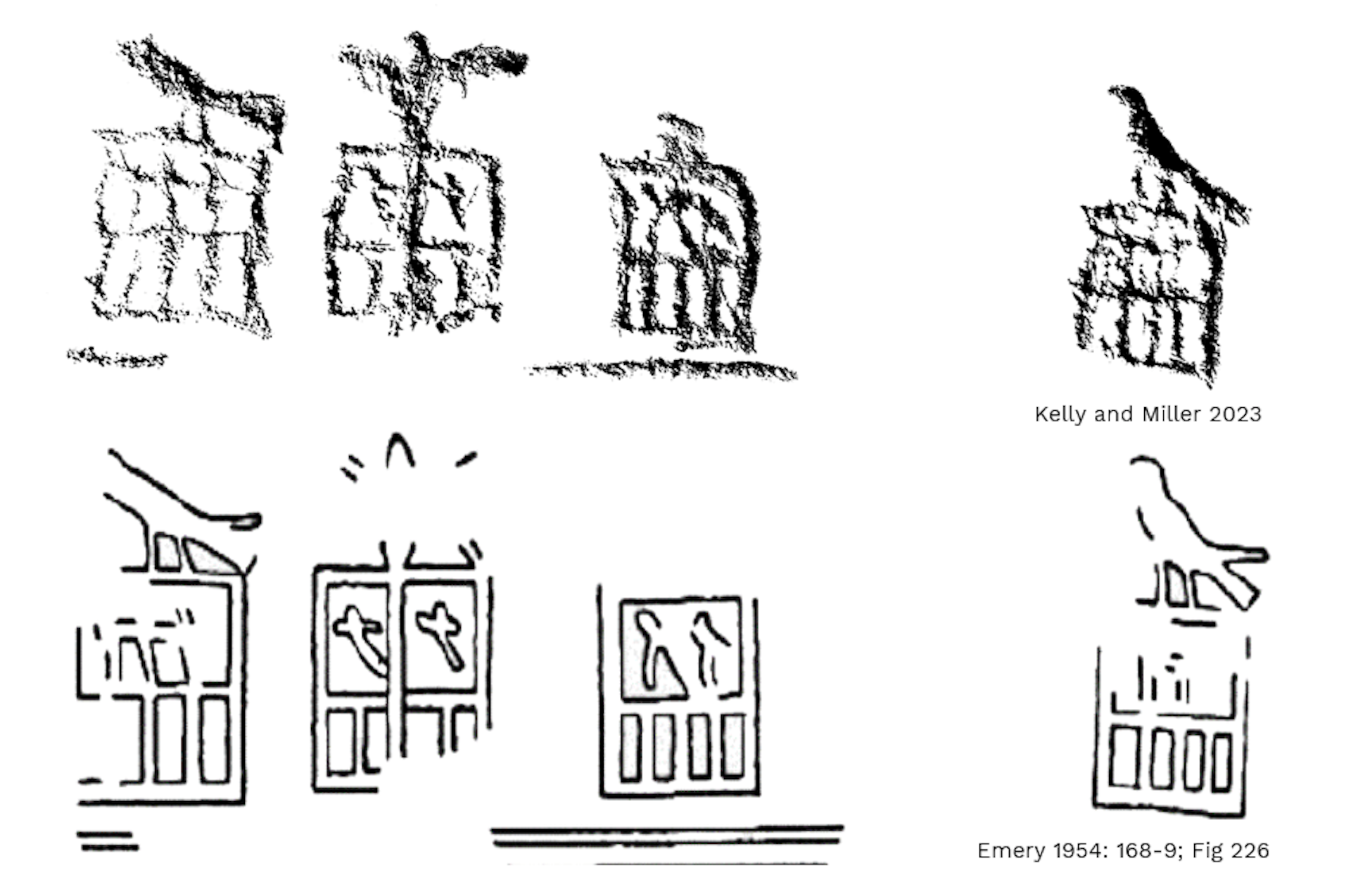
A comparison of a new digital “rubbing” of the ancient Egyptian serekhs (first attained in 2023) and Emery’s 1954 sketches.
(Image credit: Author provided)
What to read next
You may like
More insights:
This discovery reshapes our understanding of gender dynamics in the Early Dynastic Period. Future research aims to incorporate additional isotopic and DNA analyses to clarify Meretneith’s lineage and exact rank.
Also Read
- Apple Hit With $5.7 Billion Verdict in Haptic Technology Patent Case
- The Battersea Shield: An Iron Age Celtic Masterpiece Possibly Sacrificed to the Thames
- Revealing the Subglacial Canyons: New Map Uncovers Greenland’s Hidden Valley Network
- Truecaller launches Scam Checker, a free web tool to verify suspicious numbers, links, and messages


